
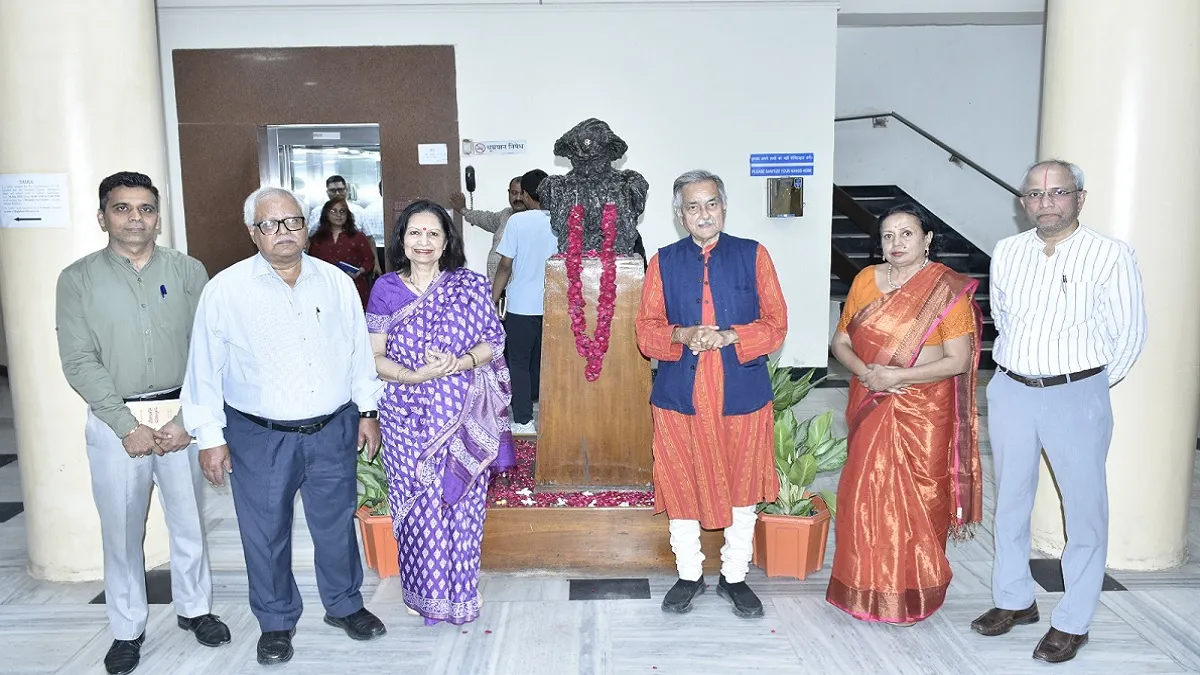

New Delhi. A program was organized on the birthday of Rabindranath Tagore on Saturday at Sahitya Akademi. The program was presided over by Malashree Lal, convenor of the English Advisory Board of Sahitya Akademi and Mandira Ghosh, Nirmal Kanti Bhattacharjee and Prayag Shukla expressed their views. At the beginning of the program, N., Executive Secretary of Sahitya Akademi welcomed everyone by presenting Angavastram and books. Suresh Babu did it.
In his presidential address, Malashri Lal said that education was an important point in Rabindranath Tagore’s humanism, that is why he established Visva-Bharati University. He also considered Rabindranath’s giving equal status to men to women as a part of this humanism. He further said that Rabindranath considered the World War as a failure of Western civilization but despite all this, he had faith in humanity.
Mandira Ghosh said that the writings of Rabindranath Tagore are helpful in maintaining our faith in humanity even today. Humanism is consistently reflected in his poems and other writings. It was for the sake of humanity that he supported Gandhi’s anti-untouchability movement. There was respect for all religions in his writings and he considered education as a major means for this.
Nirmal Kanti Bhattacharjee said that he did not want to limit humanity only to the individual but he wanted to bring it into our collective behavior. He found its sources from Indian Upanishads. He wanted humanity not only among humans but also with nature. He believed that our love for the Earth would bring about change in the world. He envisioned international brotherhood at that time which was very meaningful.
Referring to his poems, Prayag Shukla said that he had deep faith in humanity and nature. His relation with the common people was the source of his humanity. Markets, ghats and localities are all visible to us in his poems. He considered every aspect of humanity that could preserve humanity. Thakur linked humanism to animals and nature.
After the program, in the question-answer session, his Rabindra Sangeet and especially his travels were discussed, on the basis of which it can be said that these travels within the country and abroad were also related to the search for humanism. At the end of the program, Executive Secretary of Sahitya Akademi N. Suresh Babu proposed vote of thanks. The program was conducted by Program Officer Pankaj Seth.

Comments are closed.