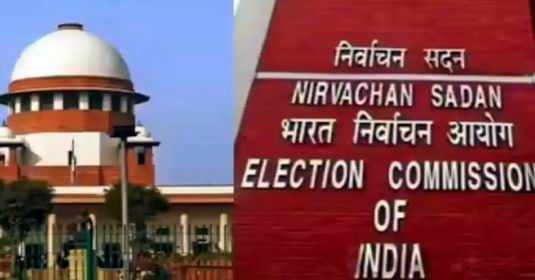
New Delhi. The legal dispute between the Election Commission and the opposition regarding the Special Intensive Revision (SIR) of voter lists has reached the Supreme Court. Leader of Opposition in Lok Sabha, Rahul Gandhi, has alleged in the counter affidavit filed in the court that the Election Commission claimed that the decision on SIR was taken with the unanimous consent of the three Election Commissioners, but did not present any concrete documents in support of it. The case was to be heard on Tuesday, but the Supreme Court postponed it till December 9.
Rahul Gandhi and other leaders of the India Alliance have said in their reply that no record of the meeting proceedings, file noting, written approval, agenda or deliberations has been attached with the Commission's affidavit. The opposition's question is that when the Commission claims that the decision was taken unanimously, then why the official documents related to that process were not placed before the court.
Questions raised on the consent of the three election commissioners
The center of controversy is the role of Chief Election Commissioner Gyanesh Kumar and Election Commissioners Sukhbir Singh Sandhu and Vivek Joshi. The Election Commission, in its reply, said the decision on the nationwide SIR was taken unanimously by all three members. On the contrary, Rahul Gandhi argued in the court that the Commission has not provided the original records to prove this claim.
It has also been asked in the counter affidavit that on what date and under what procedure the important orders related to SIR were approved. Was there a meeting of the three commissioners, was the file sent among them or was consent taken through electronic means? The opposition has sought clear answers to these questions and related records.
Preparation to seek answers through 48 questions
Rahul Gandhi and 12 other leaders of the India Alliance have filed separate applications in the Supreme Court seeking permission to ask 48 formal questions to the Election Commission officials. Answers to these questions have been sought through affidavits from the Chief Election Commissioner, both the Election Commissioners and concerned senior officials.
These questions include points related to orders related to SIR, correspondence within the Commission, alleged objections and approval of changes made in Online Voter Registration Form-6. The opposition wants to know which officer took the decision to include the additional declaration in the online form and with whose permission.
Changes in Form-6 and voter list also at the center of controversy
The opposition has also raised questions on the additional declaration added with the online Form-6. His argument is that making this declaration a separate document in the online application process does not make it mandatory, because the applicant has to fill it during the same process.
Apart from this, questions have also been raised on the operation of digital platforms like ECINET and ERONET, the process of removing and re-adding names from the voter list. Rahul Gandhi, in his reply, has said that the Commission's general denial does not address these technical and administrative questions.
Election Commission said its decision was in accordance with the rules
The Election Commission has defended its actions in court. The Commission says the SIR process is in line with constitutional and legal provisions. He has also reiterated that decisions should be taken unanimously by all three members. At the same time, the opposition wants original documents and direct answers of the concerned officials in support of this claim of the Commission.
Next hearing will be held on December 9
The case was listed on Tuesday before a three-member bench headed by Chief Justice Surya Kant. The bench also includes Justice Joymalya Bagchi and Justice V. Mohana. The court has adjourned the hearing till December 9.
At present, the main question before the Supreme Court is whether the decisions related to SIR were actually taken with the collective consent of the three members of the Election Commission or not and what is the official record of this process. The further situation on this dispute will become clear only after the arguments and documents of both the parties appear in the court.