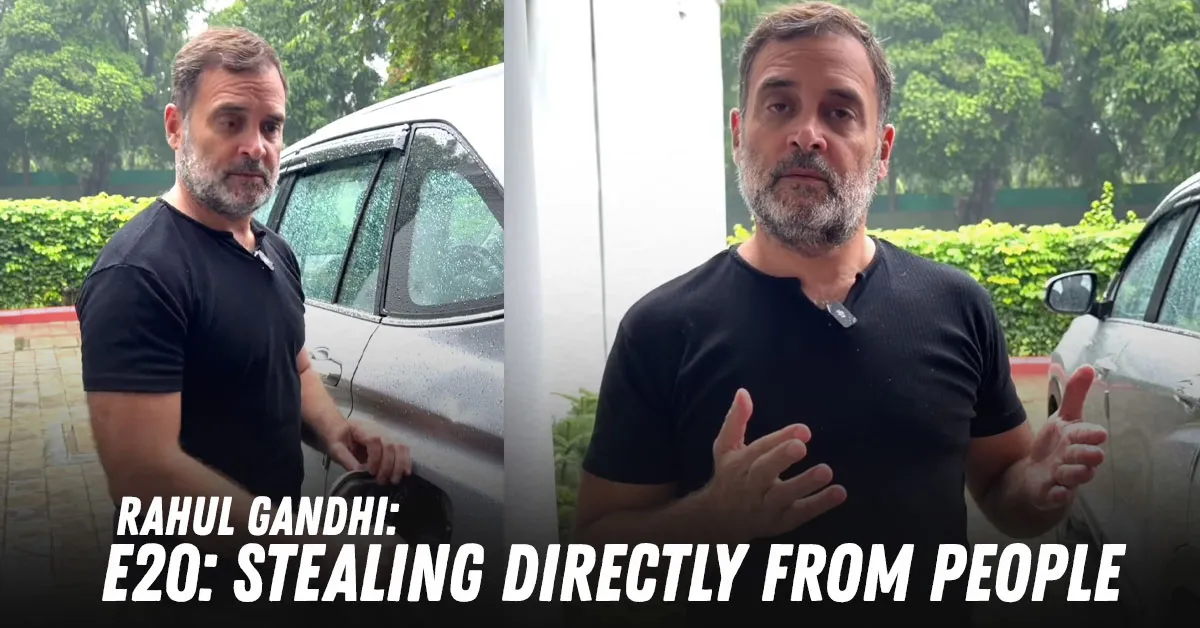
Debates related to the nationwide rollout of E20 (20% ethanol-blended petrol) have been heating up lately. Now, the Indian National Congress (INC) is preparing to take up the issue. INC’s senior leader Rahul Gandhi has now shared a video on Instagram saying that E20 petrol is destroying people’s cars and is directly stealing money from their pockets. He also promised to take up the issue and find a resolution.
As the video opens, Rahul says that E20 issue is a very serious matter. In any campaign, the sequence of affairs, according to Rahul, is important. In other words, the order in which issues are taken up. He says that the country now has too much corruption. There is a lot in queue. He then promises that the INC will soon take up the E20 issue ‘in a massive way’. The E20 rollout, he says, is destroying people’s cars, scooters, and lives. ‘It is literally stealing directly from them’- he said.
The Indian National Congress had recently alleged that the Centre’s push for E20 petrol increased fuel prices for end customers, and benefitted ethanol producers. Motorists, the party claimed, were paying more despite previous assurances of cheaper fuel.
Congress leader Jairam Ramesh recently said that fuel stations across the country have been supplying ‘practically only E20 petrol’ since March 2025. He even referred to previous remarks by the Union Road Transport and Highways Minister Nitin Gadkari, in which he claimed that ethanol-blending would bring the prices down and provide an alternative to petrol at Rs 55 per litre. He added that no such reduction has yet materialised.
Jairam’s X post also mentions that according to an independent analysis, consumers collectively had to spent approximately Rs 88,234 crore to compensate for the mileage drops brought about by the use of ethanol-blended petrol. The post claims that the citizens are paying more for E20 petrol than for the previous regular petrol.
The X post also refers to NITI Aayog’s Ethanol Roadmap that recommended financial and tax incentives for E20 and E10 fuels as possible compensations. The Modi government, the post says, approved a subsidy of over Rs 4000 crores for ethanol producers instead. The E20 program, according to the post, benefitted industries (ethanol producers, to be precise) and not consumers. It also alleges that E20 has stripped the average middle-class buyer of options and increased his fuel expenses.
Despite these commotions, the centre has maintained that the ethanol-blending program has helped in reducing India’s dependence on imported crude oil and has also brought about significant savings in foreign exchange. Another benefit, according to the government, is a steep increase in the farmers’ income.
In recent developments, the government has acknowledged the drop in fuel efficiency associated with the use of E20 petrol. This happens due to the lower energy density of blended petrol than pure petrol.
People have also been worried about possible damages to their vehicles due to the persistent use of E20 petrol. While an outright engine damage is unlikely, E20 can affect fuel lines, and fuel pumps adversely. According to reports, there has been a steady increase in the number of cases in which fuel pumps of vehicles were damaged and needed replacements. In many cases, it was reportedly found out that the strainers got choked, eventually leading to the fuel pumps getting burnt out.
One of the common E20-related demands is that citizens should be given the freedom to choose between different blends. Pure petrol or lower blends should be made available alongside E20 petrol. This demand makes a lot of sense. Many including activist Tehseen Poonawalla have been voicing this demand and working towards realising it. Poonawalla’s recent protests had got a lot of attention.
A major problem that many have been facing after the full rollout of E20 petrol is that of fuel contamination. Due to the hygroscopic nature of Ethanol, there have been several cases of E20 petrol undergoing phase separation within storage tanks at petrol pumps and getting spoiled. Such cases have become more frequent with the onset of monsoons. Oil marketing companies have intensified their quality checks to ensure quality of fuel sold and prevent wastage.