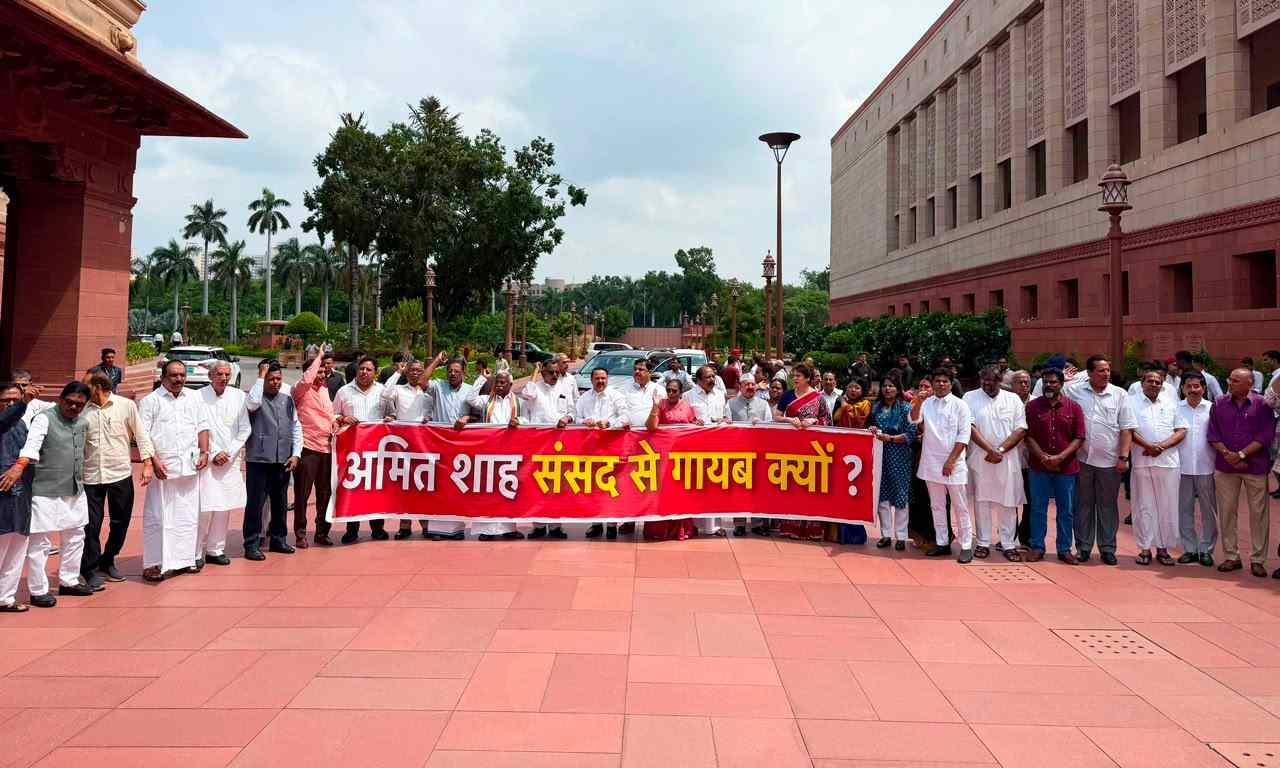
A home minister’s presence in Parliament to answer questions relating to his ministry is not optional but a constitutional obligation, former Lok Sabha Secretary General PDT Achary said, arguing that the Chair has the authority to direct a minister to appear before the House when members raise a legitimate demand.
His remarks come amid the escalating standoff between the government and the Opposition over Union Home Minister Amit Shah’s absence from Parliament following the July 20 police crackdown on student protesters. The deadlock has intensified after Rajya Sabha Chairman CP Radhakrishnan asked Parliamentary Affairs Minister Kiren Rijiju to convey the Opposition’s demand that Shah address the House.
‘Minister must face Parliament’
“The Chair has the power and authority to direct a minister to come to the House when there is a justifiable demand from members. It is the Home Minister’s duty under the Constitution to explain what happened, whether there was a lapse on the part of the police, and what action has been taken,” Achary said on The Federal‘s Capital Beat show.
Also read | Asking Amit Shah to resign: Why it is Congress’ boldest gambit yet
Explaining the constitutional basis for his argument, Achary said Article 77 empowers the President to allocate government business among ministers, while Article 75 makes the Council of Ministers collectively responsible to Parliament.
Achary also dismissed the argument that a minister’s presence in the parliamentary chamber is sufficient. “A minister’s chamber is not officially a part of the House. Under our parliamentary system, a minister has a direct responsibility to the House itself, and that duty cannot be dispensed with,” he said.
Rulebook leaves no ambiguity
Senior journalist TK Rajalakshmi raised concerns over the government’s response to the Chair’s intervention and the delay in addressing the House on an issue of public importance. She noted that parliamentary rules provide clear mechanisms for members to raise urgent matters with the executive.
“Under Rule 197, members can move a calling attention motion with the Chair’s permission to draw a minister’s attention to a matter of urgent public importance. There is a legislative obligation to respond to issues of public gravity, especially those involving alleged police excesses in the national capital,” Rajalakshmi said.
She added that the government could have used established parliamentary procedures to address the House without prolonged delay. “The Home Minister or a Minister of State could have made a statement on behalf of the Home Ministry. Delaying a statement on an issue that has drawn widespread attention creates unnecessary ambiguity when the rulebook provides clear provisions for an executive response,” she said.
Parliament demands accountability
Political analyst Ayushman examined the parliamentary deadlock through the lens of institutional accountability, comparing the executive’s conduct to a corporate structure in which senior managers are expected to answer to a board. He argued that the continuing impasse undermines the functioning of parliamentary democracy.
Also read | Rahul Gandhi turns up heat on Amit Shah as Parliament showdown escalates
“Consider a corporate structure where a key manager refuses to appear before the board to answer direct questions. The anger expressed by senior Opposition leaders stems from their long parliamentary experience, having witnessed House proceedings function even during historical crises,” Ayushman said.
Looking ahead, the proposed amendments to the Foreign Contribution (Regulation) Act (FCRA) are expected to bring Amit Shah back to Parliament, where the focus will be on whether he addresses the Opposition’s demands over the July 20 police crackdown on student protesters.