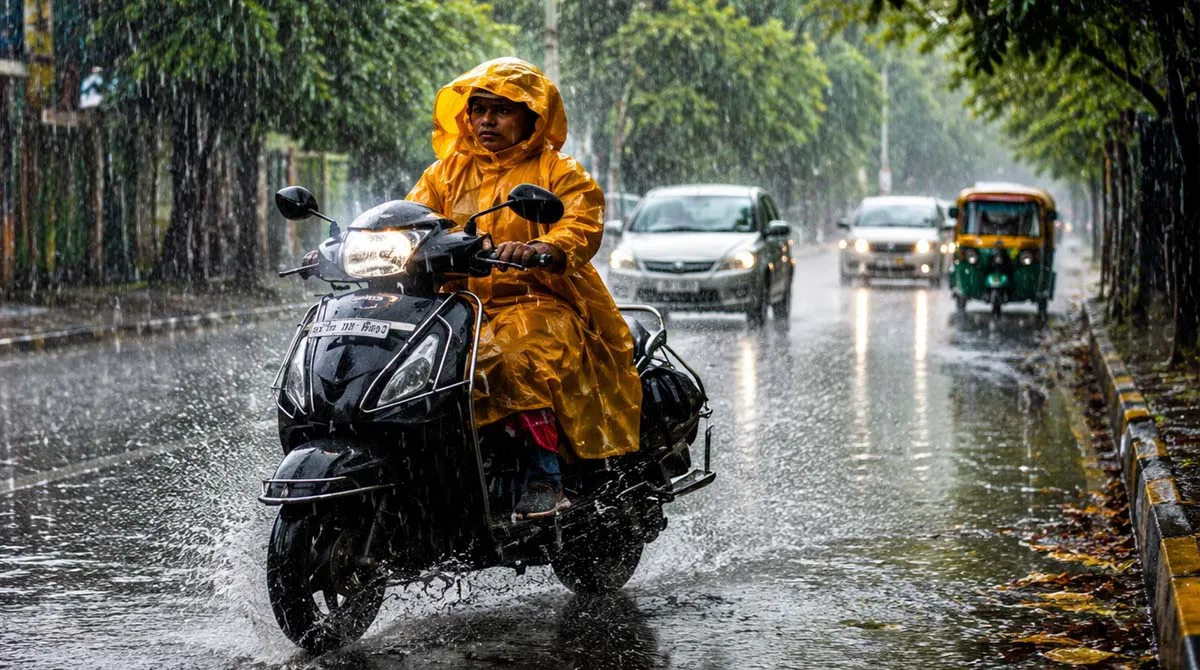
The monsoon has once again become active in full force in Uttar Pradesh. The Meteorological Department has predicted heavy to very heavy rainfall in many parts of the state over the next 24 hours, and a severe orange alert has been issued.
According to the Meteorological Center, due to the re-strengthening of the monsoon system, this continuous rain is expected to continue in most parts of Uttar Pradesh for the next four to five days.
Why is there such heavy rainfall?
According to the Meteorological Department, the monsoon trough remains near its normal position. It extends from Firozpur, Rohtak, Kanpur, Daltonganj, and Digha to the northeastern Bay of Bengal. Furthermore, a cyclonic circulation over the southeastern and southwestern parts of the state has significantly strengthened the flow of monsoon winds over the Gangetic plains. This has resulted in widespread rainfall, as well as a warning of extremely heavy rainfall in selected areas over the next 24 hours.
Heavy to very heavy rainfall is expected in these 17 districts.
According to the Meteorological Department’s forecast, Prayagraj, Kaushambi, Fatehpur, Pratapgarh, Sonbhadra, Mirzapur, Kanpur Nagar, Kanpur Dehat, Rae Bareli, Saharanpur, Muzaffarnagar, Firozabad, Mainpuri, Etawah, Auraiya, Jalaun, and Hamirpur, along with their surrounding areas, may experience torrential to very heavy rainfall.
In addition, several other districts, including Banda, Chitrakoot, Varanasi, Jaunpur, Amethi, Sultanpur, Meerut, Ghaziabad, Agra, Jhansi, and Lalitpur, are also expected to experience heavy rainfall.
How will the weather in Uttar Pradesh be from August 7 to 10?
According to the latest update from the Meteorological Department, heavy rainfall is expected in selected areas of eastern Uttar Pradesh on August 7 and 8. Following this, heavy rainfall is expected at isolated places in both the eastern and western parts of the state on August 9. Meanwhile, heavy rainfall is forecast for August 10, primarily in some areas of western Uttar Pradesh.
Rainfall so far has been 21 percent below normal.
Although the rains have intensified these days, the overall monsoon rainfall for the season has remained below normal across the state. As of August 6, eastern Uttar Pradesh has recorded 314.6 mm of rainfall, which is 27 percent below normal. Western Uttar Pradesh has received 317.4 mm of rainfall, which is 13 percent below normal. Overall, Uttar Pradesh has recorded a total of 315.8 mm of rainfall so far, which is 21 percent below normal.
Etawah received the most rainfall, Lucknow also received heavy rain.
During the past 24 hours, the Badhpura area of Etawah district recorded the highest rainfall at 126 mm, followed by Chakarnagar at 120 mm. The Meteorological Department has categorized the rainfall in both these locations as “very heavy rainfall.”
In addition, heavy rainfall of 95 mm was recorded in Kaiserganj in Bahraich, 90 mm in Chunar in Mirzapur, 85.6 mm in the BHU area of Varanasi, and 78.4 mm in the capital Lucknow.
There is a high risk of these problems amid heavy rainfall.
The Meteorological Department has warned that this torrential rainfall could cause severe waterlogging in low-lying areas. Furthermore, the water level of rivers and reservoirs could rise rapidly, damaging mud and dilapidated houses, and disrupting road and rail traffic. Power supply is also expected to be disrupted in many places.
The public has been urged to completely avoid waterlogged areas, overflowing drains, and rivers. Do not attempt to cross flooded roads and avoid any unnecessary travel during inclement weather.
The Meteorological Department’s Special Advice for Farmers
The Meteorological Department has issued important advice to farmers, urging them to make adequate arrangements for draining excess water from their fields. Avoid spraying any fertilizers or chemicals in the fields during this period of heavy rainfall. Avoid waterlogging in crops like rice, maize, pigeon pea, peanuts, and other vegetables. Additionally, tall crops like banana and papaya should be supported with bamboo or stakes to minimize damage caused by strong winds and rain.