
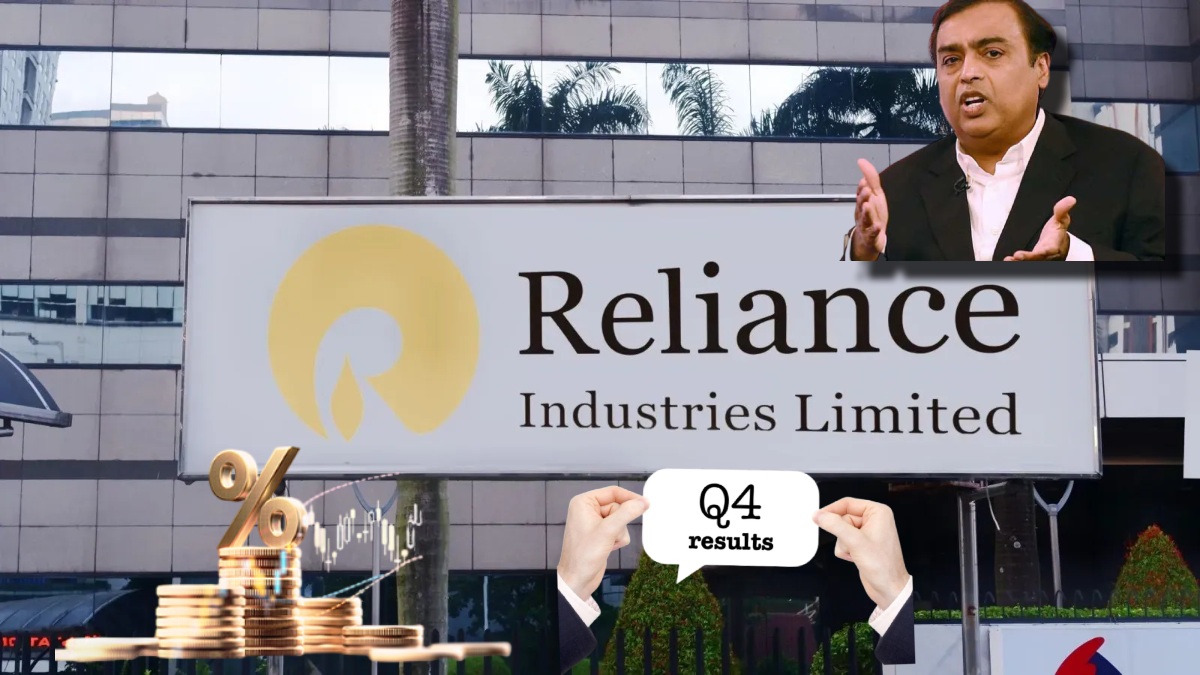

Reliance Industries Ltd (RIL), led by Mukesh Ambanihas once again demonstrated the power of scale and diversification. While FY26 turned out to be a record-breaking year for India’s largest conglomerate, the March quarter reflected the realities of a volatile global environment. The contrast between annual highs and quarterly pressures makes this performance both impressive and insightful.
Credits: Goodreturns
A Record-Breaking Financial Year
FY26 was nothing short of historic for RIL. The company reported its highest-ever consolidated net profit of ₹95,754 crore, alongside a massive revenue of ₹11.76 lakh crore. These numbers highlight not just growth, but resilience across business cycles.
The strong annual performance was driven by consistent momentum in telecom, retail, and oil-to-chemicals (O2C). RIL’s diversified structure ensured that no single segment dictated overall performance. Instead, growth across verticals collectively pushed the company to new financial milestones, reinforcing its position as India’s most valuable corporate powerhouse.
March Quarter: Growth Meets Global Turbulence
Despite a stellar year, the March quarter told a slightly different story. Consolidated net profit declined 8.9% year-on-year to ₹20,589 crore. This dip was largely influenced by volatility in global energy markets, particularly due to geopolitical tensions in West Asia.
However, revenue for the quarter rose 12.9% to ₹3,25,290 crore, reflecting strong operational momentum. This divergence—falling profit but rising revenue—signals margin pressures rather than demand weakness. It also underlines how external global factors can impact even the most robust businesses.
EBITDA Stability Shows Business Balance
RIL’s EBITDA for the quarter remained largely stable at ₹48,588 crore. This stability is a key highlight, especially given the challenges in energy markets.
The company managed to balance weaker energy earnings with stronger contributions from consumer-facing businesses like telecom and retail. However, profitability faced some pressure due to higher finance costs and depreciation, particularly after the rollout and operationalisation of 5G spectrum assets.
Energy Segment Faces Pressure
The oil-to-chemicals (O2C) business, a core pillar of RIL, saw a 3.7% decline in EBITDA to ₹14,520 crore. While fuel cracks remained strong, they were offset by rising crude premiums, higher freight and insurance costs, and weaker chemical spreads.
The oil and gas segment faced even sharper challenges, with EBITDA falling 18.1%. Lower production levels, softer price realisations, and increased operating expenses weighed heavily on performance. These trends reflect the broader uncertainty in global energy markets, where pricing and demand dynamics remain unpredictable.
Jio and Retail Drive Consumer-Led Growth
On the brighter side, RIL’s consumer businesses continued to shine. Jio Platforms emerged as a major growth driver, with EBITDA rising 17.9% to ₹20,060 crore. Subscriber additions and improved average revenue per user (ARPU) played a crucial role in this growth.
Meanwhile, Reliance Retail maintained steady momentum, posting a 3.1% increase in EBITDA to ₹6,921 crore. The company’s aggressive expansion saw its store network cross the 20,000 mark, further strengthening its dominance in India’s retail landscape.
Together, these consumer-facing segments are increasingly becoming the backbone of RIL’s growth story.
Strong Balance Sheet Supports Expansion
RIL continued to invest heavily in future growth. Capital expenditure for the quarter stood at ₹40,560 crore, fully funded by internal cash generation of ₹41,132 crore. This indicates strong financial discipline and operational efficiency.
Net debt remained stable at ₹1.25 lakh crore, suggesting that the company is managing its leverage effectively despite large-scale investments. This balance between expansion and financial prudence positions RIL well for long-term growth.

The Bigger Picture
RIL’s FY26 performance is a story of resilience in the face of global uncertainty. While energy businesses faced short-term pressure, the company’s pivot toward consumer-driven segments like telecom and retail is clearly paying off.
The March quarter may have reflected external challenges, but the broader trajectory remains firmly upward. With a diversified portfolio, strong cash flows, and continued investments in future technologies, RIL appears well-equipped to navigate volatility and sustain its growth momentum in the years ahead.

Comments are closed.