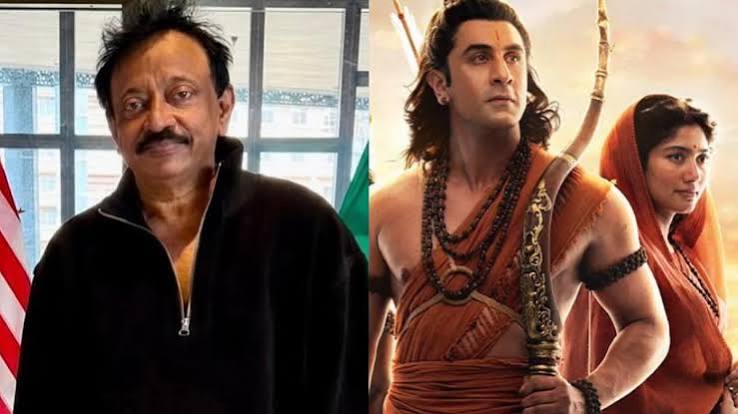
Mumbai: Filmmaker Ram Gopal Varma has praised director Nitesh Tiwari’s Ramayana: Rise of a Legend, describing the epic as a “devotional force” rather than simply a devotional film. In a strongly worded review shared on X, Varma also urged the filmmakers to ignore negative criticism, comparing detractors to “barking street dogs”.
Varma’s review focused on the film’s visual ambition, character portrayals and dramatic interpretation of the epic. He praised the creative team for attempting a large-scale cinematic adaptation and argued that the film should be viewed as an ambitious artistic effort rather than judged through conventional expectations of a devotional production.
“All in all I want to say this to each and everyone of all the greats who collaborated to make this great film is to treat any and all negative critics of this film as barking street dogs against the elephantine effort you all put in to create this magnifique piece of WONDER (sic),” he wrote.
The filmmaker’s comments have drawn attention because of the strong language he used while defending the production against negative reviews. His assessment also offered an interpretation of the film’s central characters and the emotional and dramatic choices made in retelling the Ramayana.
RGV describes Ramayana as a devotional force
In his review, Varma argued that the film goes beyond the conventional idea of a devotional movie. He described its portrayal of Lord Rama as that of a character who faces difficult circumstances and consciously chooses his path.
“The #Ramayana is not a devotional film. It is a devotional force. The hero is not a blue god floating above the story. He is a man who has already seen the end of the world and still willfully chooses to walk into it (sic),” he wrote.
Varma also commented on the film’s treatment of power, weakness and consequences. He suggested that the narrative’s central transformation was not simply about the rise of a kingdom, but about the evolution of a character’s mindset.
“The rise is not of a kingdom. It is of a mind that challenges weakness. Every frame carries the weight of someone who has burned the old rules and is now moving only by the logic of power. The violence is not spectacle. It is the clarity of consequences (sic),” he added.
His remarks indicate that he viewed the film’s dramatic intensity as an important part of its interpretation of the epic. Rather than focusing only on its religious themes, Varma highlighted the psychological dimensions of its characters and the consequences of their decisions.
Varma highlights the emotional impact of Sita’s abduction
One sequence that received particular attention in Varma’s review was the aftermath of Sita’s abduction.
He described a moment in which Rama stands in an empty ashram and looks at the place where Sita had been. According to Varma, the scene allows the audience to observe the character’s grief without relying on overt expressions of emotion.
“In the sequence after Sita’s abduction, when he stands in the empty ashram and simply looks at the place where she was, the camera holds long enough to show that grief has already been converted into an arithmetic (sic),” he wrote.
The observation reflects Varma’s emphasis on the film’s use of visual storytelling and restrained performances. He suggested that the scene communicates the emotional consequences of the abduction through the character’s silence and the camera’s sustained focus.
Sita’s abduction by Ravana is one of the central turning points in the Ramayana. It sets Rama and Lakshman on the journey to find her and eventually leads to the conflict between Rama and Ravana.
Varma’s comments suggest that he considered the sequence an important moment in the film’s portrayal of Rama’s emotional journey.
RGV praises Yash’s portrayal of Ravana
Varma also singled out actor Yash, who plays Ravana in the film, for his screen presence and portrayal of the antagonist.
He observed that Yash does not simply play a character positioned against the hero. Instead, Varma described his performance as an embodiment of a person who has already made a decision about what he intends to destroy.
The filmmaker referred to a tense confrontation between the opposing sides across open ground before the final night. He noted that the scene does not depend on an army or an elaborate display of aggression to create tension.
According to Varma, Yash’s character does not raise his voice but communicates the consequences of his decision through his presence. He highlighted the actor’s controlled facial expressions and stillness during the confrontation.
Varma’s comments placed particular emphasis on the intensity of the performance, suggesting that the character’s threat is conveyed through restraint rather than loud dialogue or exaggerated action.
Yash’s casting as Ravana has been one of the notable aspects of the film’s ensemble. His portrayal forms a central part of the conflict with Ranbir Kapoor’s Rama.
Anupam Kher’s Jatayu portrayal earns praise
Varma also praised veteran actor Anupam Kher for his depiction of Jatayu, the bird who attempts to rescue Sita when Ravana abducts her.
In the Ramayana, Jatayu confronts Ravana despite being physically outmatched. The character’s attempt to stop the abduction ultimately leaves him gravely wounded.
Varma described the battle as more than an expression of loyalty. He highlighted Jatayu’s determination to continue fighting despite his injuries.
He referred to the character’s wings being “half broken, bloodied” while his mind refuses to accept the limitations of his body.
Varma also drew attention to the moment when Jatayu falls. He said the camera remains focused on the character’s face, with the emotional weight conveyed through his eyes rather than a dramatic cry.
The filmmaker interpreted the scene as an expression of persistence and sacrifice, praising the performance for conveying the character’s determination until he can no longer continue.
Ranbir Kapoor, Sai Pallavi lead the film’s cast
Ramayana: Rise of a Legend features Ranbir Kapoor as Lord Rama and Sai Pallavi as Goddess Sita. Ravie Dubey plays Lakshman, while Yash appears as Ravana.
The cast also includes Rakul Preet Singh as Surpanakha, Lara Dutta as Queen Kaikeyi and Arun Govil as King Dashrath.
The film draws on the epic tradition associated with sage Valmiki’s Ramayana and Goswami Tulsidas’s Ramcharitmanas. Its adaptation brings together familiar characters and episodes from the story in a large-scale cinematic production.
The makers have also been building interest around the film’s wider cast and presentation. A recently released post-credits scene introduced Sunny Deol as Lord Hanuman, accompanied by a Hanuman Chalisa music video.
The announcement added another prominent name to the film’s ensemble and generated attention around the portrayal of Hanuman.
Film releases in theatres on November 5
Ramayana: Rise of a Legend was released theatrically on November 5, 2026.
Varma’s review has added to the discussion surrounding the film, particularly because of his direct comments about its creative approach and the criticism directed at it.
While his assessment was strongly positive, it remains his personal opinion of the production. His review focused on the film’s interpretation of Rama, Ravana and Jatayu, as well as the emotional weight of key scenes.
His remarks about negative critics were equally striking, with the filmmaker asking the creative team to look beyond hostile reactions and recognise the scale of the effort involved.
For now, the film’s portrayal of the Ramayana continues to attract attention through its cast, visual ambition and interpretation of familiar characters.