

Since early April, durian prices have declined steadily in inverse proportion to rising supply, driving many varieties to their lowest levels in years.
Premium Musang King durian is now sold at VND60,000–65,000 per kilogram and Monthong at VND65,000–75,000, about half their prices at the start of the year.
In the Mekong Delta province of Dong Thap, Xuan of Hiep Duc Commune said her family has more than one hectare ofRi6 durianready for harvest, but the price collapse would leave them with almost no profit.
Traders are offering around VND35,000 per kilogram for grade A (highest quality) fruit and just VND20,000 for lower-quality ones, while fertilizer and cultivation costs have risen steeply.
She described current prices as “the lowest on record.”
Vo Tan Loi, chairman of the Dong Thap Durian Association, said certain varieties have managed to hold their prices.Monthong has strong demand in China, and its price is also supported by its thick flesh, lesser fiber and longer shelf life, while Ri6 and Musang King durian have disadvantages in terms of preservation and transport quality, he said.
Dong Thap has over 20,000 hectares under durian and grows some 550,000 tons annually, but only 10% is exported.
Ri6 accounts for a majority, and is consumed domestically at low prices, resulting in low added value and vulnerability to market fluctuations.
Loi said concerns over cadmium residues continue to weigh on output, with some samples exceeding permissible limits and causing buyers to be cautious. Cadmium is a toxic heavy metal and strictly controlled due to its potential cancer risks.
While not all growing areas are affected, the uncertainty has slowed transactions.
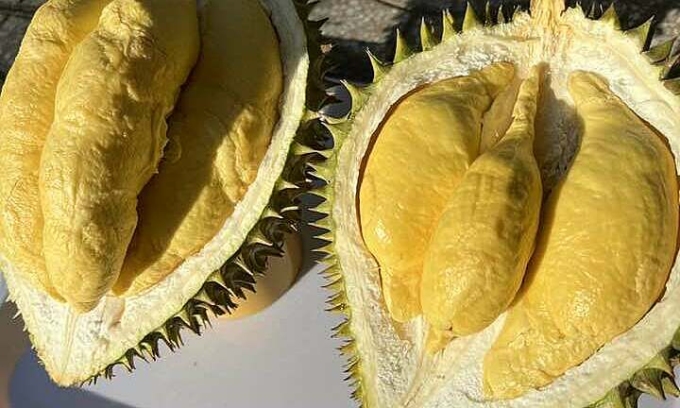
Ri6 durian in a garden in the Mekong Delta. Photo by Manh Khuong |
Dang Phuc Nguyen, general secretary of the Vietnam Fruit and Vegetable Association, said the price slump is also driven by seasonality.
Thailand is in its peak harvest season from April to June, flooding the market with supply and driving prices down across the region.
Meanwhile, Vietnamese production is fragmented and residue control is uneven and heavily reliant on testing systems that are overwhelmed during peak periods. Its durian exports were worth nearly $222 million in the first quarter, up 128% year-on-year.
But sustaining that momentum will require more stringent quality control and better coordination across the production chain.

Comments are closed.