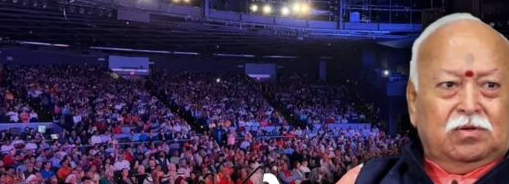
The story of a shakha that started 100 years ago in Nagpur has today reached the stage of New York. Sangh chief Mohan Bhagwat’s visit to America in the centenary year of RSS is special because it is not just a foreign visit of the head of an organization, but a glimpse of the journey in which the Sangh built its presence from the local branch to the global diaspora network. Addressing Indian-Americans in New York, Bhagwat gave the message of ‘one world, one humanity’ and asked the people of Indian origin to remain connected to their cultural roots and also fulfill their full responsibility towards America.
Addressed the Indian and American communities at an event in New York’s Square Garden. He said that India and America have ‘unity and diversity’ in their DNA. Bhagwat said that diversity should be celebrated, respected and accepted, and a feeling of unity should also be maintained among the people.
There is a big story of 100 years hidden behind Bhagwat’s speech. The question is, how did RSS, which started from Nagpur, reach New York? When did the branches of the Sangh go beyond the borders of India? How did Sangh-related organizations expand among Indian immigrants in America? And why is Mohan Bhagwat’s visit to America in 2026 considered important for the Sangh?
Does Nagpur of 1925 connect with today’s New York?
On 27 September 1925, on the day of Vijayadashami, Dr. Keshav Baliram Hedgewar founded the Rashtriya Swayamsevak Sangh in Nagpur. At that time its scope was limited. Bringing together volunteers through shakhas, discipline, physical training and ideological discussion became the basis of the organization’s work.
Gradually this shakha model came out of Nagpur. Branches were started in different cities and the network of volunteers continued to grow. The most important part of the organizational structure of the Sangh was that the organization was expanded from person to person and from branch to branch. This model later became the basis for the Sangh to move out of India.
How did the Sangh go beyond the borders of India?
The Sangh’s foreign journey did not begin with a single day or a single decision. As people of Indian origin settled in different parts of the world, the network of volunteers also expanded.
Organizations like Hindu Swayamsevak Sangh i.e. HSS developed for Sangh related work in foreign countries. Here the nature of work was changed according to local conditions. Cultural engagement among people of Indian origin, knowledge of Hindu traditions, youth activities and social service became its major parts.
In India RSS means Rashtriya Swayamsevak Sangh, while in foreign countries the name HSS was used. This difference in itself shows that the organization adapted its work abroad to the context of the expatriate society.
When did the story of the Confederacy become stronger in America?
To understand the network associated with the Sangh in America, the story of Indian migration must also be understood. After 1965, with changes in American immigration laws, a large number of students and professionals from India came to America. Doctors, engineers, scientists and other professionals began settling in American cities.
As the Indian-American community grew, so did the need for cultural and religious organizations. In this environment, networks associated with the Sangh also increased their activities in America.
According to Hindu Swayamsevak Sangh America, the organization was registered as a non-profit organization in 1989. Its programs include social service and community-based initiatives along with cultural activities.
That is, the story of RSS in America is not just the story of taking an organization there from India. This is also a parallel organizational journey with the expansion of the Indian diaspora.
Was the Sangh model in America the same as in India?
It’s not like that. This is the interesting part of this story. The identity of RSS in India was formed with the organizational work related to shakha and national-society. While working in America, one had to keep in mind the local laws, social structure and needs of the expatriate community.
Therefore, the organizations associated with the Sangh abroad also laid emphasis on cultural programs, family based activities, children and youth programs and service work.
Here there was another challenge for the Sangh – to connect the new generation of Indian origin with its cultural identity, even though it was born and brought up in America.
Why is Mohan Bhagwat’s New York visit so important?
The year of completion of 100 years of RSS gives special significance to this tour. In the centenary year, the Sangh is not only looking at its organizational expansion in India, but is also giving importance to dialogue with the people of Indian origin settled abroad.
Mohan Bhagwat’s tour to America, Canada and Britain is part of this extensive contact campaign. Before this, Sangh’s Sarkaryavah Dattatreya Hosabale had also visited America, Britain and Germany.
This indicates that for the RSS, the Indian-origin community living abroad is no longer just a migrant society, but also an important part of the cultural and ideological dialogue.
What message did Bhagwat give in New York?
Mohan Bhagwat emphasized on diversity, humanity and social unity in his address in New York. Underlining the diversity of Indian society, he said that despite different religious identities, humanity is common.
His speech also had a clear message for Indian-Americans. It is important to maintain their Indian cultural roots, but equally important is responsibility and loyalty towards the country they live in.
That is, two identities are seen together in Bhagwat’s message. Indian cultural roots and responsibilities of American citizenship/expat life.
Is Bhagwat’s statement on Muslim society an important part of the tour?
In New York, Bhagwat also talked about the existence of Muslim society in India and social relations with it. Linking India’s identity to diversity, he said that the idea of separating Muslims from India is not in accordance with the Indian point of view. One who thinks like this cannot be a Hindu.
This statement is also important because there has been a debate in foreign countries about the ideology of RSS for a long time. In such a situation, Bhagwat’s emphasis on social unity and humanity from the American platform also connects with the ongoing discussion regarding the global image of the Sangh.
Then why was there opposition to Bhagwat’s program?
While on one hand a large number of people from the Indian-American community attended Bhagwat’s program, on the other hand there were criticisms about RSS.
Some political and social groups in America have been raising questions about the ideology of RSS. Protests and political debate were seen in New York also regarding Bhagwat’s program.
RSS does not accept these criticisms. The Sangh says that it is an organization that organizes the Hindu society and works in the socio-cultural field.
Therefore the New York stage was not just a platform for speech. It became a platform where the ideology of the Sangh, its global presence and the questions of its critics were visible together.
Is the journey from Nagpur to New York just a story of expansion of the organization?
This is also just a story of expansion of thought. The organization, which started in Nagpur in 1925, is today connected to an active network outside India also. The role of the Indian expatriate community has been very important in this journey.
For people living outside India, the question of culture and identity often becomes more important. The organizations associated with the Sangh made this need a basis for their activities. The organizational style that started with the shakha became visible abroad in the form of cultural programs and community activities.
What is the biggest question facing RSS after 100 years?
The biggest question now is what will be the global role of the Sangh in the next 100 years. In the first century, RSS emphasized on organization formation and expansion. In the second century it will have to face a different kind of challenge. To explain one’s ideology in the global society, to communicate with the new generation and to maintain one’s identity amidst the social and political sensitivities of different countries. Bhagwat’s speech in New York points towards this changing role.
The story that started from the Nagpur branch has now reached a city where different cultures and ideas of the world are seen together. This is the reason why Mohan Bhagwat’s visit to America in RSS@100 is not just a foreign trip, but an important picture of the 100 years of the Sangh’s journey.
After all, what is the biggest story of RSS@100?
It would probably be incomplete to call this story only ‘Nagpur to New York’. The real story is the gradual transformation of a local organization into a national and then global network. 1925 marks the beginning of Nagpur Union. Today’s New York is becoming a symbol of its global dialogue.
In 100 years, the Sangh has faced many political, social and ideological debates. Its role and ideology have been debated in India as well as abroad. But Mohan Bhagwat standing on the American stage in the centenary year shows that the story of RSS is no longer the story of India only.
The future will answer in which direction this story will go in the next 100 years. But one thing is clear – the journey that started from Nagpur has now reached New York and the biggest story of RSS@100 is hidden in this journey.
Fact Box: RSS@100
Establishment: 1925
Founder: Dr. Keshav Baliram Hedgewar
Installation site: Nagpur, Maharashtra
Centenary Year: 2025-26
Major affiliated organizations abroad: Hindu Swayamsevak Sangh (HSS)
HSS in America: Network of cultural, social and service activities among people of Indian origin
Current key face: Mohan Bhagwat
Main questions: How big and what will be the global role of the Sangh after 100 years?