
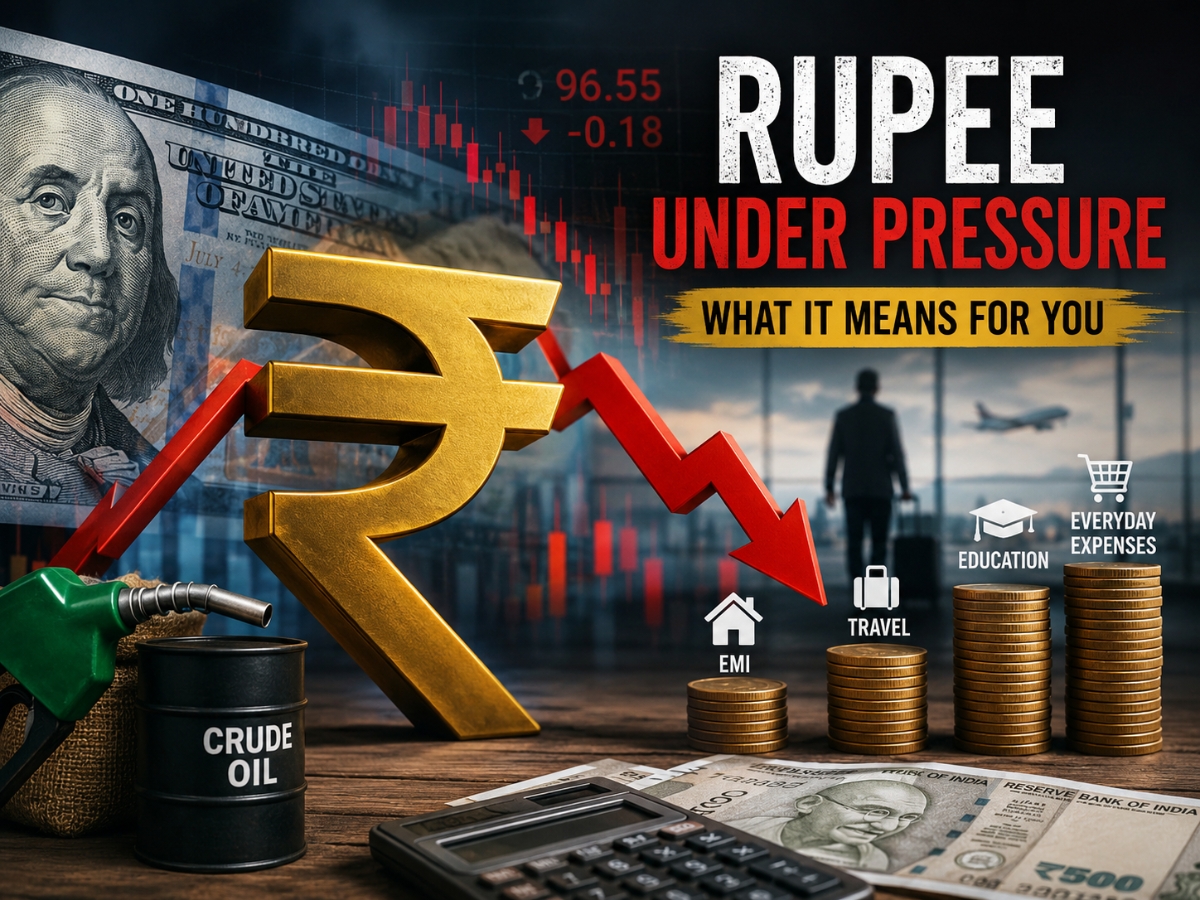
Rupee Under Pressure? Here’s How a Weak Currency Could Affect Your EMI, Travel Plans and Everyday Expenses

The Indian rupee managed to avoid earlier drops on Friday, as the Reserve Bank Of India (RBI) was allegedly in support of the currency. However, the current pressure is not over. Rising prices for crude oil and the global instability, in addition to continuous sell-offs by foreign institutional investors, continue to push the Indian rupee to remain at the rear.
However, after declining to a daytime low, it has recovered and is closing down at 96.55 rupee per US dollar at day’s end. The Indian rupee opened at 96.81 and fluctuated between 96.30 and 96.81 during trade today. Deslers stated that RBI was active in the spot, forward and offshore non-deliverable forward (NDF) markets, hence enabling the rupee to regain lost ground.
Even though the rupee rebounded, market experts assume that volatility will likely persist, with world demand for oil, the flow of investments by FIIs and geographical and economic progress deciding the course of currency in the coming weeks.
Why Is Rupee Falling?
The primary cause for the declining currency is the increasing cost of crude oil due to geopolitical stress and rising risks in the Middle East region.
India primarily relies on crude oil imports for 85 per cent of its total consumption from outside and such import activities are predominantly funded through the US greenback. Due to the growing price of crude oil, Indian companies are now needing to spend more dollars to import, causing the dollar to strengthen relative to the rupee. Even though there was some relief in crude oil prices yesterday, they remain around $96.78 for Brent crude and $89.31 for WTI crude on global crude oil exchanges – well over what they were a few months ago.
And the pressure does not cease here alone, as strengthening of the greenback, higher US Treasury yields, and outflows of investments from the Indian shares continue to exert downward pressure on the Indian rupee.
Why Does it Matter to Indian Citizens?
It is easy to think that the rupee-dollar exchange rate only affects importers or people travelling abroad. Its influence, in fact, touches almost every home.
A weaker rupee means imports are more expensive. This doesn’t just affect businesses but also leads to higher prices for fuel, electronics, household goods and many everyday products.
High crude oil prices over a long period can also raise transportation and logistics costs, which in turn raises prices for groceries and other essentials.
Does a Weak Rupee Impact Your EMI?
But it does not affect borrowing costs in the long run.
Imported inflation usually rises when the rupee weakens. If inflation remains elevated, the RBI may have less room to cut rates or may even have to tighten monetary policy to control prices.
That’s important for borrowers with floating-rate loans.
Get a Rs 50 lakh Home Loan for 20 years If the lending rates go up by 0.5 percentage points, then the monthly EMI could rise by Rs 1,500-2,000 approximately.
It’s not just home loans that are affected. Floating-rate car loans, education loans and personal loans could also be more expensive.
Planning A Vacation Abroad? Expect to Pay More
Every dollar goes up in cost when the rupee is weak.
If you are travelling abroad for a holiday or paying university fees overseas, you will have to shell out more in rupee terms. When the rupee’s value drops, hotel bills, tuition fees, rent, shopping and daily expenses can all become significantly more expensive.
The same goes for people who regularly send money abroad.
Imported Gadgets May Also Be More Expensive
A weaker rupee may not work in your favour if you were planning to buy a new smartphone, laptop or gaming console.
Many electronics brands use imported parts and as the cost of imports rises, companies often pass on at least part of the increase to customers.
Automobiles, aviation, electronics and chemicals could also see higher input costs if the currency remains weak.
Who Stands To Gain?
A weak rupee is not unwelcome by all.
Export-orientated sectors, like IT services and pharmaceuticals, tend to do well as they earn a large part of their revenues in US dollars. Local currency companies get more rupees when they convert their earnings.
Indians receiving money from relatives working abroad also get more rupees per dollar sent.
What Should You Do Right Now?
If you have a floating rate loan, check with your bank how your EMI would change if interest rates move up by half a percentage point. Knowing the numbers now can help you better plan your finances.
Another simple step is to set up auto-debit for loan repayments, which can help you avoid missed EMIs, penalty charges and unnecessary damage to your credit score.
If you are intending to pay for overseas education fees or other foreign currency expenses, you should ask your bank about booking a forward contract. It means that people can fix an exchange rate for future payments and so lessen the danger of further currency movements.
Savers can also compare fixed deposit rates around this time. If inflation starts to go up, it might be a sensible idea to lock up today’s rates.
How to Protect Your Money From Rupee Fluctuations
Friday’s recovery gave some breathing space to the rupee, but the larger picture remains unchanged. Oil prices remain high, geopolitical tensions continue to agitate world markets, and foreign capital flows remain uncertain.
For the households this means the impact may be far beyond the foreign exchange market. A weaker rupee can gradually lead to higher fuel prices, pricier imported goods, more expensive trips abroad and, eventually, bigger loan repayments. If the currency keeps coming under pressure, it can do a lot to watch your finances and plan ahead.
Also Read: Gautam Adani’s Journey: How a School Dropout Became Asia’s Richest Billionaire
Priyanka Roshan is a business writer and assistant editor at the NewsX website who tracks everything from stock market swings and corporate earnings to personal finance trends and policy shifts. Known for turning fast-moving business developments into sharp, reader-friendly stories, she combines speed, accuracy, and a data-driven approach to break down complex financial news for everyday audiences.
With over 9.5 years of newsroom experience, Priyanka has worked with leading media organisations, including Bussiness, Times Now, and Ping Digital, covering diverse beats such as business, politics, technology, auto, travel, sports, and the world. From live breaking news desks to SEO-led digital storytelling, she specialises in creating engaging content that keeps readers informed without overwhelming them.
The post Rupee Under Pressure? Here’s How a Weak Currency Could Affect Your EMI, Travel Plans and Everyday Expenses appeared first on NewsX.

Comments are closed.