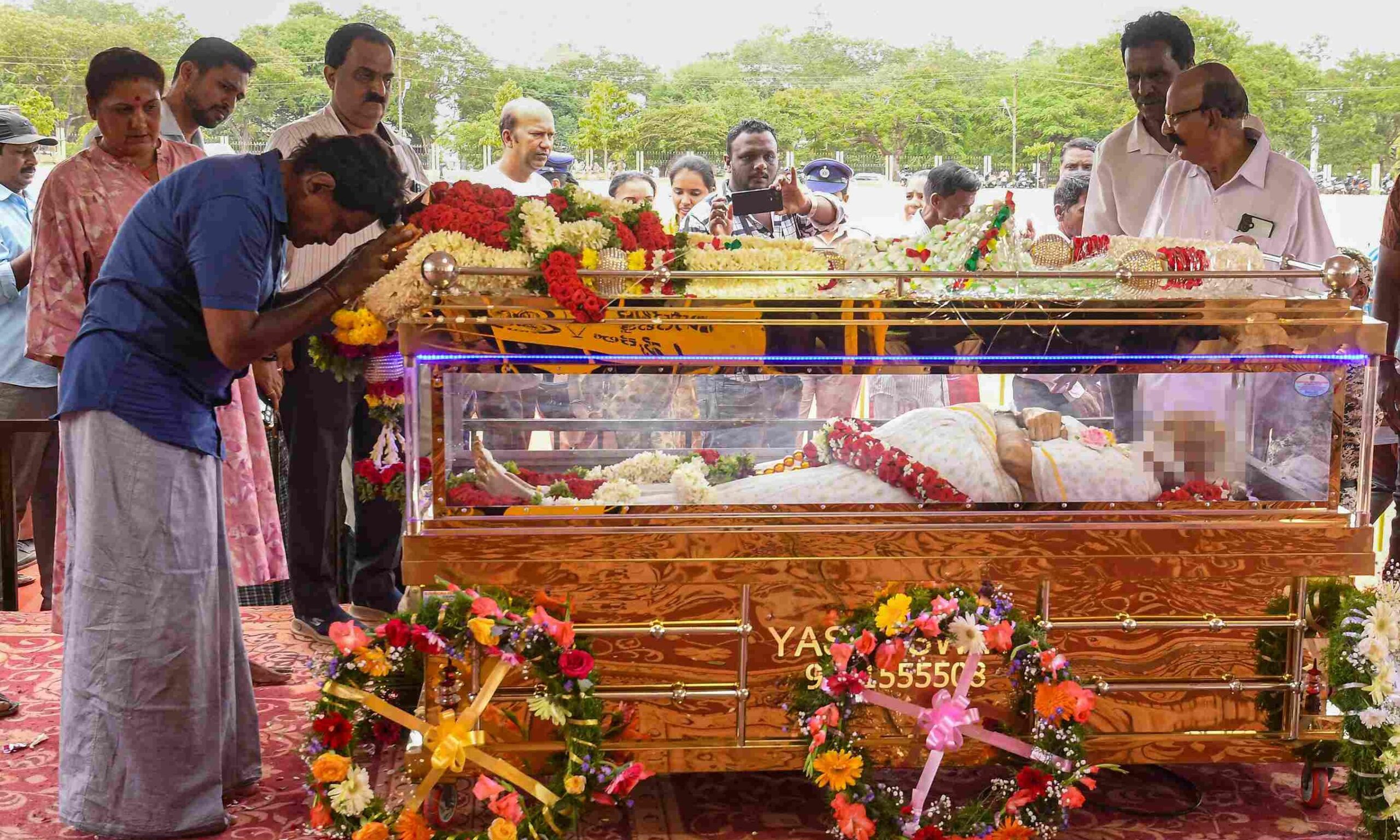
The passing of the legendary playback singer S Janaki at the age of 88 in Mysuru plunged millions of music lovers into deep mourning. For 55 years, her transcendent voice defined Indian cinema, spanning over 48,000 songs across 17 languages, including Hindi cinema. Yet, as fans flooded X to celebrate her immortal tracks like Kanmani Anbodu and Thumbi Vaa, outrage too simmered.
Fans and regional media are openly questioning why one of India’s greatest musical icons was given a remarkably low-key send-off, devoid of the grand spectacle and star-studded attendance reserved for her male contemporaries.
The missing fraternity
While the Karnataka government honoured Janaki with full state honours in Mysuru, the conspicuous absence of prominent film stars and directors from the Tamil, Telugu, and Malayalam film fraternities raised eyebrows. There was no visible representation from the Tamil Nadu government, a snub that deeply stung fans given her monumental contribution to Tamil culture.
Also read | S Janaki obit: The singer whose voice transcended languages and generations
Social media users were quick to contrast her quiet funeral with the massive, high-profile recent farewells of other industry stalwarts like K Bhagyaraj. His recent final rites were attended by Kollywood elite, including Tamil Nadu Chief Minister C Joseph Vijay, superstar Rajinikanth, and an emotional Dhanush.
Legendary filmmaker Bharathirajaa was laid to rest on June 11, 2026, at his Theni farmhouse with full state honors and a 72-gun salute. Many Tamil film celebrities, including TN CM Vijay, flocked to his residence to pay tribute to the late director.
‘Why the disparity?’
When Janaki’s frequent duettist SP Balasubrahmanyam passed away in September 2020, top stars like Vijay, Arjun, and Bharathiraja defied strict COVID-19 pandemic restrictions to pay their respects at his Red Hills farmhouse.
“Mysuru is only a few hours’ drive from Chennai,” noted one disappointed fan on X. “It is truly sad that the biggest names of the Tamil fraternity couldn’t make the journey for the woman who shaped our cinema.”
Another fan regretted that “celebrities who makes a bee line in Chennai when film personalities pass away did not find time to go to Mysore (except KS Chithra) to pay respect to Janaki Amma who has recorded over 48000 songs!”
Misogyny in film industry
Some cultural commentators argue that the lack of an industry-wide spectacle stems from Janaki’s own lifestyle choices. Unlike SPB, who remained a constant, visible household presence as an actor, anchor, and television judge, or directors like Bharathiraja and Bhagyaraj, who remained in the spotlight, Janaki was fiercely private.
She chose to live like a saint, retiring intentionally to Mysuru years ago, entirely removed from the modern media circus. To some, a quiet farewell was the natural extension of a life spent away from public fanfare.
However, for a large section of fans, this explanation feels like an excuse that masks a deeper, systemic issue. The stark disparity between the send-offs of male industry giants and a female legend has raised uncomfortable questions on social media about deeply-embedded misogyny within the southern film industries.
Fighting national bias
The muted farewell has also reignited the long-standing grievance regarding how the national establishment treats South Indian icons. Mainstream English and Hindi news channels gave minimal airtime to her passing—a recurring complaint among South Indian cinema fans who feel their legends are routinely overshadowed by Bollywood figures.
Also read | Four films, four genres: How K Bhagyaraj created cinema history in 1981
Janaki herself was acutely aware of these biases. In 2013, she famously made headlines by politely declining the Padma Bhushan award. Having won four National Awards and 33 State Film Awards, she felt the recognition arrived 55 years too late and was “too little” for her staggering body of work.
At the time, she boldly asserted that if the central government truly wished to honour her legacy, they should award her the country’s highest civilian honour, the Bharat Ratna. She also publicly called out the national establishment, demanding timely recognition and greater consideration for South Indian artists.
True legacy
Though the glitz of Chennai and the national media looked away, S Janaki’s true legacy remains untouched by the politics of awards and misogyny in south film industries. She effortlessly held her own alongside male titans like SPB—whom she famously discovered at a college singing contest—and KJ Yesudas.
Ultimately, while the film fraternity’s absence has left a bitter taste, Janaki Amma’s final farewell was defined exactly how she lived: free of industry politics, wrapped in the quiet dignity of Mysuru, and sustained by the timeless, deep reverence of the millions who love her.