0
New Delhi
The Bharatiya Janata Party and the Shiromani Akali Dal on Tuesday formally announced the revival of their alliance for the 2027 Punjab Assembly elections, bringing together two former partners who had parted ways in September 2020 over the three farm laws.
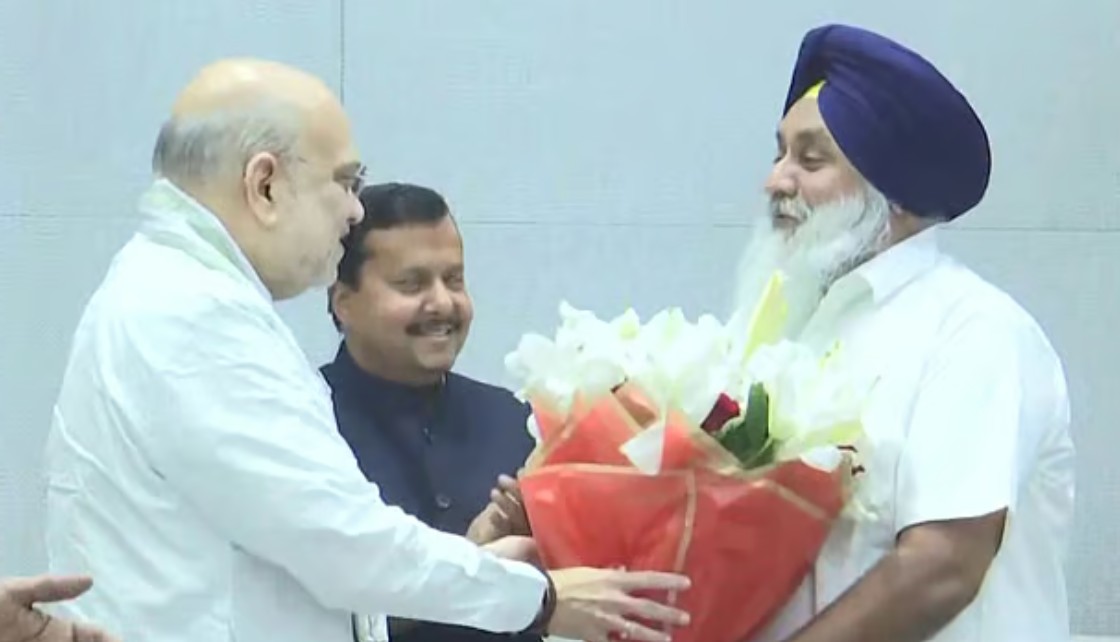
The announcement was made at a joint press conference at the BJP headquarters in New Delhi by Union Home Minister Amit Shah, BJP national president Nitin Nabin and SAD president Sukhbir Singh Badal.
Welcoming the Akali Dal back into the National Democratic Alliance, Shah described it as the NDA’s oldest ally and announced that the two parties would contest the forthcoming Punjab Assembly elections together. Shah also indicated that the Chief Minister would be from the Akali Dal, while the two parties would contest all 117 Assembly constituencies together. The detailed seat-sharing arrangement, however, was not announced.
The revival of the BJP-SAD alliance represents more than the return of two former political partners. It marks a significant political recalibration by both parties, particularly the Akali Dal, whose electoral fortunes have declined considerably since the breakdown of the alliance in 2020.
While the BJP’s return to an arrangement with the Akali Dal might give the impression that the BJP needs the Akali Dal to establish a stronger political presence in Punjab, electoral figures suggest that the relationship could be more reciprocal than it appears. In fact, the Shiromani Akali Dal may need the BJP as much as, if not more than, the BJP needs it.
The political partnership between the BJP and the Shiromani Akali Dal dates back to November 1996, following the Moga Declaration. The two parties first contested the Punjab Assembly elections together in 1997. It subsequently became one of the more enduring political partnerships in the country.
The parties contested five Punjab Assembly elections together, in 1997, 2002, 2007, 2012 and 2017, and six Lok Sabha elections, in 1998, 1999, 2004, 2009, 2014 and 2019. Their partnership also resulted in three terms of government in Punjab, with Parkash Singh Badal serving as Chief Minister.
However, the relationship came to an end in September 2020, when the Akali Dal walked out of the BJP-led National Democratic Alliance over the three farm laws enacted by the Narendra Modi government. The departure, accompanied by the resignation of Harsimrat Kaur Badal from the Union Cabinet on 17 September, was presented by the Akali Dal as a principled stand in support of farmers. The party formally announced its withdrawal from the NDA on 26 September 2020.
Six years later, the two parties have decided to come together again, but the circumstances surrounding the revival are considerably different from those that shaped their original partnership.
The most significant factor behind the Akali Dal’s decision is its declining electoral strength. The party’s vote share in Punjab Assembly elections fell from 34.73% in 2012 to 25.24% in 2017 and further to 18.38% in 2022.
Its performance in parliamentary elections has also reflected a significant decline in the latest cycle. Having secured 27.45% of the vote in 2019, the party’s share fell to 13.42% in the 2024 Lok Sabha elections. Its vote share had stood at 26.30% in 2014, indicating that the sharpest decline occurred between the 2019 and 2024 elections.
Sources familiar with the thinking within the Shiromani Akali Dal suggest that the party’s assessment was that it needed an alliance to protect its political relevance and retain a substantial legislative presence.
The calculation was not necessarily limited to the possibility of forming the next government. An arrangement with the BJP would also provide an opportunity to contest a significant number of constituencies and secure representation in the Assembly, even if the alliance failed to win power.
The second consideration was the party’s assessment of the emerging political contest.
According to sources in Punjab, the Akali Dal was increasingly conscious that it was no longer positioned as one of the principal contenders for power, with the Congress and the Aam Aadmi Party emerging as the principal contestants. Remaining outside a broader political arrangement, the party believed, could further weaken its position.
The BJP, meanwhile, brings its national organisational network, campaign resources and election-management capabilities to the partnership. These are factors that the Akali Dal can potentially benefit from as it seeks to rebuild its electoral presence.
The electoral figures also indicate that the BJP’s independent position in Punjab has changed since the alliance broke down.
In the 2019 Lok Sabha elections, when the two parties were still allies, the BJP secured 9.63% of the vote, against the Akali Dal’s 27.45%. In 2024, when both contested separately, the BJP secured 18.56%, while the Akali Dal’s share declined to 13.42%.
The figures are particularly relevant because they challenge the assumption that the BJP is necessarily the more dependent partner in the revived arrangement. Although the Akali Dal retains an established political network and a distinct regional identity, the BJP has demonstrated an ability to expand its independent vote share.
Significantly, the decision to revive the alliance was not without reservations within the BJP’s Punjab unit.
A section of the party was understood to be opposed to entering into an arrangement with the Akali Dal, arguing that the BJP should continue to contest independently and build on the electoral support it secured in 2024. The assessment within this section was that another independent electoral contest could further increase the BJP’s vote share, giving it greater political legitimacy and acceptability among Punjab’s electorate. A larger independent vote base, they believed, would also strengthen the party’s position in subsequent elections and help it establish itself as a more substantial political force in the state.
However, the BJP’s national leadership ultimately decided in favour of reviving the alliance.
The combined vote share of the two parties in the 2024 Lok Sabha elections would have been 31.98%, compared with 37.08% in 2019. In 2019, SAD had secured 27.45% and BJP 9.63%, while in 2024 their respective shares were 13.42% and 18.56%. However, this arithmetic does not automatically translate into transferable votes, particularly given the political circumstances in which the two parties contested separately.
The revival also raises questions about the political cost of the Akali Dal’s 2020 departure from the NDA. Having taken the high moral ground over the farm laws and walked away from a longstanding partnership, the party is now returning to the same political arrangement after its electoral position has weakened.
For the BJP, party sources said, the alliance offers an opportunity to work with a party that has an established political presence and organisational network in Punjab. For the Akali Dal, it offers access to a national political organisation with considerable campaign resources and a wider electoral infrastructure.