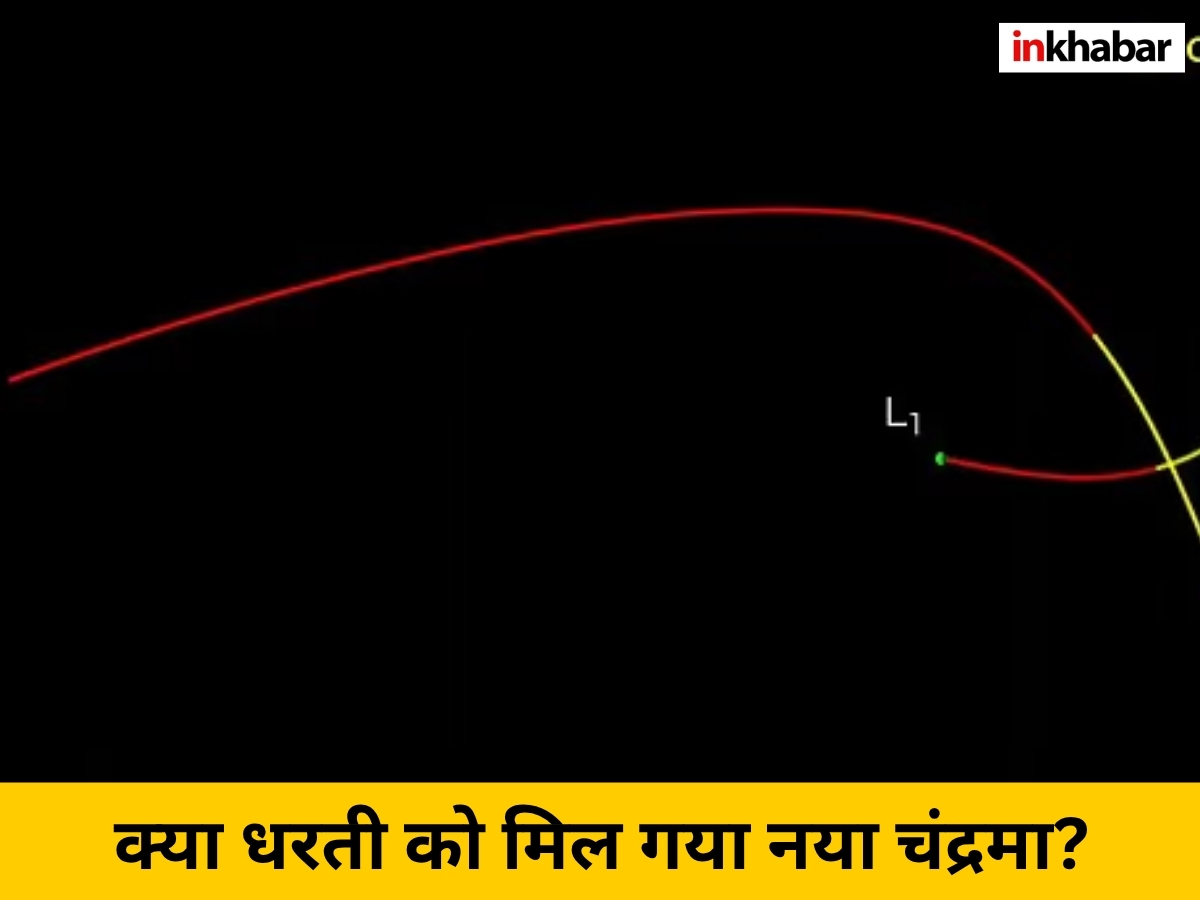
Has Earth got a new mini moon? So the answer is yes to some extent. Scientists have discovered a space rock that has been pulled into Earth's orbit and will remain with us until January. According to scientists, a space rock has been pulled into the Earth's orbit and it will remain with us till January. The diameter of this minimoon named '2026 QQ8' is approximately 6 feet. In April it came under the Earth's gravitational pull.
can it be destroyed
Although it is so small that it could burn up and be destroyed if it comes too close to the Earth's atmosphere, but experts believe that the chances of this happening are low. Its closest approach to Earth will be about 353,000 miles (568,000 km), which is about one and a half times the distance to the Moon.
At the same time, it is expected that '2026 QQ8' will exit the Earth's gravitational field in January 2027. Although it is so small that it cannot be seen with ordinary telescopes (amateur telescopes), astronomers around the world are closely monitoring its movements. They want to understand how the Earth attracts small, temporary moons towards itself. It was first discovered by Hungarian researcher Krisztian Sarneczky in August.
But when Sarnezky presented his discovery to the International Astronomical Union's Minor Planet Center (which records and confirms new astronomical objects), experts were divided about what this thing was?
It's a Nature Chattai Minimoon
At the same time, some people believe that they have found a natural rocky 'minimoon', which is trapped in the Earth's gravity for some time. While some others believed that it was space junk made by humans. The Minor Planet Center said in an official statement that 'The orbit of object Sar2901… indicates that it could be either a 'minimoon' (small moon) or a human-made object. There are different opinions among experts about what it actually is.
Similarly, Harvard University theoretical physicist and astrophysicist Professor Avi Loeb even suggested that this object could be a 'lost' panel of the Apollo 13 Moon mission. However, subsequent investigations by the Lowell Discovery Telescope in Arizona and the 2.2-meter telescope at the University of Hawaii ultimately confirmed that it was a naturally occurring object.
On October 29, 2026, the Minor Planet Center officially recognized the object as a 'minimoon' and named it '2026 QQ8'. Scientists believe that 2026 QQ8 is a type of space rock called 'Aten asteroid'. These are the remains left from the initial formation of the solar system 4.6 billion years ago.
Big 'Aten Asteroids' are dangerous
This object, named 2026 QQ6, is a small rock about six feet (2 meters) wide, which entered Earth's orbit in April this year. The orbits of Aten asteroids lie primarily within Earth's orbit and often intersect Earth's orbit, meaning they often come very close to our planet.
Large 'Aten asteroids' are particularly dangerous, as they can be hidden in the sun's glare as they approach Earth and may collide with Earth without warning. Luckily the 2026 QQ8 is small enough that it poses no threat. Even if it is in a position to directly collide with the Earth?
The imaginary boundary is the 'Hill Sphere'
Scientists believe that this asteroid usually takes about 359 days to revolve around the Sun and comes close to the Earth once every ten years. Usually no object comes close enough to enter the Earth's 'Hill Sphere'. The 'Hill sphere' is an imaginary boundary that separates the region where Earth's gravity is dominant and outer space where the Sun's pull dominates.
According to scientists, sometime in April 2026, QQ8 probably entered the 'Hill Sphere' and got stuck in it for some time. Previous studies have shown that Earth usually has at least one additional 'minimoon'. Most of these minimoons orbit the Earth for less than a year and then go back into space.
Sighting of 'minimoon' is not a rare phenomenon
Previous studies have shown that Earth usually has at least one additional 'minimoon'. Most of these minimoons orbit the Earth for less than a year and then go back into space. This is not the first time that scientists have discovered a 'minimoon' revolving around the Earth. Such an object was first observed in 1991, when astronomers observed an object 30 feet (10 meters) across, which was named '1991 VG'.
At that time, seeing the circular orbit and extremely bright surface of '1991 VG', there were concerns that perhaps an alien probe (a vehicle from another planet) was investigating the Earth, but now scientists know that the appearance of such a 'minimoon' is not a rare event, but it happens frequently. In fact, recent research suggests that Earth usually has at least one additional 'minimoon' that remains in its orbit for some time.
go back to space mini honeymoon
These additional satellites usually remain near the Earth for less than a year and then go back into space. Therefore, as this short journey of 2026 QQ8 completes, scientists will try to gather as much information as possible about it. Like how this process happens and what it can mean for the safety of the Earth.
The post Did the Earth get a Mini Moon, can it burn to ashes if it comes closer? After all, what is the whole truth appeared first on Tezzbuzz.