The 56-year-old founder and chairman of Lens Technology holds a fortune of 127 billion yuan (US$19 billion), according to the Hurun Richest Women in China 2026 list published by Shanghai-based Hurun Research Institute in late October.
She reigned at the top for the second time, overtaking Zhong Huijuan, the former chemistry teacher who founded drugmaker Hansoh Pharmaceutical.
Coming from rural poverty, Zhou’s journey to the top is a classic rags-to-riches tale that has inspired countless migrant workers across China.
Born in a mountain village in Hunan province, she lost her mother at the age of five, while her father later became blind following a workplace accident, The Standard reported.
She dropped out of high school at 16 and moved to Shenzhen, where she worked first as a construction site security guard and later as an assembly line worker at a glass factory, according to the South China Morning Post.
She set up her own workshop in 1993, at just 23, and taught herself more advanced screen-printing and specialized curved-glass printing techniques.
|
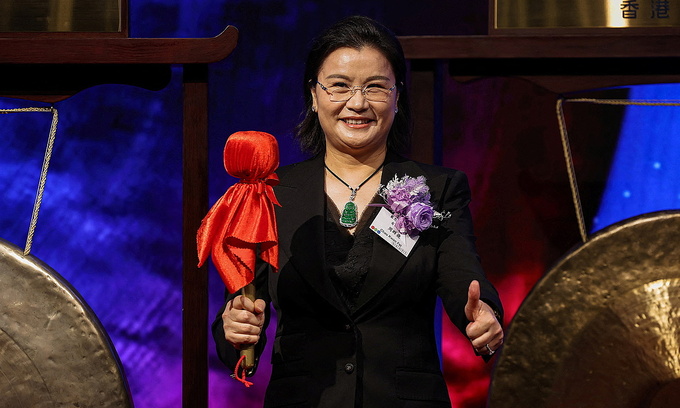
Zhou Qunfei, chairman of Lens Technology, attends the company’s listing ceremony at the Hong Kong Stock Exchange in Hong Kong, China, July 9, 2025. Photo by Reuters |
Lens Technology was established a decade later in Shenzhen by Zhou and a partner.
The firm landed a deal with Motorola and later got its big break supplying touchscreens for Apple’s first iPhone. It went public in Shenzhen in 2015, the same year Zhou was first crowned China’s richest woman.
Over those years, Zhou saw her fair share of tribulations, from her partner leaving the firm to a rival trying to squeeze her out of the game, she once recounted in an interview with CNBC.
Another major blow came in 2018, when her firm’s stock plunged amid US-China trade trade tensions and concerns about Apple’s sales, erasing much of Zhou’s wealth, according to The Straits Times.
Lens Technology has since been diversifying beyond smartphones, expanding into advanced manufacturing and capitalizing on growing demand driven by artificial intelligence, robotics and other emerging industries.
It now makes parts for a broad range of products, including computers, smart wearables, electric vehicles and humanoid robots.
The shift appears to be paying off. Lens made a secondary listing in Hong Kong last July that was oversubscribed by roughly 462 times, fueling Zhou’s comeback.
She drew attention earlier this year when she was seated between Apple CEO Tim Cook and Tesla founder Elon Musk at a state banquet hosted by Chinese President Xi Jinping for US President Donald Trump in May.
She was also featured in Fortune‘s 2026 Most Powerful Women Asia list in October, where she ranked third, with the magazine crediting her with building Lens into a manufacturing giant.
Most businesswomen on China’s rich list are self-made
Hurun’s list, which featured the 50 richest women in China, noted that 65% of the listees built their fortunes on their own, having started their businesses at around age 32 and are 59 years old today on average.
Among the top five, only two inherited their wealth, namely Hong Kong property developer Sun Hung Kai Properties’ Kwong Siu Hing and beverage giant Wahaha’s heiress Kelly Zong.
China is home to more than half of the world’s self-made women billionaires, with 78 of the 150 on the global list, or more than the rest of the world combined, Hurun said.
Meanwhile, Chinese men make up over 30% of the world’s self-made male billionaires.
“By this measure, Chinese women punch further above their weight in business,” Hurun said.