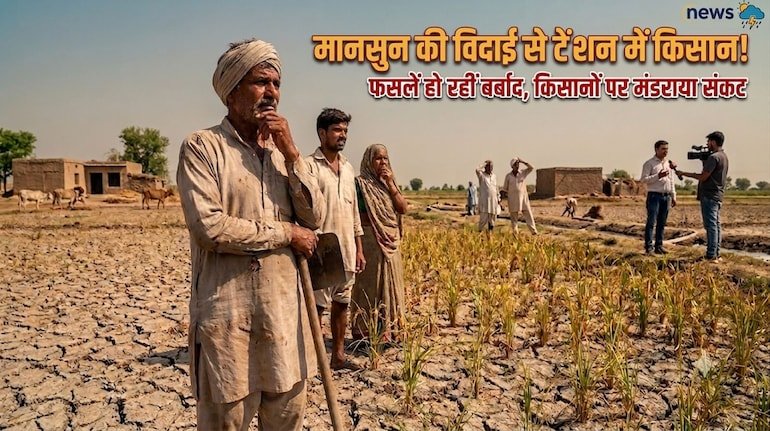
A big and worrying news has come from the Meteorological Department for the country's food providers and rural economy. According to the Indian Meteorological Department (IMD), the process of official withdrawal of Southwest Monsoon from the country has started. The withdrawal line of monsoon is passing through Phalodi, Ramgarh and Khajuwala in western Rajasthan and in the coming days it will also move away from Punjab, Haryana and Kutch region of Gujarat. However, this time the departure of monsoon is not a relief but is becoming a cause of deep concern. More than 20 percent less rainfall than normal has been recorded in 14 big states of the country. Meteorologists estimate that when the 4-month monsoon season ends on September 30, the overall deficit of rainfall across India could be more than 10%—in meteorological definition, an all-India deficit of more than 10% is classified as drought conditions. Water crisis deepens in 14 states, drought looms in more than 200 districts. According to IMD's cumulative rainfall data, there is a deficit of about 14% to 15% in total rainfall across the country since June 1. The worst situation is in 14 states of the country where rainfall deficiency has crossed the danger mark of 20 percent. These include North India's Punjab (about 40% reduction), Haryana (23% reduction) and Rajasthan (25% reduction). Bihar state in eastern India is going through the most serious crisis, with 35% less rainfall than normal. Whereas in Meghalaya (59% deficit) and Arunachal Pradesh (42% deficit) of the North-East, rivers and water sources are on the verge of drying up. Additionally, all five states of peninsular India—Andhra Pradesh (a massive deficit of 43%), Karnataka (29%), Kerala (27%), Tamil Nadu (26%) and Telangana (20%)—are facing the double whammy of a weak monsoon. There has been a severe decline in ground water level and serious drought-like conditions in more than 218 agricultural districts across the country. The main reason for the uneven and weak monsoon winds this year is considered to be the active El Niño seasonal phenomenon in the Pacific Ocean. The effect of El Nino causes the sea surface of the equatorial Pacific to become unusually warm, which weakens the monsoon trough line that draws moisture towards India. The country witnessed a severe rainfall deficit of up to 40% in the month of June, although rainfall had improved due to western disturbances in July. But due to the long 'Monsoon Break' in the months of August and September, the movement of clouds came to a halt. Even though the eastern coastal states (Odisha, Bengal, Andhra Pradesh) are witnessing some last minute showers due to the recent low pressure and depression in the Bay of Bengal, these rains will prove to be insufficient to compensate for the cumulative deficit of the entire four months. Crisis in the agricultural sector of Uttar Pradesh, Lucknow, Bihar and Punjab. From the capital of Uttar Pradesh, Lucknow, Kanpur, Prayagraj, Varanasi, Gorakhpur and Bundelkhand districts to the border Bihar (Patna, Gaya, Muzaffarpur), the eyes of the farmers are fixed towards the sky. In those districts of Eastern Uttar Pradesh and Bihar which are completely dependent on rain-fed farming, the cost of irrigation has increased tremendously. Farmers have to spend heavily on providing water through tube wells and diesel pumps, due to which their production costs have doubled. Even in irrigated states like Punjab and Haryana, the water table is falling and electricity consumption has reached record levels. In the districts where water storage in canals and dams has been recorded 30 to 40 percent less than the normal capacity, there may be a severe water crisis for drinking water and irrigation in the coming months. What will be the impact on the Kharif paddy crop and the upcoming Rabi season? This 10% to 15% deficiency of monsoon is sure to have a direct impact on the country's food security and crop production: Impact on paddy production: There has been a decline of about 4 percent in the area of paddy, which consumes the most water, as compared to last year. In areas where there is no rain at the critical time of flowering and grain filling, the yield may decline by 15 to 20 percent. Pulses and Oilseeds: In Karnataka, Maharashtra and Rajasthan, the production of tur (tur), urad, moong and soybean crops is likely to be affected due to non-availability of timely moisture, due to which the retail prices of pulses may increase in the coming days. Preparation for Rabi sowing (Soil Moisture Deficit): The biggest concern is regarding the Rabi season (wheat, mustard, gram) starting from October-November. If the residual moisture in the soil is not sufficient at the time of departure and there is shortage of water in the reservoirs, it will become extremely challenging for the farmers to sow wheat and mustard on time. Government's Contingency Plans and advisories for farmers In view of the early signs of weak monsoon, the Union Agriculture Ministry and state governments have activated agricultural contingency plans for more than 315 sensitive districts of the country. Special attention is being given to those 111 districts where irrigation coverage is less than 25%. Agricultural scientists have given this practical advice to farmers: Where the paddy crop is on the verge of drying up, use micro irrigation methods like drip or sprinkler. For the coming Rabi season, give priority to sowing of pulses and oilseed crops with short duration and low water maturity (like gram, lentil and rye/mustard) instead of long duration varieties. Use organic mulching in the fields so that the moisture present in the ground can be preserved for a long time.