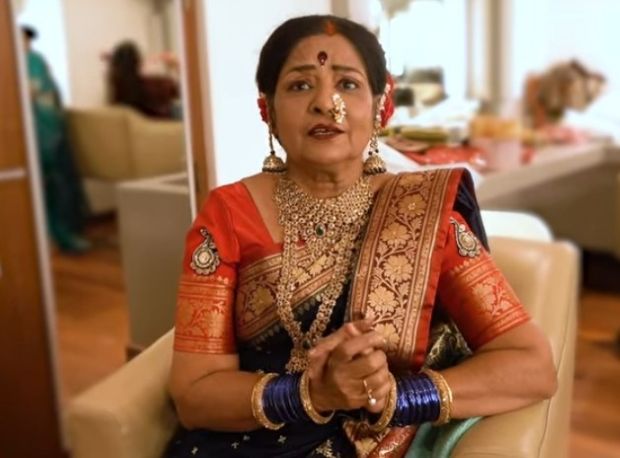
“Before I met Shakuntalabai Nagarkar, I’d been warned,” recalls Lavani and folk-art scholar Bhushan Korgaonkar. “I was told, ‘She is a terror. Meet her at your own risk’.”
He had already met several Lavani artistes by then. Shakuntalabai was among the last he had encountered of that generation — which included legends like the late Vithabai Narayangaonkar, who had ruled the stage through the 1970s to the late ‘90s. She would eventually become one of the closest to him.
Their first meeting was in 2007.
“The very first glance, I still remember the way she looked at me,” he says. “It was very critical. I felt I was being scanned.” Then, almost immediately, something shifted. “Within a moment she became friendly. She was very funny, always joking. But guarded in her own way. Other artistes opened up to me very quickly. Shakubai was quite guarded in many ways.”
It took years for that guard to come down.
“Over the years, slowly, she opened up. In the last five years we became very close. There was a lot of sharing. I learnt a lot of things from her.”
Some of those lessons had little to do with Lavani — a traditional folk song and dance performance, part of Maharashtra’s folk theatre tradition of tamasha. “How you should manage your life,” he says. “How you manage every opportunity that comes your way, how you deal with the calls that keep coming, how you decide what to take up. She taught me very well how to manage opportunities in life.”
It is an unexpectedly intimate way of remembering Shakuntalabai Nagarkar, the Sangeet Natak Akademi award-winning Lavani artiste who passed away on September 22. She was 66, had been battling lung cancer for the past six years and breathed her last at Nimgaon, in Maharashtra’s Ahmednagar (now Ahilyanagar) district, where she had moved last year after her health deteriorated. Her daughter Shraddha cared for her through those final months and was with her when she died.
Mastering Lavani
For more than five decades, Shakuntalabai knew what a pair of ghungroos could do.
They could turn a little girl from Ahmednagar into a performer. They could put food on the table. They could command a room. They could also become a burden, because the woman wearing them was often judged more harshly than the people who came to watch her.
Born in 1960 into the Kolhati community (traditionally professional entertainers), Shakuntalabai inherited Lavani from her mother, Chhabu Bai Nagarkar. Her family had settled as farmers, but her mother returned to performance, beginning to dance at Mumbai’s (then Bombay’s) Pila Haus theatre in 1968.
Shakuntala followed. She was still in Class IV when her mother took her out of school. “Can you read and write Lavani songs?” her mother asked. “Then that’s enough.”
Also read: Why opinion’s divided on whether Gujarat playing National Film Awards host can benefit home industry
At 11, she tied on ghungroos for her first performance in Parli Vaijnath in Beed in 1971. Her first tip was one rupee. “The joy that the meal I had bought with that money can never match what I now make,” she had told this writer on the sidelines of a performance at Mumbai’s Prithvi Theatre five years ago.
The education that followed happened largely outside classrooms. “She learnt by watching the footwork of other women performers, their expressions, timing and their ability to hold a baithak,” recalls cultural historian and writer Mukund Kule, who interviewed her several times. “She learnt that in Sangeet Bari (a more intimate setting with a few patrons), knowing the songs was only part of being a performer.”
The other part was learning how to deal with the gaze. “She learnt early on how to hold the audience by looking back, by understanding what the room wanted without allowing it to entirely define you or your art.”
Shakuntalabai’s professional life was a journey across several worlds. She worked with younger performers. She taught. She performed for audiences far removed from the baithaks where she had begun. Photo: By special arrangement
That contradiction stayed with her.
“Lavani was loved, but Lavani dancers were not always respected,” Kule says. “The same society that consumed the sensuality of the performance could look down upon the woman performing it.”
Shakuntalabai had little interest in making herself palatable to that society. “I am an artiste. That should be enough,” Kule remembers her saying.
Yet she knew exactly how much hypocrisy surrounded that simple assertion. During one performance, she pointed out “the absurdity of a society that could admire scantily dressed women on television while looking down upon Lavani dancers performing in their nine-yard saris.” There was anger in the observation. But, as with so much about her, humour travelled alongside it.
“The two often travelled together in Shakuntalabai,” says Kule. “It’s like once her dagger found its mark, she knew exactly when and how much to twist it.”
Korgaonkar too saw the same combination in his years of working with her. “As an artiste, I have no words to describe her contribution,” he says. “But as a human being, she was an absolute pleasure to work with. Her punctuality, her professionalism, when it came to work, there was nothing to worry about.”
And then there was the Shakuntalabai who existed after the work was done. “The bonding we had, the long funny chats we had and the silly laughing, the ‘time-pass’ and the double entendres… That was another level.”
That “time-pass” perhaps says more about their friendship than any award could. There was work, certainly. Rehearsals, performances, discussions about Lavani. But there was also hanging around. Chatting. Joking. Sharing the small details of ordinary life.
The woman everyone had warned Bhushan about had become someone with whom he looked forward to simply spending time.
Perhaps that is where the real intimacy of friendship begins.
The woman behind the performer
Shakuntalabai’s professional life was a journey across several worlds. She came out of the traditional Sangeet Bari circuit and eventually moved into theatre, helping take Lavani into spaces where it was encountered not simply as entertainment but as a performance tradition with its own history, grammar and politics. She worked with younger performers. She taught. She performed for audiences far removed from the baithaks where she had begun.
The awards followed. She received the Sangeet Natak Akademi Award. Later, Lavani Ke Rang, which she created with Korgaonkar, brought further recognition, including a Mahindra Excellence in Theatre Award in 2023.
But those awards do not quite explain her.
“Her achievement was more complicated,” says Kule. “She helped make people look again. At Lavani, at the women who performed it, at the communities from which they came and at the enormous difference between consuming an artiste’s performance and respecting the artiste herself.”
She also carried the memory of a generation of women whose work had rarely been documented with the seriousness it deserved.
And occasionally, when provoked, the anger beneath the humour surfaced. Kule recalls an event in Delhi more than a decade ago where a prominent Bharatanatyam and Odissi exponent spoke to Shakuntalabai disparagingly. Shakuntalabai said little. She waited until it was her turn to take the stage.
What happened then was her answer.
“Her sensuality and grace were such that on the audience’s demand the 30-minute performance went on for over an hour and a half, eating into the classical dancer’s time,” Kule recalls. “And though she stood fuming in the wings, she could do nothing as Shakuntalabai had the audience eating out of her hands.”
When Shakuntalabai finally crossed her in the wings, after five whole minutes of cheering, claps and whistles, she did not need a speech. “All she had to do was give her a look,” laughs Kule.
There was another battle she fought too: the battle over who gets to tell an artiste’s story. When writers approached her about writing her life story, she would reportedly ask, “Padhta kaun hai (Who reads)?”
There was humour in the question. But also a deeper understanding of how easily the lives of folk artistes disappear. They give their youth to an art. Others build careers studying that art. Audiences remember the songs. The performers themselves can become footnotes.
Shakuntalabai was determined to remain neither a footnote nor a stereotype. Even cancer did not make her surrender the stage.
For six years she battled lung cancer, undergoing chemotherapy while continuing to perform. Her body was increasingly becoming a difficult instrument to work with. Yet she kept returning to it as an artiste. She once told Kule, “Fear is the biggest disease”.
It was a very Shakuntalabai thing to say, he admits.
She had spent her life confronting different kinds of fear: poverty, social judgement, being dismissed because she was a folk artiste, ageing and, finally, the fear that comes with knowing one’s own body is running out of time.
Last year, when her condition worsened, she returned to her ancestral home in Nimgaon. The stages gave way to home. The applause gave way to the quiet care of her daughter Shraddha. And the woman who had spent most of her life surrounded by audiences was finally cared for by the person who knew her away from the stage.
Korgaonkar finds something fitting in that return. “She had travelled far from the village. She had taken Lavani to theatres, universities and audiences that might never have entered a Sangeet Bari. She had accumulated awards and admirers. She had become a teacher and a reference point for younger artistes. And finally, she went home.”
Also read: Why questions of memory, honesty are central to the art of writing a memoir
For Korgaonkar, though, the memory that remains is much more personal. He remembers the guarded woman he first met 19 years ago. The woman who watched him before deciding whether to trust him. The woman who, once she did, could laugh for hours. “The last five years we were very close,” he says. “There was a lot of sharing. I learnt so many things from her.”
Perhaps that is the Shakuntalabai worth remembering. The woman who watched before she trusted. Who laughed easily once she did. Who knew the value of work and the value of ‘time-pass’ with a friend. Who understood the business of survival as well as the grammar of dance.
The ghungroos made her visible. The woman behind them made her unforgettable.