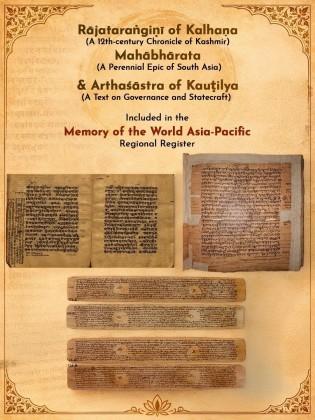
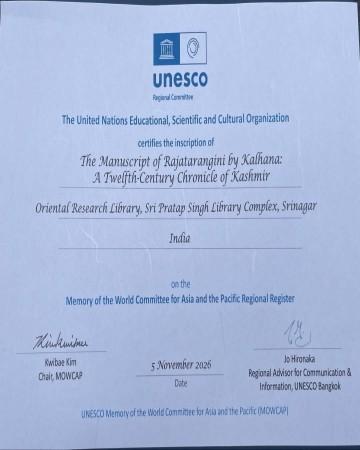
Manuscripts of Kalhana’s 12th-century historical chronicle Rajatarangini have been inscribed on UNESCO’s Memory of the World Asia-Pacific Regional Register, bringing international recognition to one of Kashmir’s most significant historical works.
The manuscripts of the epic Mahabharata and Kautilya’s Arthashastra, a treatise on governance and statecraft, have also been included in the register.
Proud moment for Jammu Kashmir & the nation! Kalhaṇa's Rajatarangini, Mahabharata & Arthasastra have been inscribed in @UNESCO's Memory of the World Asia-Pacific Regional Register. The inclusion of Rajatarangini celebrates UT's rich intellectual heritage.
— Office of LG J&K (@OfficeOfLGJandK) November 6, 2026
Rajatarangini is known as Kashmir’s historical and intellectual heritage.
“Proud moment for Jammu & Kashmir & the nation! Kalhana’s Rajatarangini, Mahabharata & Arthasastra have been inscribed in UNESCO’s Memory of the World Asia-Pacific Regional Register. The inclusion of Rajatarangini celebrates UT’s rich intellectual heritage. This global recognition reaffirms the timeless value of India’s civilisational traditions and their contribution to humanity, reminding us of our collective responsibility to preserve and promote this invaluable wisdom for future generations, the office of the Jammu and Kashmir Lieutenant Governor Manoj Sinha posted on official social media handle.
Rajatarangini and the Mahabharata have direct links to Kashmir’s rich knowledge tradition, Sharada script, and manuscript heritage.
The knowledge contained in the scriptures did not remain confined to them; it reached the people through proverbs and folk tales.
A rare manuscript of Rajatarangini, written by Kalhana in the 12th century, is preserved in the Oriental Research Library in Srinagar. A nearly 400-year-old birch bark manuscript of the Mahabharata was also recovered from Kashmir. This achievement highlights Kashmir not only for its natural beauty and tourism but also as an important centre of India’s ancient writing and knowledge tradition.
Rajatarangini is a document of Kashmir’s history.
Kalhana’s Rajatarangini is considered one of the important works of history writing in Indian literature. Written in Sanskrit in the 12th century, this text provides a systematic account of Kashmir’s kings, dynasties, political developments, and socio-cultural life. Kalhana not only described the kings’ achievements but also attempted to present historical accounts.
Mahabharata manuscript also has a connection to Kashmir.
Another important Kashmiri connection is a rare manuscript of the Mahabharata. This approximately 400-year-old manuscript is written in Sharada script on birch bark. It is currently preserved at the Bhandarkar Oriental Research Institute in Pune. According to UNESCO, it was discovered in Kashmir by Georg Bühler in 1875. It is considered an important evidence of the ancient Kashmiri text of the Mahabharata. Thus, Kashmir’s Sharada script and its tradition of writing on birch bark played a role in preserving an important manuscript of the Indian epic.
Sharada script has its own rich heritage.
The Sharada script has been an important script for Sanskrit writing in Kashmir and the northwestern Indian subcontinent. Manuscripts written on birch bark and old Kashmiri paper bear testimony to the region’s tradition of scholarship, literature, and the preservation of knowledge. The recognition of the Rajatarangini and Mahabharata manuscripts further underscores Kashmir’s historical role. This is a proud moment for all of Jammu and Kashmir.