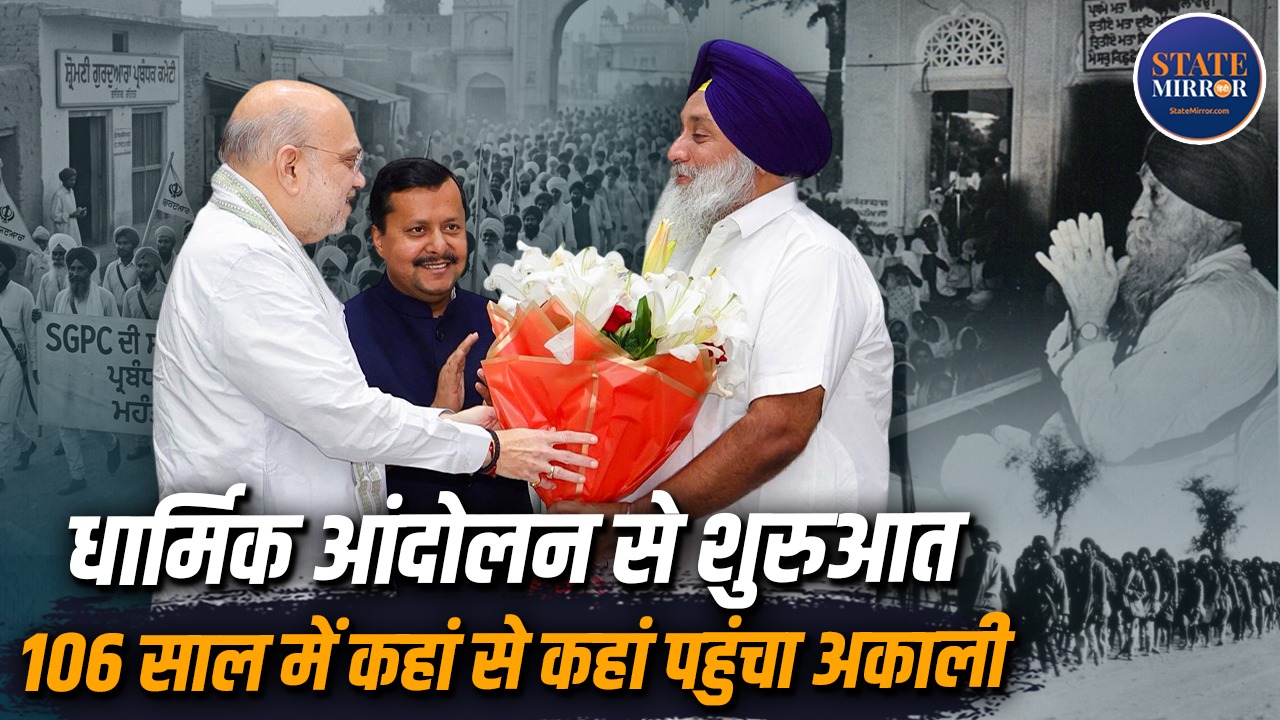
In the politics of Punjab, the name of Shiromani Akali Dal is taken not only as a political party, but also as the trumpeter of revolution against the British and a long historical movement. This 106 year old party was not started to contest elections or gain power. Its foundation was laid amidst the movement to free the Gurudwaras from the control of the Mahants and hand over the management of Sikh religious places to the community. Gradually this movement turned into a struggle against the British rule and the Akali Dal became a major force in the politics of Punjab.
Now Akali Dal is once again in the news before the 2027 Punjab Assembly elections. On 24 November 2026, Shiromani Akali Dal and Bharatiya Janata Party again announced their alliance after six years. Union Home Minister Amit Shah, BJP President Nitin Nabin and Akali Dal chief Sukhbir Singh Badal made this formal announcement at the BJP headquarters in Delhi. In 2020, Akali Dal broke its 24-year-old alliance with BJP in protest against the agricultural laws. Now with the return of both the parties, a new chapter has started in the politics of Punjab.
But what is the history of the Akali Dal with which BJP has joined hands again? Why is it counted among the oldest political parties after Congress? Why did he start the movement against the British? Understand its complete history.
Who is the main Akali leader?
Prominent leaders of Akali Dal include names like Master Tara Singh, Sant Fateh Singh, Prakash Singh Badal, Sukhbir Singh Badal, Gurcharan Singh Tohra and Harchand Singh Longowal. These leaders made important contributions in expanding the organization of Akali Dal, Sikh politics, rights of Punjab and shaping its role in power in the state.
How is Akali Dal so old?
Shiromani Akali Dal was established on 14 December 1920 in Amritsar. Indian National Congress was established in 1885. Akali Dal is counted among the oldest active regional political parties in the country. Akali Dal chief Sukhbir Singh Badal had said after re-uniting with BJP on November 24 that Akali Dal is the second largest party in the country. Our alliance will create a new Punjab.
Akali Dal was formed as a voluntary organization. Its objective was to organize the ongoing movement to free the Gurudwaras from the control of the Mahants. Earlier, Shiromani Gurdwara Parbandhak Committee (SGPC) was formed on 15 November 1920. SGPC was to take over the responsibility of managing the Gurudwaras, while Akali Dal was to give direction to the movement and mobilize volunteers.
Why is the liberation of Gurudwaras necessary?
At that time, Mahants had control over many major Gurudwaras of Punjab. He was accused of ignoring religious traditions, misusing the property of Gurudwaras and running the management in an arbitrary manner. The Sikh community wanted the management of religious places to be in the hands of its representatives.
Many Mahants had the protection of the British administration. Therefore, the movement to liberate the Gurudwaras gradually started turning into a struggle against the British rule. Akali Dal organized this movement and raised the demand to hand over the control of Gurudwaras to the community in a peaceful manner. This was the basic objective of the formation of this organization.
How did the conflict with the British increase?
The Nankana Sahib incident during the Akali movement shocked the entire Sikh community. On 20 February 1921, the Sikh group that came to take control of the Gurudwara was attacked by the supporters of Mahant Narayan Das. A large number of devotees were killed in this violent incident. This is known as Nankana Sahib massacre.
After this, the demand to free the Gurudwaras from the control of Mahants intensified. Akali agitators launched movements like Tarn Taran Morcha, Chabiyan Morcha, Guru Ka Bagh Morcha and Jaito Morcha. Thousands of people took part in these struggles. During the movement the British administration made arrests and took action against the protesters.
Why was there a struggle for the keys?
In November 1921, the British administration took possession of the keys of the treasury of the Golden Temple. In protest against this, Akali Dal started a movement to take back the keys. After continuous opposition and pressure, the government handed over the keys to SGPC on 11 January 1922. This was considered a major victory of the Akali movement.
Guru Ka Bagh Morcha started in August 1922. After this, Jaito Morcha also took the movement forward. These struggles gave Akali Dal the identity of an organized mass movement in Punjab.
What changed from the 1925 law?
The major result of the Gurdwara reform movement that continued for four to five years came to light in 1925. The British government passed the Sikh Gurdwara Act. Under this, the management of major Gurudwaras was brought under the statutory jurisdiction of SGPC. This law ensured the role of the Sikh community in the management of Gurudwaras. In this way, the movement achieved great success in achieving the objective for which Akali Dal was formed.
How did Akali Dal expand into politics?
After the Gurudwara Reform Movement, Akali Dal increased its role in the fight for religious and community issues as well as political rights. Before independence, the party raised its voice for the representation and rights of the Sikh community. Akali Dal also took part in the provincial elections of 1937. Leaders like Master Tara Singh gave the party a new identity in Sikh politics.
After independence, Akali Dal started a movement demanding the formation of a Punjabi speaking state. This was called Punjabi Suba Movement. After a long struggle, on 1 November 1966, Punjab was reorganized on linguistic basis and Haryana became a separate state. After this, Akali Dal strengthened its hold in electoral politics. Prakash Singh Badal became one of the most prominent leaders of the party and became the Chief Minister of Punjab several times.
How did the old relationship with BJP break?
The relationship between Akali Dal and BJP is also an important part of the history of Punjab politics. Akali Dal also formed governments with Jan Sangh and Janata Party. The alliance between the two parties was formed in 1996. After this, in 1997, 2007 and 2012, both of them together formed the government in Punjab. Akali Dal played the role of elder brother and BJP played the role of younger brother in the alliance.
However, in September 2020, both the parties parted ways over agricultural laws. Akali Dal left NDA in protest against the three agricultural laws of the central government. The then Union Minister Harsimrat Kaur Badal also resigned from the Union Cabinet. After this, the 24 year old alliance between the two parties broke. Later, the central government withdrew all three agricultural laws in November 2021.
Why together again in 2027?
Now after six years both the parties have come together again. The alliance was formally announced in Delhi on 24 November 2026 on the occasion of Guru Parv. Amit Shah welcomed the return of Akali Dal to NDA and called it a symbol of Hindu-Sikh brotherhood. He said that Akali Dal will play the role of elder brother in the alliance and the Chief Minister in Punjab will also be from this party. Both the parties will contest elections under the alliance on all 117 seats of Punjab Assembly. The distribution of seats will be decided later.
Amit Shah has included eliminating drugs and corruption from Punjab, welfare of farmers and development of the state among the priorities of the alliance. Whereas Sukhbir Singh Badal called it not just a political but also an emotional alliance. He said that the foundation of this alliance was laid by his father Prakash Singh Badal and Atal Bihari Vajpayee.
In this way, the journey of Akali Dal, which started for the liberation of Gurudwaras in 1920, has today reached the power politics of Punjab. The same party which fought for religious rights during the British rule is now going to contest the 2027 assembly elections with BJP. In this journey of about 106 years, Akali Dal has seen many phases of movement, struggle, power, alliance and political breakdown. Now his return with his old ally will be a new test in Punjab politics.