


After the success of the E20 program, India is now planning to blend Isobutanol in diesel. Diesel is the fuel that moves India. The logistics ecosystem depends heavily on it. Tata Motors Managing Director and CEO Girish Wagh recently confirmed that the pilot trials for Isobutanol blending will begin in the second quarter of the financial year 2027. So, should you be worried about blending Isobutanol in diesel? Short answer, no! Initially, the blend ratios are expected to stay modest. This leaves little room for concerns.
The government initially explored blending Ethanol in diesel. These experiments however, failed miserably due to the incompatibility between the two. Ethanol is a two-carbon, polar alcohol.
When mixed with diesel without adding expensive additives, it would separate inside the tank. This led to ignition inconsistencies and long-term reliability issues. These forced policymakers to abandon the ethanol-diesel blending program. Isobutanol was then chosen as an ideal alternative. It behaves more like diesel and has a comparable flashpoint as well.
Initially, Isobutanol blending will be capped at 2%. It is unlikely to increase beyond a certain level. This is, in fact, what backs our confidence in the program and keeps worries away.
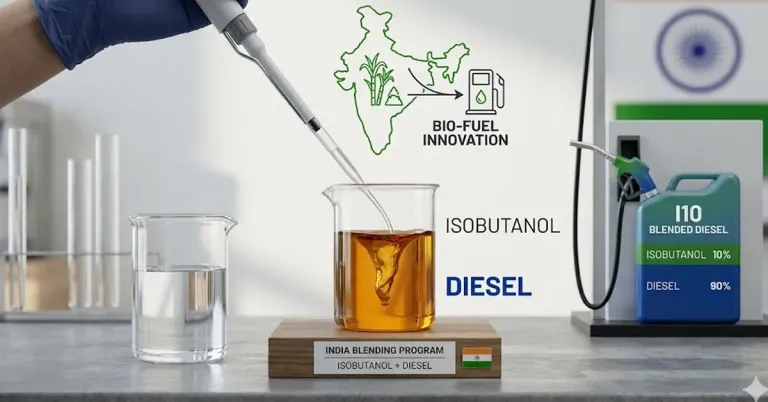
Isobutanol is a four-carbon alcohol produced from biomass, feedstock, sugarcane and other raw materials. Interestingly, Ethanol is also made from these. Isobutanol, on the other hand, is less corrosive and is more stable when mixed with diesel.
Also, it doesn’t have the hygroscopic nature of Ethanol. It has a much lower tendency to absorb water. This reduces the risk of phase separation inside the fuel tank. More importantly, it will have combustion characteristics close to diesel.
Isobutanol has a flashpoint that sits close to diesel. It will remain within the same safety classification. It will also be easy to store and transport Isobutanol.
Even if the blending levels increase to 5-10 percent, the combustion behaviour will remain almost the same as that of unblended diesel. BS6 and newer engines will be able to handle such blends without any adverse impacts. Older engines (pre-BS6) may need more caution. Even so, isobutanol is far less aggressive than ethanol.
One visible impact of Isobutanol-blended diesel (Iso-diesel) will be on fuel efficiency. Isobutanol has a notably better energy density (29.2 MJ per litre) than Ethanol (21.3 MJ per litre).
As long as the blending levels stay low, the overall impact on fuel efficiency is expected to be minimal. Mileage drops of just 1-2 percent are expected, in a 2-5% blend. Lower blend ratios will not cause engine knocking or other ignition issues either.
Another major advantage is with the infrastructure. Ethanol blending in diesel required specialised storage, additives and handling processes. Isobutanol doesn’t. It can be transported and stored using the existing distribution network. This makes it easier to scale without major investments in infrastructure.
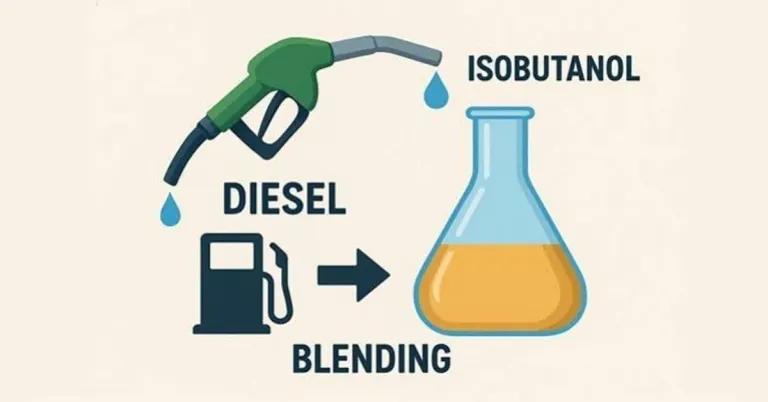
Even as the program progresses, a sharp increase in blending ratios is unlikely. Diesel is deeply integrated into India’s logistics ecosystem. Any disruption to its reliability could have widespread consequences. Therefore, the government will only adopt a cautious approach, keeping blend ratios low and gradually increasing them only if long-term data supports it.
But let’s be frank, even at 2% blending, the Isobutanol program will help clear Ethanol surplus and push distilleries into massive profits. The size of the diesel market is what makes us assume so. Data from the financial year 2026 shows that India’s diesel consumption was exactly double the size of its petrol consumption. So even 2% blending will translate to 4% net utilisation of Ethanol.

- Users may notice slight (and negligible) drops in mileage.
- Performance and reliability will remain the same as before, despite blended diesel packing less energy.
- Little to no compatibility concerns and related troubles.
If for some reason, Isobutanol blending increases sharply in the future, diesel vehicles may have to deal with severe issues. These may range from engine knocking, ignition delays, a drastic drop in fuel efficiency and power, combustion anomalies, increased unburned emissions, and component wear in legacy engines. At the current blending levels, none of these are likely. Our diesel vehicles are indeed safe!
Comments are closed.