That marked a 17% jump from the preceding quarter and was the highest since 5,640 layoffs in the last quarter of 2020, according to preliminary data released by the Ministry of Manpower late last week.
The rise in retrenchment was focused in some outward-oriented sectors like information and communications and manufacturing, and mostly driven by business restructuring, the ministry said.
Foo See Yang, managing director and strategic business group head at human resource solutions firm Persol Asia-Pacific, said these sectors are particularly vulnerable to geopolitical tensions, trade policy shifts and fluctuations in the global economy as they often depend on external demand.
“Ongoing uncertainty has prompted many businesses in these sectors to reassess their operating models, resulting in restructuring and workforce rationalisation,” he told The Straits Times.
Even so, the ministry noted that layoffs in the quarter were lower than those recorded during the 2009 Global Financial Crisis (5,980-12,760) and the Covid-19 pandemic (5,640-9,120).
It added that the city-state’s broader labor market remained resilient, with overall employment growing by 10,700 and the unemployment rate hovering at 2%.
During the quarter, Singapore’s economy expanded by 5.7% year-on-year, slower than 6.3% in the preceding three months but ahead of the government’s full-year forecast. The stronger-than-expected performance has prompted several economists to revise up their 2026 growth projections, according to Bloomberg.
|
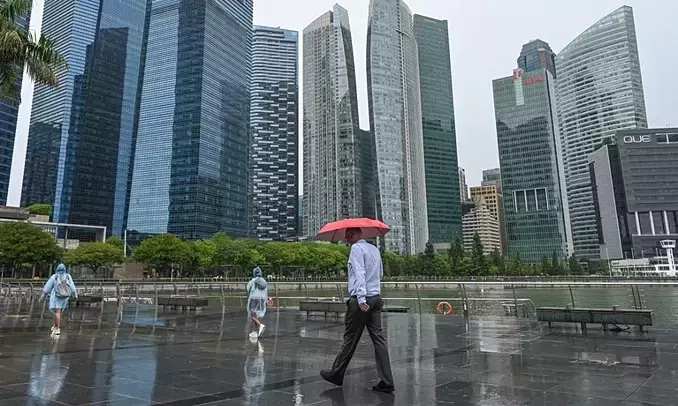
Pedestrians walk along the promenade near the financial business district in Singapore on October 14, 2024. Photo by AFP |
The ministry said labor market expectations improved in June, with 43.9% of businesses surveyed expecting to add staff in the next three months, up from 40.6% in May.
Some 29.3% of firms expected to hike wages in the same period, up from 23.7%. Meanwhile, 2.7% expected to lay off staff, down from 3.2%.
These improvements pointed to resilient labor demand, though expectations stayed below the level seen in February before the energy shock triggered by the Middle East conflict, the ministry noted.
This suggested that businesses will likely take a measured approach to hiring and wage decisions in the near term, it added.