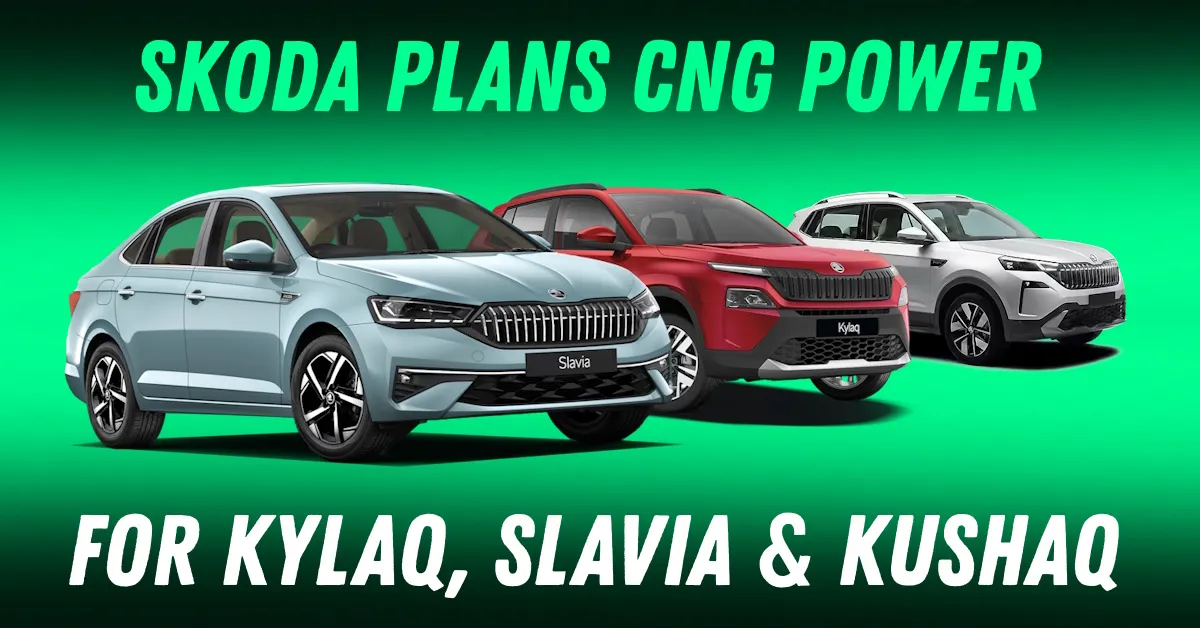
Skoda is seriously evaluating CNG versions of its 1.0-litre turbo-petrol cars, and the important part is that this may not stop with the Kylaq. Because the same 1.0 TSI engine and MQB-A0-IN architecture sit under the Kylaq, Kushaq and Slavia, all three are technically in the frame.
Nothing has been formally launched yet, and Skoda has not announced prices or a timeline. But Brand Director Ashish Gupta has confirmed that the company is working aggressively on a CNG strategy and that all three 1.0-litre models are open to it.
That could be a meaningful change for a brand that has so far relied almost entirely on turbo-petrol power in its high-volume cars.
The answer is demand. CNG is no longer a small, budget-only corner of the car market. In June 2026, CNG cars accounted for 24.3 per cent of passenger-vehicle retail sales. In April, the share was already 23 per cent.

For Skoda, that is too large a pool to ignore, especially when its most affordable car, the Kylaq, starts at Rs 7.59 lakh and competes directly with sub-4 metre SUVs that increasingly offer factory CNG options.
The Kushaq starts at Rs 10.69 lakh, while the Slavia sits roughly in the Rs 10 lakh to Rs 18 lakh band. A CNG option would therefore give Skoda a lower-running-cost alternative without having to create an entirely new engine family.
All three use the same 999cc, three-cylinder 1.0 TSI in petrol form, producing 115 PS and 178 Nm. That commonality is the reason Skoda can realistically study CNG across the range rather than for just one model.

Skoda’s problem is that its 1.0 TSI has always been sold on performance as much as efficiency. CNG engines normally lose some output compared with petrol, and Gupta has openly acknowledged that.
Skoda appears willing to accept a 10 to 15 per cent performance reduction if that is what customers will tolerate. Applied simply to the current 115 PS figure, that points to something in the region of roughly 98 to 104 PS, although Skoda has not disclosed any final CNG output and the eventual number could differ.
That still leaves an interesting possibility. Most factory-CNG cars use naturally aspirated engines. A turbo-CNG Kylaq, Kushaq or Slavia could offer stronger mid-range performance than the typical CNG car if Skoda gets the calibration right.
There are practical questions too. CNG cylinders take up luggage space, so packaging will matter particularly in the Kylaq and Slavia. Rival manufacturers have increasingly moved to twin-cylinder layouts to preserve boot usability. Skoda has not yet said what tank arrangement it is studying.

There is no official price guidance. Factory-CNG variants from mainstream rivals generally carry a noticeable premium over comparable petrol manuals, so expecting a Skoda CNG to cost more than its equivalent 1.0 TSI petrol is sensible. Putting an exact number on that premium today would be guesswork.
The most logical first candidate is the Kylaq because of its price and volume positioning, but Skoda’s own comments make clear that the Kushaq and Slavia are not excluded.
The company is trying to grow beyond its traditional urban enthusiast base. It ended last year in around 175 cities and 320 touchpoints, had reached 190 cities and 340 touchpoints by the first half of 2026, and is targeting 200 cities by year-end.
CNG could fit that expansion rather neatly. The product still has to clear the engineering hurdle, and Skoda has not committed to a launch. But if it does arrive, this could be the biggest change yet to the 1.0 TSI formula that has powered Skoda’s mainstream revival.