

80
Residents report shortages, contamination, and mounting dependence on private tankers.
South Delhi is facing a deepening water crisis this summer, with several neighbourhoods reporting irregular supply, low pressure, and episodes of contaminated water. The situation has intensified with rising temperatures and increased dependence on water tankers, exposing structural weaknesses in the city’s distribution network managed by the Delhi Jal Board (DJB).
Residents from colonies such as Green Park, Hauz Khas, Dakshinpuri, Gulmohar Park, and South Extension have reported erratic supply schedules, often receiving water only for a few hours or not at all on certain days. In several cases, complaints have also been made about discoloured or foul-smelling water, forcing households to rely on private tankers and bottled water.
“We have not received regular supply for weeks now. When water does come, the pressure is so low that it barely reaches the overhead tanks,” said Ramesh Kumar, a resident of Green Park. “We are now spending thousands every month on tanker water just to manage basic needs.”
In Hauz Khas, residents described a similar situation, with intermittent supply disrupting daily routines. “It’s not just an inconvenience anymore, it is complete uncertainty,” said Neha Sharma, a local resident. “You cannot plan your day because you don’t know when or if water will come. Even when it does, we are unsure if it is safe to use.”
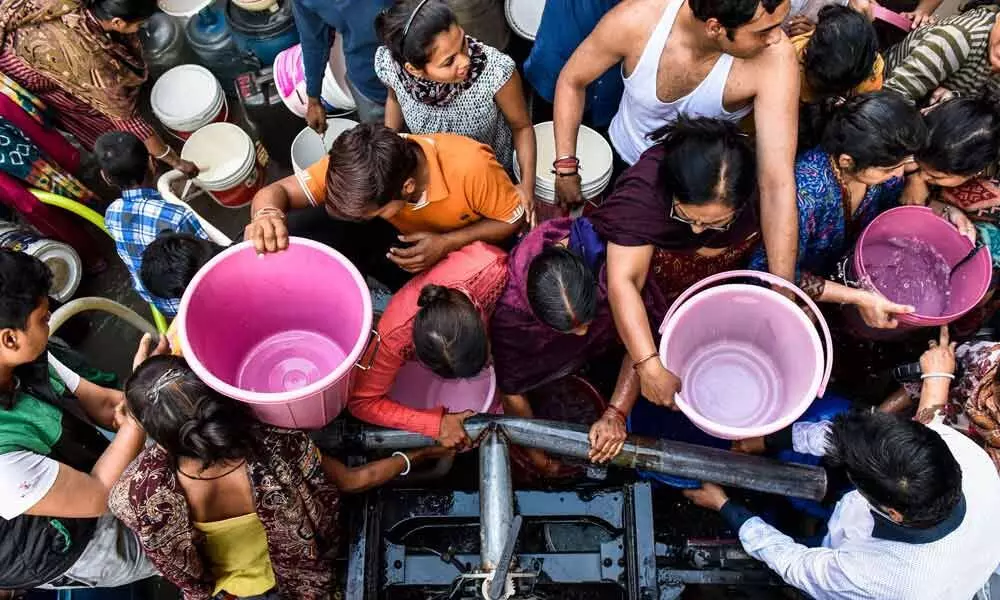
In several South Delhi colonies, households report spending between ₹1,000 and ₹3,000 per week on private water tankers during peak shortage periods. Some areas have also reported queues forming around tanker distribution points, with residents waiting for hours in extreme heat.
A resident from Gulmohar Park, requesting anonymity, said, “We are paying municipal taxes for water, but we are forced to buy water privately. Sometimes the tanker arrives once every three or four days. Until then, we ration every drop.”
Officials and water management experts point to a combination of factors behind the crisis: high summer demand, reduced raw water availability from the Yamuna system, ageing pipelines, and distribution losses in the network. Delhi’s water infrastructure, much of which is decades old, struggles to meet peak seasonal demand.
A senior DJB official, speaking on condition of anonymity, acknowledged that certain zones in South Delhi are under stress. “Demand has surged significantly due to heatwave conditions, while supply remains constrained. We are deploying additional tankers and adjusting distribution schedules to manage the situation,” the official said.
The crisis is also being compounded by leakage, illegal connections, and pressure imbalances in the pipeline system. Experts say that while Delhi produces a large volume of treated water daily, uneven distribution and outdated infrastructure lead to localised shortages.
The impact on Delhi’s broader water system is expected to be significant if the situation persists. Increased dependence on tankers is straining logistics and diverting supply from other parts of the city. Groundwater extraction is also likely to rise as residents seek alternative sources, adding pressure on already depleting aquifers.
Residents fear that if the current trend continues through peak summer months, the crisis could deepen further, affecting not only household consumption but also schools, hospitals, and small businesses dependent on steady water supply.
For now, South Delhi’s water woes reflect a broader challenge facing the capital: a growing city struggling to balance rising demand with ageing infrastructure and uneven access to one of its most essential resources

Comments are closed.