|
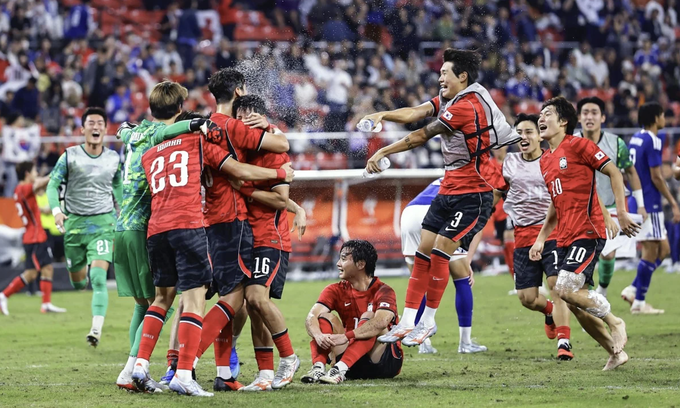
South Korea players celebrate after defeating Japan 1-0 in the men’s football final of the Asian Games at Toyota Stadium in Japan on Oct. 3, 2026. Photo by Reuters |
South Korea beat Japan 1-0 on Oct. 3 to secure a fourth consecutive men’s football gold medal at the 2026 Asian Games. It also marked South Korea’s seventh overall Asian Games men’s football gold.
The victory qualified most of the 23-man squad for the special military service exemption reserved for high-achieving athletes. However, the joy of triumph was quickly overshadowed by post-match comments regarding the military benefit.
Captain Lee Gi-hyuk revealed that he had only nine days left before his scheduled enlistment upon returning home.
“I’m not going to the military,” he said while smiling and waving his gold medal, as reported by BBC.
Midfielder Yang Min-hyuk also highlighted the military service exemption as the biggest reward, not the victory.
“Medals and trophies don’t matter. Our only reward is exemption from military service,” he said.
Newcastle academy defender Park Seung-soo posted on social media a photo of himself wearing a cap typically associated with people who have completed their mandatory military service.
The public outrage prompted the players to apologize. Upon returning to Incheon Airport on Oct. 4, Lee admitted he should have understood the weight of his words as captain, asserting he had no intention of trivializing military obligations. He apologized and said it was “a thoughtless remark and action that should not have been done as a captain and player.”
“I should have spoken with responsibility for each and every word,” he added, as quoted by Chosun.
Yang posted a clarification on social media, explaining the exemption was just one of several motivations and apologizing for his careless remark.
Park deleted his controversial photo, explaining the hat was handed to him by a fan and he wore it out of excitement after winning the goal medal. He also denied any intent to mock active-duty soldiers.
 |
|
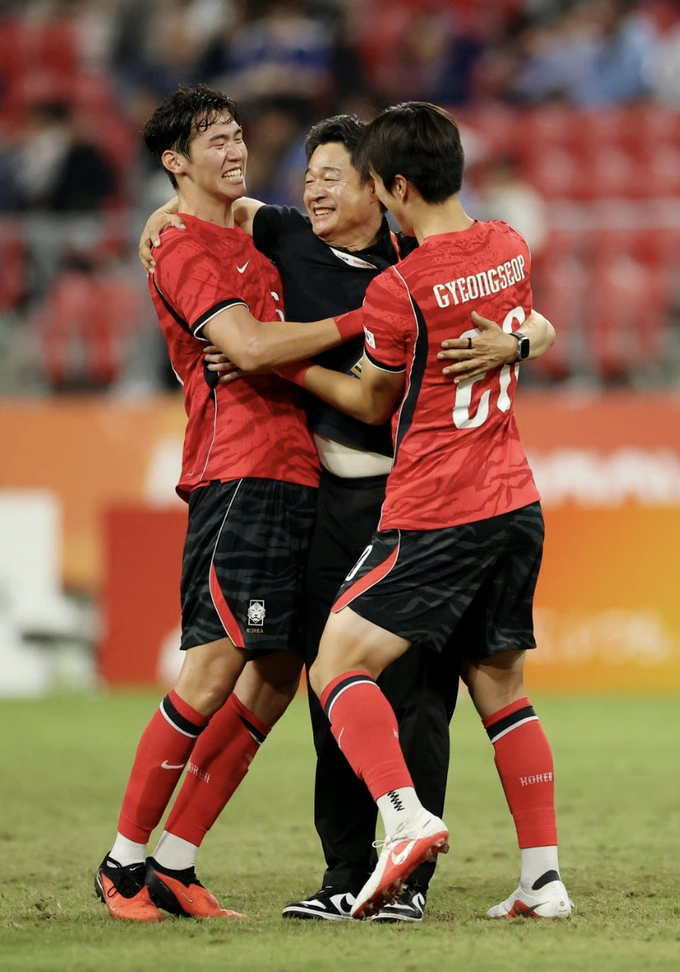
Captain Lee Gi-hyuk (L) celebrates with coach Lee Min-sung and Park Kyung-seop (R) after winning the 2026 Asian Games men’s football gold medal. Photo by Reuters |
The Korea Football Association (KFA) issued a formal apology for the careless remarks, promising to strengthen ethics and conduct education while emphasizing the responsibilities associated with the arts and sports personnel system.
Korean Sport & Olympic Committee (KSOC) president Yoo Seung-min said the remarks “do not match public sentiment,” and added that he would make further efforts in training players to maintain dignity and decorum in interviews and on social media.
The incident has put the 1973 military service exemptions and reduction system back into the spotlight. Under current regulations, Olympic medalists and Asian Games gold medalists, such as star players Son Heung-min, Kim Min-jae and Lee Kang-in, are qualified for a special form of service rather than standard military duty. This will only require the medalists to complete basic military training and a brief period of community service.
Following the remarks, lawmaker Ahn Cheol-soo asked: “Is the military a despicable place?”
“The Asian Games’ exemption from military service should now be reconsidered. It’s truly heartbreaking that a member of the national team, an athlete who fights under the flag, would have such limited awareness,” she added, as quoted by the South China Morning Post.
Lawmaker Na Kyung-won demands a fundamental overhaul to ensure fairness for South Korean youth. She cited global pop icons BTS as examples of individuals who made massive contributions to the nation’s image yet still fulfilled their military obligations.
 |
|
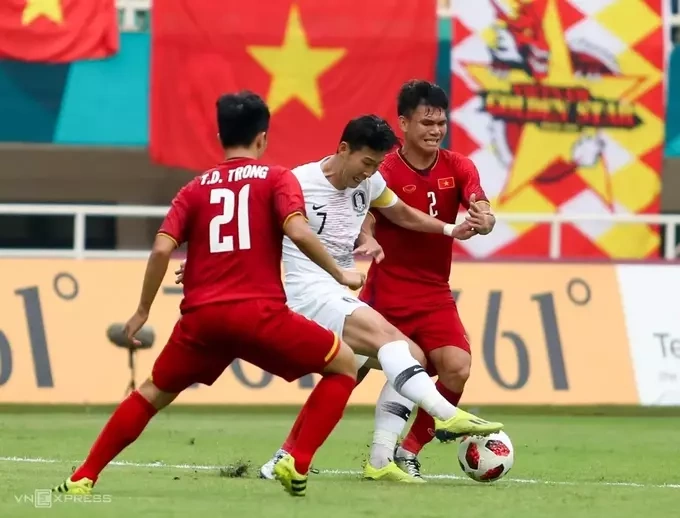
Son Heung-min (in white) during the match against Vietnam in the semifinals of the 2018 Asian Games in Indonesia. Photo by Read/Hieu Luong |
The controversy has sparked public discourse. While some defend the elite athlete system by arguing the immature behavior of a few players should not ruin it for everyone, others suggest restricting the benefit to only the best-performing individuals in a tournament rather than the entire squad.
Another fan argued that the 53-year-old policy is outdated. Noting that South Korea’s international standing is now heavily driven by cultural exports like K-pop, this person called for reconsideration of the criteria for what constitutes a valid contribution to the nation.
According to YonhapSouth Korea remains one of the few nations where athletic achievement significantly reduces mandatory military service, giving the gold medal a special meaning for male athletes pursuing professional careers abroad.