
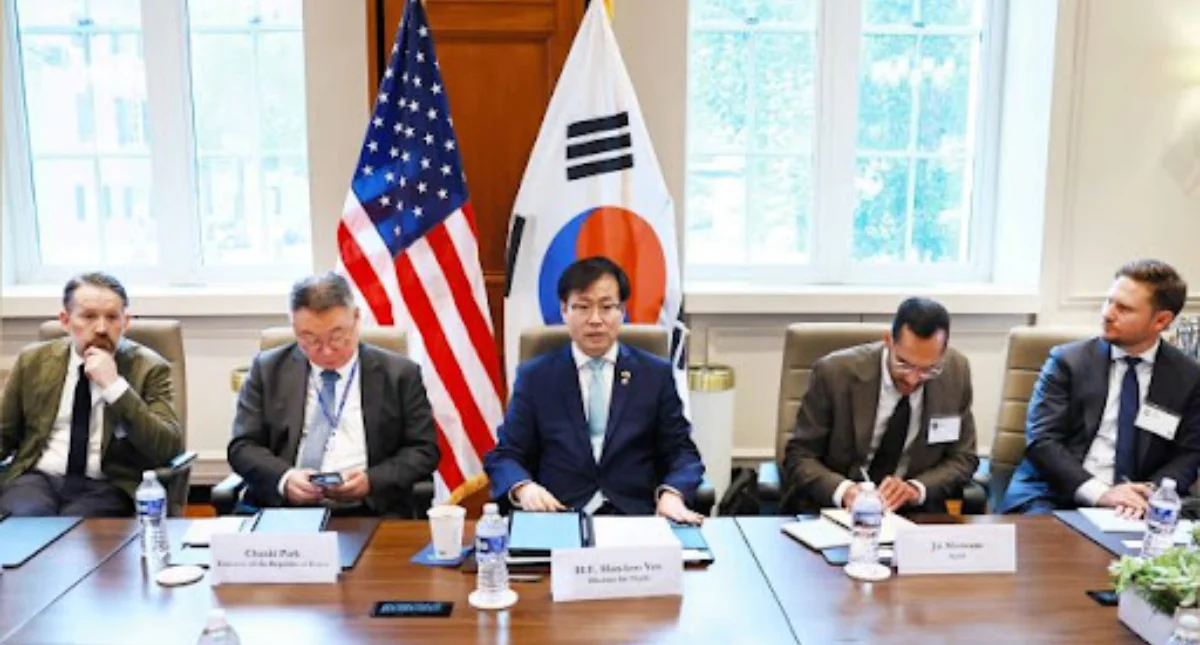

South Korea’s Finance Minister, Koo Yun-cheolwill meet with U.S. Treasury Secretary Scott Bessant this Friday, April 17, 2026, in Washington. The summit occurs at a critical juncture for Seoul’s export-driven economy, following a U.S. Supreme Court ruling that disrupted previous bilateral trade exemptions and triggered a new 15% global tariff under Section 122 of the Trade Act.
The $350 Billion “Strategic Shield.”
The primary objective for Minister Koo is to finalize the implementation of the $350 billion investment pact codified by South Korea’s National Assembly in March. Seoul is leveraging this massive commitment to neutralize threats of a further 25% tariff hike.
Sector-Specific Deals: The package includes $200 billion for U.S.-based semiconductor and AI fabrication and $150 billion dedicated to revitalizing American shipbuilding, a top priority for the Trump administration’s industrial policy.
Capital Outflow Management: To protect its own reserves amid the “Hormuz Shock,” Seoul has capped annual outflows at $20 billiona detail Minister Koo must sell as a stabilizing measure rather than a lack of commitment.
Currency Stability and “Economic Bombing”
The talks will also address the Korean won’s volatilitywhich recently hit 17-year lows. Secretary Bessent has already signaled that this weakness is inconsistent with Korea’s “strong economic fundamentals.”
Sanctions Coordination: As the U.S. moves from kinetic warfare to “economic bombing” against Iran, Koo is seeking “white-list” status for Korean banks to avoid secondary sanctions while maintaining essential energy security.
Currency Swap: Reaffirming a joint resolve to curb “excess volatility,” the ministers are expected to discuss a potential currency swap to bolster the won against regional shocks.
Why It Matters
This meeting is a vital exercise in “preventative diplomacy.” By formalizing its status as a “model ally,” South Korea aims to secure a permanent exemption from Section 301 trade probes. Success would stabilize the automotive and electronics sectors, ensuring that Seoul’s U.S. investments translate into long-term market access rather than increased protectionist pressure.

Comments are closed.