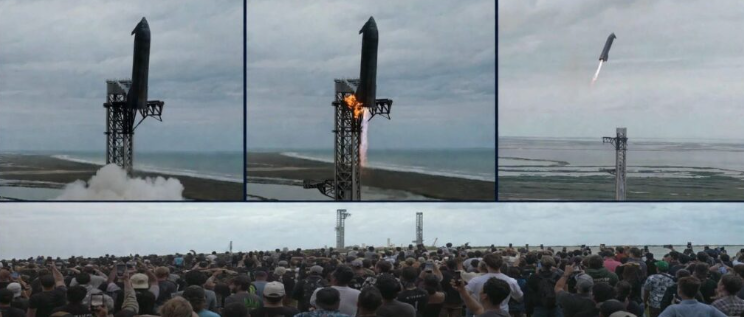
in the world of space elon musk SpaceX's company has achieved such a technological achievement, which is being considered a big change for future space missions. For the first time, the company caught its huge Starship spacecraft in the air while returning to Earth from space. For this, two giant mechanical arms installed on the launch tower were used. These arms look like chopsticks. That's why they are called 'chopstick arms'. During this historic recovery at SpaceX's Starbase launch center in Texas, the spacecraft came down from the sky, restarted its engines and slowly moved towards the launch tower. After this, giant mechanical arms held him in the air.
This achievement is also important because SpaceX's goal is to create rockets and spacecraft that can be used again and again. Till now, parts of many rockets used in space missions fall on the sea or land and it is not easy to reuse them… But if Starship can be brought back safely and ready for flight again, then the cost of space travel can be reduced and the number of launches can be increased. The company is planning to launch satellites as well as transport humans and heavy equipment to the Moon and Mars through this technology. Let us understand how this achievement was achieved and what changes it can bring to the world of space…
10 big points related to Starship's first successful mid-air recovery
- Spacecraft returning from space caught in midair: SpaceX succeeded in recovering its Starship spacecraft by catching it in the air for the first time. For this, two huge mechanical arms installed on the launch tower were used. Instead of landing on Earth, the spacecraft stopped directly between these arms. This is a major technological achievement in the direction of recovery and reuse of rockets in space missions.
- How did the 171 feet high spacecraft complete its return? Starship is about 171 feet i.e. 52 meters high spacecraft. During its return, it appeared from among the dense clouds and after restarting its engines, it slowly started descending vertically. It had to face extreme temperatures while entering the Earth's atmosphere. Despite this, the spacecraft controlled its direction and speed and was successful in reaching the launch tower.
- What are chopstick arms and how do they work? The two giant mechanical structures installed on SpaceX's launch tower are called chopstick arms. Their job is to catch the returning rocket or spacecraft. When Starship reached near the launch tower, these arms held it safely from both sides. After this, the spacecraft's engines stopped and it remained hanging in the air several hundred feet above the ground.
- Orbited Earth 14 times in 22-hour mission: This test was part of the 15th test flight of the world's largest and most powerful rocket system. During the mission of about 22 hours, Starship completed 14 orbits of the Earth. During this time, he also released 26 satellites of Elon Musk's Starlink internet network into space. These satellites were deployed at a height of about 260 kilometers from the earth.
- Spacecraft returned at a speed of 17 thousand miles per hour: After deploying the satellite, Starship started preparations for return. During this, it started the process of re-entering the Earth's atmosphere by starting one of its engines. According to the report, the speed of the spacecraft at the time of return was about 17,000 miles per hour. When entering the atmosphere at such a high speed, the spacecraft has to face extreme heat and pressure. Despite this, he reached the launch site in Texas.
- No success in recovery of Super Heavy booster: SpaceX has previously captured its Super Heavy booster three times with the help of mechanical arms, but this time the company's goal was to bring back both the Starship spacecraft and the Super Heavy booster in the same mission. The booster encountered technical problems during its return and had to land in the Gulf of Mexico instead of returning to the launch site. Because of this, the target of simultaneous recovery of both the parts could not be achieved.
- Scientists described the achievement as a major technological breakthrough: Space experts have described the successful recovery of Starship as an important achievement. According to Clayton Swope, an aerospace expert at the Center for Strategic and International Studies, this proves that the idea of completely reusing Starship may be technically possible. However, he also said that SpaceX will have to repeat this success again and again. Georgetown University expert Kathleen Curley has also called for continued successful trials.
- SpaceX is preparing to reach Moon and Mars: Elon Musk's goal is not to limit Starship to just launching satellites. The company wants to prepare different versions of it, which can be used to deliver internet satellites, data centers and heavy equipment in space. In the future, there is a plan to take humans to the Moon and Mars through this spacecraft. For this, a repeatedly used launch system will be very important, because with this the cost of the mission and the time taken in preparation can be reduced.
- Starship will also play an important role in NASA's Artemis mission: NASA is preparing to send humans to the moon again under its Artemis program. In this plan, Starship is to be used as a lunar lander i.e. a vehicle to land on the moon. NASA Administrator Jared Isaacman described this recovery as a great achievement and said that this brings the goal of reaching the moon one step closer. NASA gave a contract worth $3.2 billion to SpaceX in 2021 to develop the lunar landing system. However, many technical challenges still remain for the mission.
- Fuel transfer and heat shield big challenge before Moon-Mars mission: To take Starship to the Moon and Mars, technology for refueling from other spacecraft will have to be developed in space itself. This is called orbital refueling. Without this, it would be difficult to carry the fuel needed for long-range missions. Apart from this, the heat shield of the spacecraft is also a big challenge. Hundreds of black hexagonal tiles provide protection from the heat generated during entry into the atmosphere, but they have not yet been made completely reusable without repair. SpaceX is working on improving these tiles.
Elon Musk aims to launch every hour
Elon Musk wants to make space travel more affordable and regular through Starship. Their goal is to develop the capability to launch one Starship every hour in the future. For this, the company has also increased its manufacturing capacity in Starbase, Texas. According to the report, the capability to produce one spacecraft every two weeks and one booster every four weeks has been achieved here. SpaceX has spent more than $15 billion on the development of Starship. However, challenges like orbital refueling, heat shield and booster recovery remain to be solved. In such a situation, the first successful mid-air recovery is definitely a big start, but to send regular missions to the Moon and Mars, the company will have to conduct many more successful tests.