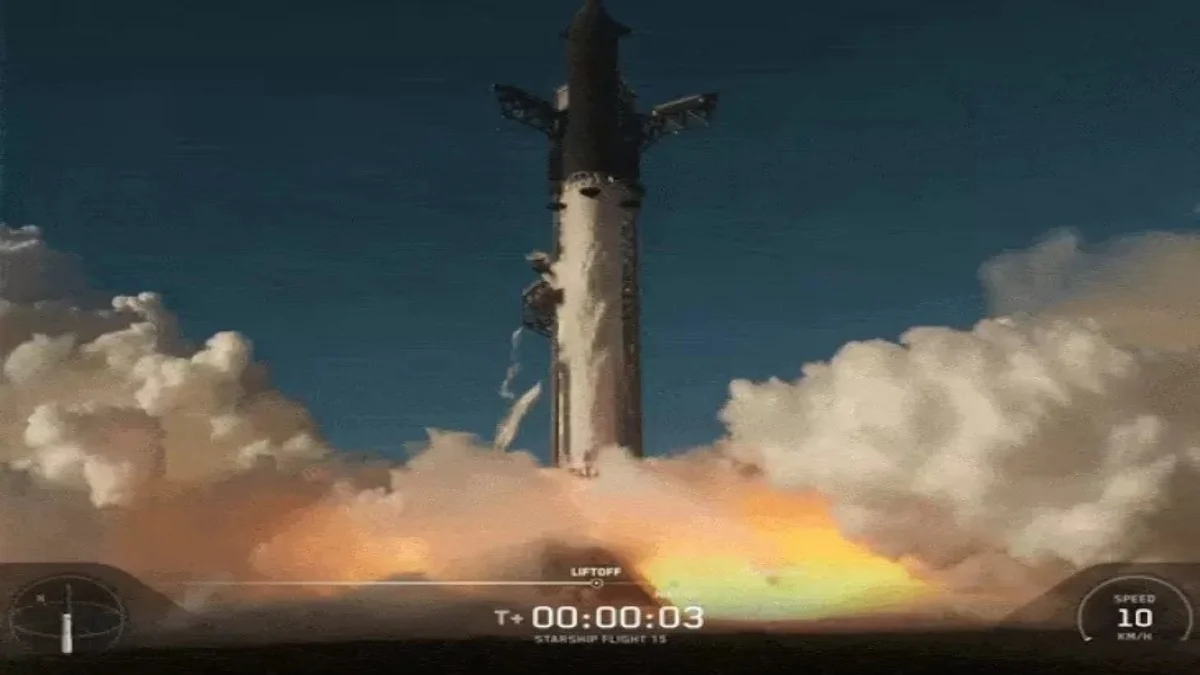
Technology Desk – SpaceX Starship 15th Test: Elon Musk's space company SpaceX launched the 15th test flight of the world's most powerful rocket Starship on November 14. The flight was taken off at 4:15 am Indian time from Starbase in Texas, USA. In this mission, for the first time, the plan was to return both parts of the rocket – Super Heavy Booster and Starship – to the launch tower and hold them with mechanical arms.
However, the attempt to land the lower part of the rocket i.e. Super Heavy Booster back on the launch tower 'Mekazilla' failed. SpaceX has managed to capture the booster this way three times before. Now the mission is eyeing the return of the upper part i.e. Starship spacecraft.
26 satellites deployed in space, now waiting for return
Starship has reached space and deployed 26 satellites. The team will monitor its system for the next 21 hours. After this, the spacecraft is scheduled to return on November 15 at 2:47 am.
During this time an attempt will be made to catch it. If it is successful, for the first time in history the upper part of the starship will be captured by mechanical arms.
At present, according to the company, all the systems are working fine. If needed, there is also an option to de-orbit the spacecraft before the scheduled time.
The entire vehicle including the starship and the super heavy booster is called 'Starship'. Its total height is 403 feet.
How have the 14 tests of Starship been so far?
The first test flight of Starship took place on 20 April 2023. About four minutes after launching, the rocket exploded at an altitude of 30 kilometers near the Gulf of Mexico. Despite this, SpaceX considered the flight of the rocket from the launch pad as an important achievement.
In the second test on 18 November 2023, separation of the Super Heavy Booster and Starship was successful. For this, hot staging technology was used for the first time. However, the booster later exploded at an altitude of 90 kilometers and the Starship also had to be destroyed after a malfunction at 148 kilometers above.
The Starship reached orbit in the third test held on March 14, 2024. She completed tests such as opening and closing payload doors and transferring liquid oxygen between the rocket's tanks. However, contact was lost during its return to Earth's atmosphere.
On June 6, 2024, in the fourth test, Starship reached space and then landed in the sea. In this flight, the company tested the capability of the spacecraft during re-entry into the Earth's atmosphere. After this, for the first time in the fifth test on 13 October 2024, the Super Heavy Booster was brought back to the launch tower and caught from the Mechajila. Starship made a controlled landing in the Indian Ocean.
Booster's return successful in 2025, but spacecraft faced problems
The sixth test on 20 November 2024 was planned to hold the booster on the launch pad, but due to all the parameters not being right, it was landed in water. The then newly elected President of America Donald Trump also reached Starbase to watch this test.
In the seventh test on 17 January 2025, the booster returned to the launch pad, but the starship exploded due to an oxygen leak. Booster return in the eighth test on 7 March 2025 was also successful, but four of the six engines in the upper section shut down. After this the automated system destroyed the spacecraft. The debris affected flights at airports in Miami, Orlando, Palm Beach and Fort Lauderdale.
On May 28, 2025, about 30 minutes after launch in the ninth test, Starship lost control and was destroyed during re-entry into the atmosphere. However, the booster made a hard landing in the Gulf of Mexico.
On 27 August 2025, eight Starlink simulator satellites were launched into space for the first time in the tenth test. All the major objectives of the mission were accomplished and controlled water landing of Starship was made in the Indian Ocean. Eight dummy satellites were also launched in the 11th test on 14 October 2025. During this, the booster made a water landing in the Gulf of America and the Starship made a water landing in the Indian Ocean.
V3 rocket and achievement of reaching orbit
The new and larger V3 version of the Starship was used for the first time in the 12th test. Despite engine failure during flight, the spacecraft landed safely in the Indian Ocean after about an hour.
In the 13th test held on 25 July 2026, the Starship landed safely on water for the first time and was then seen floating in the sea. On September 28, Starship reached Earth's orbit for the first time in the 14th test. It also deployed 26 Starlink V3 satellites. However, the mission was aborted sooner than initially planned and landed in the Pacific Ocean around the third hour.
Now in the 15th test, the biggest challenge before SpaceX is to hold back the upper part of the starship. The attempt to capture the booster was not successful this time, but if the spacecraft's return is successful, it will be an important step towards completely reusing the rocket.