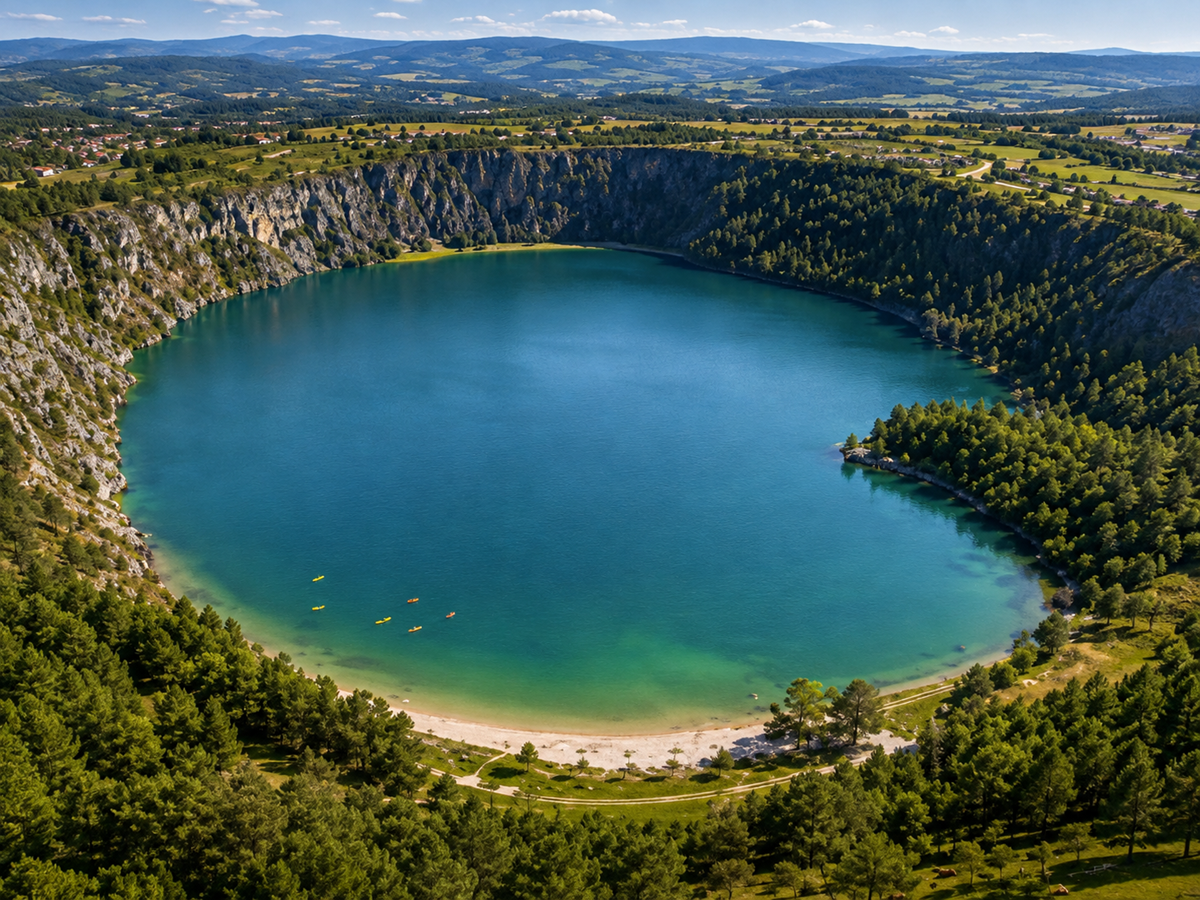
Imagine a hole nearly as deep as the Eiffel Tower is tall and spread across an area equal to around 1,600 American football fields. That was the scale of the As Pontes coal mine in Galicia, northwest Spain.
For nearly 60 years, the mine was used to extract lignite, a type of brown coal. Over time, mining created a huge pit more than 300 metres deep. But the giant hole did not remain empty. After the mine was closed, engineers began an ambitious plan to fill it with water. The result was one of Spain’s largest artificial lakes.
How Spain Created The As Pontes Mine Lake
Coal mining began around As Pontes in the 1940s. A state-run company initially operated the mine. By 1972, Endesa had taken ownership of the mine and the nearby power plant.
At its peak, the power station was described as Spain’s largest coal-fired plant. Mining continued for decades. Workers eventually extracted around 260 million tonnes of lignite from the site. The mine finally closed in 2007. Stricter European Union rules on air pollution played a major role in the shutdown. Instead of leaving the enormous pit behind, a rehabilitation project was launched.
The 547-Billion-Litre Engineering Challenge
Filling such a massive mine was not a simple task. Engineers had to study the water sources, the speed at which the pit could be filled and the changes that could take place in the water.
According to the 2023 study ‘Environmental recovery of As Pontes mine pit lake’, published in Boletín Geológico y Minero, the lake eventually held around 547 billion litres of water. The filling process began in 2008 and was completed on April 18, 2012.
A separate study, ‘Hydrochemical Evolution of the filling of the Mining Lake of As Pontes (Spain),’ also examined the lake’s changing water chemistry during this period.
Why The Lake Has Two Different Water Layers
The As Pontes lake is unusual because its water does not behave like a typical lake. Research found two distinct layers separated by a zone known as a chemocline. The upper layer is relatively oxygen-rich and only mildly acidic. It resembles the conditions found in a freshwater lake.
Deep below, the conditions are very different. The lower layer contains very little oxygen and is much more acidic. Scientists believe the difference is linked to the various sources of water that filled the mine, along with changes in temperature and mineral content.
From Coal Mine To Tourist Attraction
The transformation did not stop with filling the pit. Today, the lake covers around 865 hectares. It has a sandy beach, nature trails and surrounding habitats.
The area has also received Blue Flag certification, which recognises factors such as water quality, safety and environmental management.
Meadows, scrubland, woodland and wetlands have developed around the shoreline. Wildlife, including deer, can now be found on land that was once mining waste. Visitors can also kayak and canoe on the lake.
Why As Pontes Matters For Former Coal Mines
As Pontes offers an example of what can happen when mine closures are followed by long-term environmental planning. Large mining pits exist in many parts of the world. Some have become lakes, while others remain polluted or highly acidic.
As coal mines and power plants continue to shut down, projects such as As Pontes show how damaged industrial landscapes can potentially be given a new purpose. What was once a giant mining scar is now a lake, wildlife habitat and recreational destination.
Sudeep Singh Rawat is a Copy Editor at NewsX Digital with over five years of experience in digital journalism. He covers national and international news, with a focus on politics, crime, technology, public affairs, and trending topics. Before joining NewsX Digital, he worked with Business Standard, The Sunday Guardian, and other digital media organisations. His reporting focuses on breaking news, enterprise stories, and explainers that inform readers through accurate, balanced, and context-driven journalism.
The post Spain Turned a 300-Metre-Deep Coal Mine Into A Massive Artificial Lake. Here’s How appeared first on NewsX.