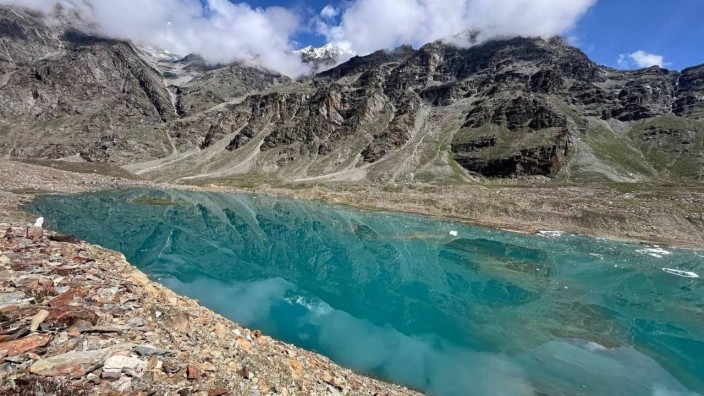
The beautiful lakes formed amidst snow and glaciers on the high peaks of the Himalayas are now becoming a challenge of possible natural disaster in the era of climate change. Rapid melting of glaciers and rise in water levels in lakes can create the risk of flash floods. In such a situation, an initiative has been taken to identify the danger in time through technology at Ghepan Lake located at an altitude of 13,450 feet in Lahaul-Spiti. Himachal Pradesh's first early warning system has been installed here.
This system has been established by the Center for Development of Advanced Computing (C-DAC). Its objective is to monitor the condition of the lake and help in timely alerting the concerned agencies if signs of potential danger are detected. This initiative is considered important towards reducing the risk arising from glacier lakes in the Himalayan region and strengthening disaster management preparedness.
Also read: Hostel girls complained, CM Sukhu announced to give Rs 2 crore
Beautiful lake but dangerous
Glacier lakes present in the Himalayan heights are naturally formed. When glaciers melt, their water starts accumulating in lakes. Due to increase in temperature and intensification of snow melting process, the amount of water in lakes may increase. In many places, debris, rocks and other natural formations deposited on the banks of these lakes act as dams to hold the water.
If such a natural barrier becomes weak and breaks, then the water accumulated in the lake can suddenly flow rapidly downwards. Big stones, rocks and debris also start flowing with the water. This phenomenon is called Glacial Lake Outburst Flood (GLOF). The impact of such floods can be serious in areas settled around mountain rivers and drains. Due to this, life can also be affected due to damage to houses, roads, bridges and other infrastructure. In hilly areas, strong flow of water and debris can engulf a large area in a short time.
What will the system do when it receives a danger signal?
The main objective of the Early Warning System installed in Ghepan Lake is to monitor the changes in the lake and help in giving timely warning in case of possible danger. Sensors and monitoring equipment used in such systems can gather information related to water level, water flow, and other measured indicators. Analysis of this data can help assess potential risks and relay information to relevant authorities.
Receiving information in time can give the administration an opportunity to assess the situation, alert sensitive areas and prepare for rescue and evacuation if needed. However, detailed description of the system's exact sensors, alert generation process, information delivery time, and technical monitoring capabilities are not available. Therefore, it is important to be clear how the warning system will work and to which agencies information about a potential threat will reach.
Also read: 30 years of wait ends in Himachal, first NCC microlight aircraft reaches Kullu
Increasing challenge in the era of climate change
Monitoring of glaciers and their associated lakes in the Himalayan region is becoming important for disaster management. Changes in temperature, melting of glaciers and rising water levels in lakes can create risky situations in many places. However, not every glacier lake has the same risk of flooding. The risk of a lake depends on its size, volume of water, the structure and stability of the natural barrier, and the surrounding topography. Therefore, the sensitivity of a lake can be determined only on the basis of scientific monitoring and risk assessment.
Establishment of early warning system in Ghepan Lake is important in this context. This will allow technology to be used to monitor the lake and can help in improving preparedness to deal with possible disasters.
Timely information will also be important for the administration
In a remote hilly district like Lahaul-Spiti, getting timely information in case of disaster is of special importance. Reaching high altitude areas, monitoring adverse weather conditions and providing relief and rescue operations in affected areas can be challenging. In such a situation, early warning can help the administration to be prepared in advance. If the information received from monitoring systems is combined with effective communication systems and disaster management plans at the local level, the ability to respond during potential threats can be improved.
However, the success of any early warning system does not depend solely on the equipment installed. Equally important is its regular maintenance, continuous monitoring of data, timely issuing of alerts, communication system and effective system of spreading warnings to the local people.
Also read: What is Samdo-Kaja Transmission Project, what will change in Himachal Pradesh?
New beginning in Himachal, monitoring system will be monitored further
According to SDM Kunika Acres, Himachal Pradesh's first early warning system has been installed to monitor Ghepan Lake. This initiative is an important step towards the use of technology to identify the potential risk of natural disasters in the high mountain areas of the state. Now its effectiveness will depend on how consistently the system works, how potential threat signals are analyzed and how fast the concerned agencies are able to take action when warnings are received.
This arrangement in Ghepan Lake raises hopes of strengthening disaster preparedness in the Himalayan region. Its most important objective is that in case of natural danger, the administration gets timely information and necessary steps can be taken to reduce the possibility of loss of life and property.