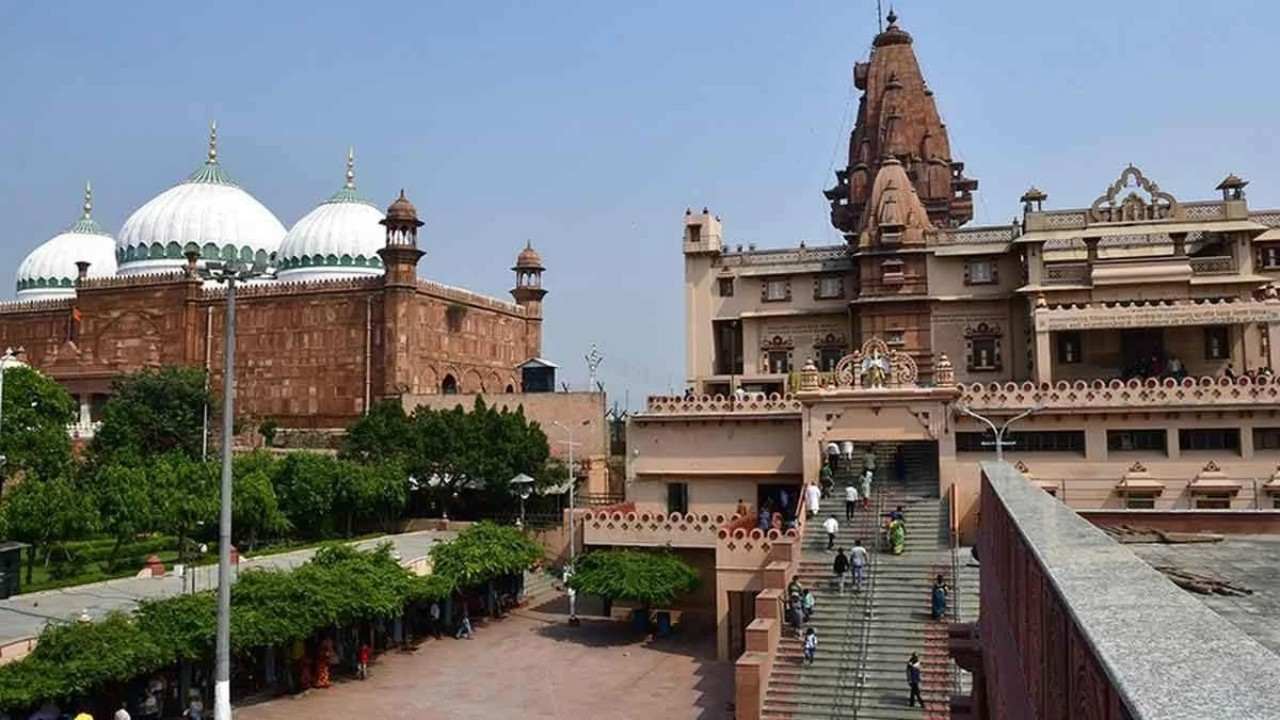
The most important link in the legal battle going on from the courts of Uttar Pradesh to the Supreme Court regarding Shri Krishna Janmabhoomi and Shahi Idgah is an agreement that is about six decades old. On the basis of this agreement signed on 12 October 1968, an agreement was reached between the two parties regarding land and construction. But today the legal validity of this document is being challenged.
To understand this matter, first of all it is important to clarify one basic fact. This agreement of 1968 was not signed by the original owner of the land, 'Shri Krishna Janmabhoomi Trust'. This agreement was signed between 'Shri Krishna Janmasthan Seva Sangh', the organization that looks after the day-to-day maintenance of the temple, and 'Trust Shahi Masjid Idgah', which looks after the management of the mosque.
Also read: Delhi Police says in SC – Reel creators cannot claim press protection
How and why was the agreement reached?
Before 1968, many civil suits were going on regarding the land, construction, possession and tenants around Shri Krishna Janmasthan and Shahi Idgah. To end these disputes, both sides chose the path of mutual consent. Devdhar Shastri was present on behalf of the Seva Sangh at this agreement signed on 12 October 1968. Whereas lawyers Shah Mir Malik and Abdul Ghaffar had participated on behalf of Shahi Masjid Idgah Trust. According to the papers, the Idgah Trust had got approval for this agreement in the meeting on 8 October 1968. Earlier, on 9 September 1968, the Uttar Pradesh Sunni Central Waqf Board had also given its permission.
The main conditions stipulated in the agreement were that the north and south walls of the Idgah would be extended up to the railway line in the eastern direction. Some Muslim families living outside these walls on the north and south sides will be removed and that land will be given to Seva Sangh. Some land of Idgah will be considered outside the jurisdiction of the service union. There will be no door, window, mesh or way to drain water in the walls of Idgah towards the temple. In 1967, Seva Sangh filed a suit (Civil Suit No. 43/1967) in the Civil Court of Mathura. This settlement was reached in the same case on 17 October 1968 and it was registered in the Sub-Registrar Office on 22 November 1968. On the basis of this, the Civil Judge of Mathura passed a compromise decree on 20 July 1973 under Order 23 Rule 3 of CPC. Court records also mention another judgment and decree dated November 7, 1974, related to the same case.
Why are questions being raised on the agreement?
The present petitioners have raised three big questions in the court regarding the validity of this agreement. The petitioners say that Jugal Kishore Birla had formed the Shri Krishna Janmabhoomi Trust in 1951 and had given 13.37 acres of land of Katra Keshav Dev to this trust. In the order of the High Court, the date of the trust deed is recorded as 9 March 1951, whereas in the arguments of the 1967 case, 21 February 1951 is mentioned. In such a situation, only the original trust deed would decide whose land it was. The service union was formed later and the two are separate legal entities.
Also read: 'India's Mir Jafar…' BJP furious over Rahul Gandhi's statements in America
The petitioners argue that the Seva Sangh was only responsible for managing the arrangements of the temple. Just as the manager of a property cannot sell the owner's land or give it to someone else, similarly the Seva Sangh had no legal right to compromise on the trust land. The temple deity is considered an independent legal entity in Indian law. The petitioners allege that neither the Janmabhoomi Trust was made a party to the 1967 lawsuit and the 1968 agreement, nor was any authorized representative included to protect the interests of Lord Krishna.
Why challenge after 58 years?
There is a heated debate going on between the two sides regarding three major laws in this matter. First is Order 23 Rule 3A of CPC which says that a fresh suit cannot be filed for setting aside a compromise decree. But on August 1, 2024, the Allahabad High Court made it clear that this ban applies to those who were parties to the old case. Since the present petitioners were not involved in the 1967 case, their cases cannot be dismissed at the initial stage. Also, this rule came into effect from February 1977 after the amendment of 1976, whereas the agreement dates back to 1968.
The second is the Limitation Act, 1963 which states that there is generally a time limit of three years for setting aside a decree. The Muslim side argues that construction took place at the site after the agreement, so the petitioners should have known about it decades ago. At the same time, the petitioners, citing Section 17 of the Limitation Act, are calling it fraud and saying that the time limit should be counted from the day of receiving the information. The High Court accepted that this question cannot be decided without evidence and testimony.
The third and most important is the Places of Worship Act, 1991, under which the Muslim side says that on August 15, 1947, the form of Shahi Idgah was that of a mosque, hence the dispute should be stopped under Section 4 of this law. On the contrary, the Hindu side says that they are challenging the ownership of the property and an illegal agreement. The court has also kept this issue open to be decided on the basis of evidence during the trial.
What is the situation at present?
On August 1, 2024, the Allahabad High Court had rejected the applications of the Shahi Idgah Committee and the Waqf Board, which sought to quash the cases of the Hindu side at the initial stage. This does not at all mean that the Court has declared the 1968 agreement illegal. The court has only said that these cases are worth hearing and the validity of the agreement will be decided on the basis of evidence in the trial.
Also read: 2000 KM journey from Jalandhar to Kashi, BJP President Nitin Naveen will flag off
After this the matter also reached the Supreme Court. According to media reports dated 13 August 2026, the Supreme Court bench had indicated that it was considering sending some cases related to Mathura back to the Allahabad High Court, as some petitioners were not given notice during the proceedings. At present, the final decision on the validity of the 1968 agreement and ownership rights of the land is yet to come.