
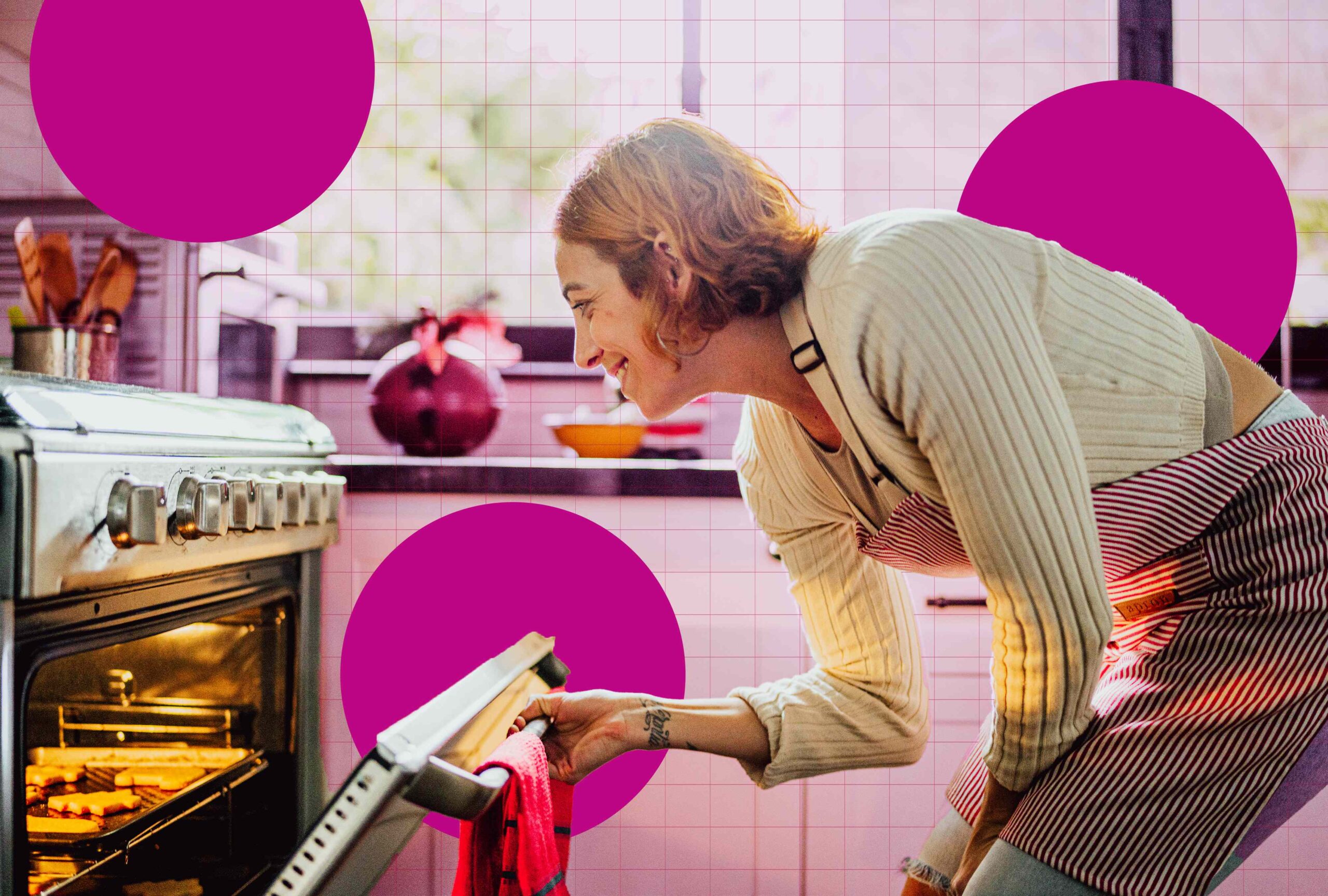

If you’ve ever ended up with suboptimal results after following a baking recipe, the reason could be one of these common habits.
Reviewed by Dietitian Casey Wing, RD, CD
Key Points
- Center your dish in the oven for even heat distribution and consistent cooking results.
- Avoid opening the oven door often to maintain a stable temperature, especially for delicate bakes.
- Use a digital thermometer to ensure accurate cooking temperatures for optimal flavor and texture.
Think you’re a maven with an oven? Even professional chefs make errors when they’re baking, braising and roasting. Sylvia Casaresthe founder of Sylvia’s Enchilada Kitchen in Houston, is also a food scientist. She tested processes and recipes at Ben’s Original for 10 years before following her passion for Tex-Mex cuisine.
And even she isn’t afraid to admit to some mistakes she’s made with her oven. “I must have been rushing around, because I set it at 500[°F] instead of 400[°F],” she says of a recent ordeal. “I guess my finger missed when I punched in the numbers. And I only found out when I started seeing smoke coming out of the oven.”
Even brand-new, high-tech ovens aren’t impervious to human error. Casares and William McBridea commercial kitchen designer and salesman for C&T Design and Equipment Co., shared their tips to avoid easily reparable issues.
Placing Your Food Incorrectly
Going back to her college days, Casares remembers haphazardly placing pans in the oven and getting uneven results. “If you’re baking something, center your dish or pan on all sides,” she instructs home cooks. “I think that’s a very common mistake, not paying attention to which rack [it’s on] or how far in or out it is.”
When the “Enchilada Queen” makes her famous chocolate tres leches cake, Casares says that she gets down at eye level to make absolutely sure that her bake is right in the middle of the oven, where temperature is most stable and heat distribution is most even.
Overloading the Oven
But what if you’re making a layer cake or cooking for a crowd? Casares says to take your time. “The most I’ve ever done is two [pans] at a time,” she says.
Why? The scientist and chef explains that as more cold or cool food items take up space in the oven, the temperature tumbles. “The cooking time isn’t going to be right,” warns Casares. And don’t forget the first error; if you fill up your oven too much, foods won’t be centered.
Not Using an Oven Thermometer
Your oven has its very own thermometer inside, so that should be enough, right? Wrong. Because there are warmer and colder areas in every oven, its thermometer only tells part of the story.
“I’ll check it to make sure it hasn’t gone off course, because in most of my recipes, I pay a lot of attention to temperature and time. That’s going to affect the flavor, texture, color, everything on it. So it is important. It’s not something that you guess at; you take it seriously,” says Casares.
She recommends “a good digital thermometer with a probe.” Casares recently used hers to roast two turkeys for a large group. “I didn’t take for granted that [the oven] was going to be accurate, and I couldn’t afford any mistakes on my turkeys,” she recalls.
Opening the Oven Too Frequently
The greatest sin you can commit with your gas or electric beauty? “Opening and closing the oven is the worst thing you can do, because the temperature will fluctuate,” Casares warns home cooks.
This is especially important when baking delicacies that rise, like fluffy cakes or soufflés. “[They] will fall. You’ll lose the air bubbles, and it messes up the process. These times and temperatures have been studied and have been determined to be optimal,” says Casares.
Forgetting That Details Matter
As an oven salesman, McBride is quick to tell customers that they may not have the right kind of oven for their particular needs. “It depends on what you’re cooking,” he says. Convection is usually your best bet at home, he believes.
But for gourmets who don’t have the space or budget of a thriving restaurant, it’s all about knowing your oven and how to work around it. For example, if your oven doesn’t have a steam feature, as McBride recommends for bakers, using a water bath to create steam when baking items like artisan bread can help create the thin, crisp crust you desire. Still, your temperatures must be correct both before and during baking.
Another example of this is cookies, says Casares. “Don’t let the dough sit out and get to room temperature. It should be chilled, because otherwise, they will set differently,” she explains. If the baking time and temperature of your recipe is for dough straight from the refrigerator, using warm dough may result in a sheet full of flat cookies.
The Bottom Line
There are plenty of myths surrounding oven usage. For example, in most cases, don’t listen to well-intentioned friends who tell you to preheat your baking sheets.
Baking expert and cookbook author Claire Saffitz has told EatingWell that time management is the most important skill to master in the kitchen. But when it comes to using your oven, finding ways to harness and control temperature at every stage of your culinary project is the most important task. The best method to ensure success every time is maintaining the correct heat settings for your dish, as well as keeping it in the oven for the proper period of time. With the correct equipment, great recipes and a sharp eye, it really is that simple.

Comments are closed.