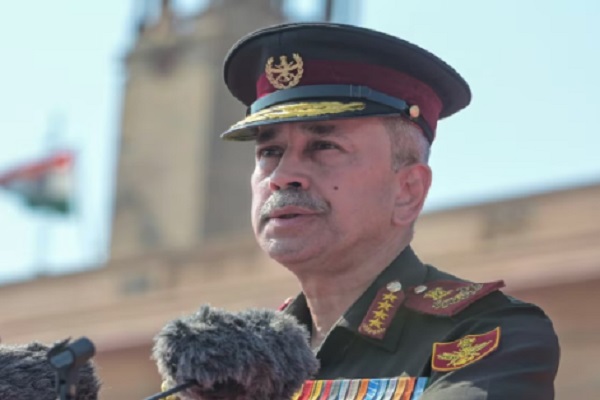
New Delhi, 16 November 2026: Chief of Defense Staff (CDS) General N. S. Raja Subramaniam has emphasized on strengthening India's indigenous space capabilities keeping future wars in mind. Citing the example of the Ukraine war, he said that excessive reliance on external satellite communication systems could seriously impact military operations. It is noteworthy that due to temporary disruption of Starlink services in Ukraine, long-range drone attack capability was significantly affected.
Addressing an event organized in Delhi, General Raja Subramaniam said that the role of space in modern warfare is continuously increasing and India will have to increase its capabilities for gathering intelligence, surveillance, communication and accurate navigation through satellites. He added that India has started 'Space Based Surveillance-3' program. Once this program is fully implemented, there will be a major increase in the country's space-based surveillance capability. However, this capability still needs to be expanded to create a reliable system for intelligence, communications and navigation.
CDSA warned that space will also become a major field of conflict in the future and opposing countries may make efforts to prevent India from using space-based facilities. Referring to the Ukraine war, he explained that Ukraine's long-range drones were rendered ineffective when Starlink services there were disrupted or their capabilities reduced. This is the reason why it is imperative for India to become completely self-reliant regarding its space capabilities. In this direction, the Indian Space Research Organization (ISRO) as well as private sector companies will have to develop strong and reliable capabilities, he added.
-
AI and drones are changing the nature of war
General Subramaniam had said that Artificial Intelligence, secret information received from satellites and drones being produced on a large scale are rapidly changing the face of modern warfare. Now the entire geographical area of any country can become a battlefield and no one is safe in it. In future conflicts, not only military bases but also industries, communication networks, energy centers and ordinary citizens could become targets.
This statement of General Raja Subramani has come at a time when discussions are going on regarding the possible entry of 'Starlink' in the Indian satellite communication market. SpaceX CEO Elon Musk has expressed concern about the disruptions in the company's business operations in India. On the other hand, the government has a clear stance that all companies are welcome in the satellite communication sector and customers will be able to choose their service provider on the basis of price, quality and services. Companies like Jio, OneWeb and Starlink have received licenses to start satellite communication services in India, however, before starting commercial services, the companies will have to follow all the prescribed security related conditions.
-
Emphasis on five main areas for future wars
CDSA highlights five important areas for India's defense preparedness and self-reliance. In which space capability, algorithm and data based warfare, indigenous defense production, modernization of old military equipment and development of skilled human resources were mentioned. He said that the role of AI will be very crucial in future wars, for which the availability of data, computing power, energy and trained people is essential.
Talking about the country's self-reliance, General Subramaniam had said that self-reliance does not only mean manufacturing or assembling ready-made defense systems, but India will also have to produce important equipment and its spare parts within the country. Referring to the success in the defense sector, he talked about 'Operation Vermillion'. He said that Operation Sindoora proved that we can fight India's war only with Indian weapons. Our indigenous air defense systems like 'Akash' had achieved great success in thwarting Pakistan's air attacks. In the end, he clarified that self-reliance does not mean living in isolation, but maintaining complete control over one's supply chain and strategic decisions.