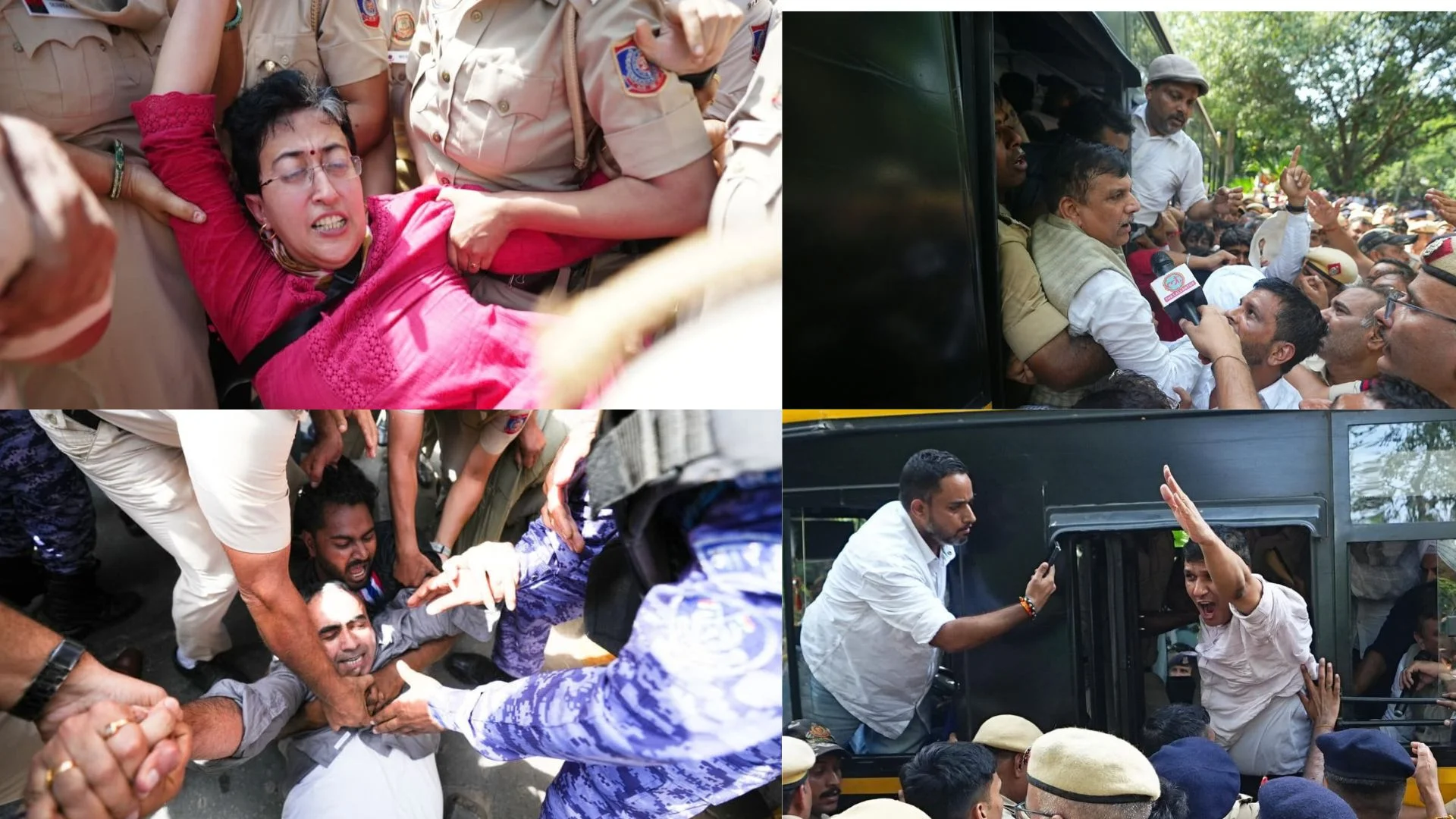
AAP Protest Delhi: On the day of Gandhi Jayanti, voices of protest against the Election Commission and Chief Election Commissioner Gyanesh Kumar were heard on the streets from Delhi to Mumbai. While Aam Aadmi Party took the lead in Delhi, Cockroach Janata Party demonstrated in Shivaji Park in Mumbai and raised the demand for the resignation of the Chief Election Commissioner. The protests, which took place amid heavy police deployment in both the cities, once again brought the controversy over SIR and voter lists to the center of the national debate.
AAP leaders protest in Delhi, many workers detained
In Delhi, many leaders including Aam Aadmi Party’s Rajya Sabha MP Sanjay Singh, national media in-charge Anurag Dhanda, former Chief Minister Atishi, Delhi State President Saurabh Bhardwaj and MLA Sanjeev Jha came out in protest. The police had made strict security arrangements in and around Jantar Mantar. More than one thousand leaders and workers were detained by the police. During this time, Sanjay Singh, Saurabh Bhardwaj, Anurag Dhanda, Atishi and Sanjeev Jha also came under the scanner of police action.
Questions raised on the functioning of the Election Commission
The pictures from Delhi raised a direct question. If questions are being raised on the functioning of the most important constitutional body that conducts elections in the country, will they be answered with facts and transparency or will barricades be placed in front of those who take to the streets with questions?
AAP has raised questions on the functioning of the Election Commission regarding the cases of SIR and deletion of names from the voter list. Party leaders linked this to citizens’ voting rights and trust in the electoral system. The Election Commission’s stand is that the purpose of voter list revision is to remove duplicate and ineligible entries. But the distrust that has arisen between the allegations of the protesters and the responses of the Commission has now moved from political rhetoric to the streets. While AAP’s protest was going on in Delhi, a few hours later CJP’s demonstration in Mumbai’s Shivaji Park further expanded the voice against the Election Commission. Despite not getting permission from the police, CJP carried out its declared ‘Jail Bharo Andolan’ and raised the demand for the resignation of Chief Election Commissioner Gyanesh Kumar. Heavy police force remained deployed in and around Shivaji Park.
Protestors reached Shivaji Park with tricolor
CJP linked the movement to the tricolor and democracy in its social media messages. The tricolor was seen in the hands of the protesters who reached Shivaji Park. The most distinct picture of the movement was the participation of common citizens and families. People along with children also reached the demonstration. During the conversation, a person told that he had come to Mumbai from Pune with his children. This picture does not allow this movement to be limited to just political slogans. It also highlights the concern that citizens are seeing regarding the electoral system and their right to vote with the future of future generations.
Demand for transparency regarding SIR and electoral process
The pictures seen on the streets of Delhi and Mumbai on the day of Gandhi Jayanti are also a challenge of accountability for the Election Commission. Allegations made against a constitutional institution do not automatically become true, but if the questions are serious, it becomes equally important to give clear and evidence-based answers to them. The commission says its decisions have been taken unanimously, while protesters are demanding greater transparency regarding the electoral process and SIR. This is why the question is no longer just about SIR. There is also a question of public trust in the electoral system. The strength of the Election Commission in a democracy comes not only from its constitutional rights, but also from the voter’s confidence that his vote is safe and the electoral process is fair. Therefore, the strongest answer to the questions raised on the Commission may not be police barricades, but more transparency, facts and public accountability.
AAP leaders were detained in Delhi, but the voice of protest did not stop. CJP’s demonstration in Mumbai was not allowed, yet people reached Shivaji Park. The protesters carrying the tricolor amid heavy police deployment tried to convey the message that asking questions on the electoral system is not an exercise in weakening any institution, but is a democratic right to demand accountability from it.
Pressure increased due to demonstrations in Delhi and Mumbai
Friday’s protests by Aam Aadmi Party in Delhi and CJP in Mumbai have exposed the growing political and public pressure on the Election Commission. Now the challenge before the Commission is not only to refute the allegations, but to give such answers to those questions that strengthen the confidence of the voters. Because in democracy, vote is not just ink on the finger. Voting is the power of the people, and seeking answers to the questions raised on the protection of that power is also a part of democracy.