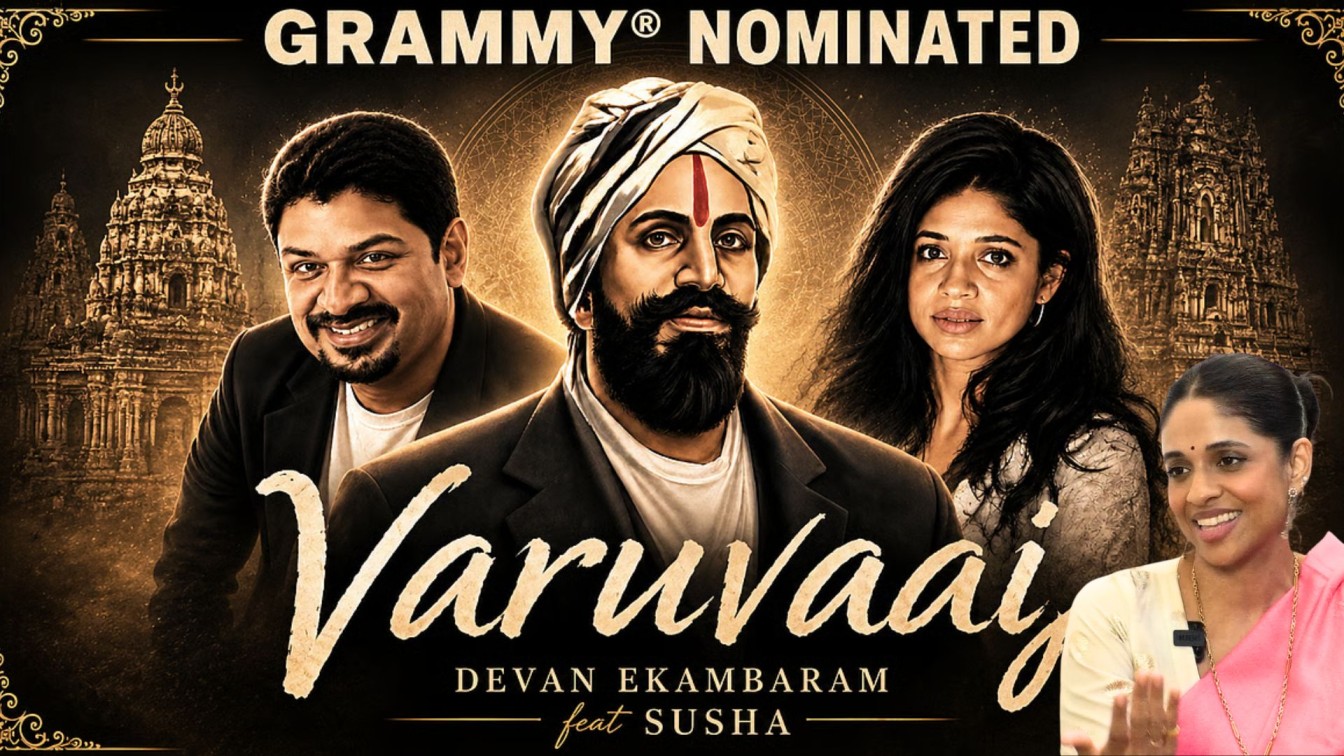
“I couldn’t have imagined that today someone from African news or Japanese news would be talking about the song—it is the best surprise of the century for me,” says singer Subiksha Rangarajan, better known as Susha. Varuvaaiy, composed by Devan Ekambaram and sung by Rangarajan, is based on a centuries-old poem by Mahakavi Subramania Bharatiyar. The song made history this week by becoming the first Tamil song to receive a Grammy nomination, earning a nod in the ‘Best Global Music Performance’ category at the 69th Grammy Awards scheduled for February 2027.
The Federal caught up with Rangarajan to find out more about the making of the track and what this global recognition means for Carnatic and Tamil music.
Excerpts from the interview.
How did your collaboration with composer Devan Ekambaram come about and why select an old poem like Varuvaaiy?
I have known Devan for about 20 years now. We met on the sets of a talk show that was quite famous at the time, Koffee with Anu. I had just started singing in films and he had already had many hits. We did that interview together and afterwards he said, ‘You know, we should keep in touch. We should work on something’.
We had been discussing how we could collaborate ever since. Even then, he had this idea of working on a Bharatiyar creation, so Varuvaaiy was not a sudden whim or fancy. He had specifically been wanting to work on a Bharatiyar song and kept asking me to share songs that I liked. As a Carnatic singer, I have a vast Bharatiyar repertoire.
Of course, as these things go, you talk about it and it takes a long time to materialise. When we finally got together, he simply asked me to sing some Bharatiyar songs that I liked and Varuvaaiy was the very first song that came to my mind. It is not one of the usual, widely known pieces that everyone already sings; I felt it was a little rare. I sang it for him and he immediately said, ‘Yeah, let’s do this one’.
The process was super fun. I also inhabit a world where I constantly dabble in different musical styles—I sing jazz and world music, and I love jazz harmony and Western classical music. The experience of conversing musically with someone from a different genre is my happiest space and I love using music as a way for two different creatives to share together.
Also read: How Grammy nomination for ‘Varuvaaiy’ recalls Bharatiyar’s desperate desire to be one with Krishna
For our non-Tamil speaking audience, what is the essence of this song?
The essence of the song, I would say, is growth. As a poet, Bharatiyar uses Krishna as a vehicle—much like many Carnatic compositions use a spiritual vehicle—to make a very grounded request.
Essentially, this song is about inner growth, shunning demons, doing away with negativity and asking spirituality to grow like a seed from within oneself. I think that is the most important part.
Why does Bharathiyar’s poem remain so relevant in present times?
Bharatiyar is evergreen. He will always remain relevant, universal and deeply special to any Tamil speaker, Tamil artiste, or Tamil musician.
For a Carnatic musician, his works have a relevance beyond just the plain text; it lies in the ragam and the history of the repertoire. While Varuvaaiy has a concrete meaning in Tamil that is easy to understand, the lineage of who has sung it, the repertoire from which I learned it and the fact that it is set in ragam Desh give it enduring resonance. Emotion and what people call spirituality or bhakti—though different people have different ways of referring to it—are woven right into our ragam, keeping Carnatic music perpetually relevant.
Did you keep modern listeners’ preferences in mind while singing, or was recontextualising the track for a contemporary audience primarily Devan Ekambaram’s territory?
I would not say catering to modern preferences was my first goal. I sang it in a way that felt wholesomely representative of who I am: a modern Carnatic artiste interpreting an ancient poem. I did not make any artificial tweaks or changes to how I would naturally sing the piece.
At the same time, 50 per cent of the presentation came from how Devan approached the production—taking a quintessential Carnatic-sounding song and creating a Western arrangement, adding harmonies, and layering rich vocals. He recorded Anil Srinivasan on the piano, Naveen Samson on the guitar, along with a wonderful range of other musicians including Joe, John, Sarvajit, and Prakash Abhinav.
In fact, Devan and I had just one initial session where I sang, he played some harmonies, we jammed a bit and recorded the vocal track that day. Afterwards, Devan produced so much around it and brought in all these incredible musicians. However, I feel recontextualising does not mean altering how you sing, it means having genuine intention and presenting the art as authentically and wholesomely as possible.
For singer Subiksha Rangarajan Varuvaaiy’s Grammy nomination is the ‘best surprise of the century’. Photo: Facebook
Did you anticipate that Varuvaaiy would resonate so well with a global audience, get a Grammy?
When we made the song — or at least when I sang it — we were not thinking about who would listen to it or what would appeal to them. For us, it was simply, ‘I genuinely love this song; what can you and I create together?’
The fact that we created it with genuine love and passion is what seems to be reaching people across the globe. I could never have imagined that today someone from African news or Japanese news would be talking about this song. It feels like the curveball of a century — truly the best surprise of the century for me.
Even the Grammy nomination, it’s been the wildest surprise. Devan told me he was going to submit it and give it a shot, and I told him, ‘You have all my support; I would love to see it go there’.
He was releasing and pursuing this right around the same time I was releasing my first original indie album, Love Language, which blends jazz, Indian, Tamil, and English influences. I was quite overwhelmed at the time and told him, ‘I am working on my album right now; give me a little time before we shoot a music video or do more around this’. That was only a couple of months ago, and suddenly all of this happened.
Beyond the Grammy nomination, does this song hold any special personal meaning for you?
There is a very sweet little story behind how I learned this song. My mother reminded me recently about my grandmother—my music gurus were my mother, Lakshmi Rangarajan, and my paati (grandmother), Saraswati, who started teaching me music when I was five years old.
The only thing my paati ever cared about was music. She would constantly write down songs, rewrite lyrics, flip through her music notebooks and hunt for pieces for my mother and me to learn. Back then, there was no YouTube or social media. She happened to hear Varuvaaiy on the radio or at a concert—I believe sung by Nithyasree Mahadevan—and fell in love with it.
She told my mother, “Nithyasree sang a song called Varuvaai; I would like you to learn it, as it is an unusually beautiful composition.” Without social media, tracking down the source was difficult, so my mother searched around, eventually found an audio cassette tape somewhere, and learned it. The moment she learned it, she felt she had to teach it to me. That lineage of women in my life who have been my gurus—passing music from my grandmother Saraswati to my mother Lakshmi to me—makes this song a precious snapshot of how we learned and lived music at home.
Tamil music has a rich heritage. Why do you think it took until now for a Tamil song to reach the Grammy stage?
Honestly, I have no idea why it has not happened earlier. For us Carnatic musicians—even though I am based in Chennai in South India—the repertoire we sing spans all South Indian languages and beyond, not just Tamil. We sing extensively in Tamil, Kannada, Telugu, Malayalam and Sanskrit and we also love learning Marathi abhangs, Hindi bhajans, and Gujarati songs. So I really cannot say why a particular language has not broken through there until now.
What will this nomination mean for Indian music and Tamil Nadu going forward?
Putting it on a global platform like this is wonderful. Within our own circles, there are passionate Tamil lovers—my father is one of them, constantly sourcing Tamil lyrics and poems for me to work on. Similarly, Carnatic music has a small but intensely dedicated community of musicians who devote their entire lives to rigorous practice and focused living.
Seeing this art reach beyond our immediate circles is special, though I should note this is by no means the first time it has happened. While the Grammys amplify things to an unimaginably global scale, countless musicians before me have done remarkable work taking Carnatic music and Tamil to different cultures around the world. Tamil is an ancient and gorgeous language that moves people whenever they hear it.
What are your upcoming projects and musical plans going forward?
My next project is my second album, though my timeline has been delayed slightly with everything happening right now. While my first album had a strong jazz influence with a touch of rootedness, this second album goes much deeper into my Carnatic roots while still incorporating Western harmony and jazz ideas. I have an exciting big-band sound envisioned for it, with several musicians whom I cannot wait to collaborate with.
Meanwhile, hearing what started as a small vocal track with Devan blossom into something attracting so much love and cheer from around the world is truly heartwarming.