
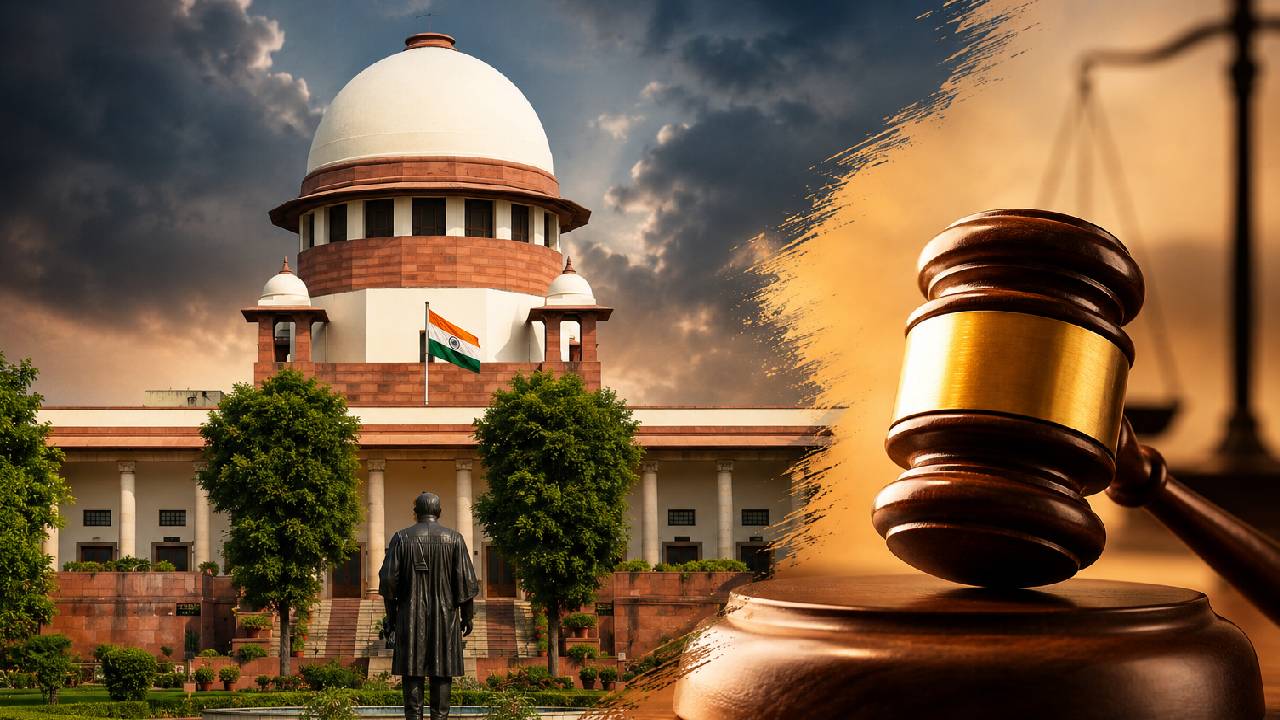

Supreme Court on 1996 Blast: The Supreme Court has canceled the death sentence and conviction of Dr. Abdul Hameed, convicted in the 1996 Samleti bus bomb blast case. The court has given this order almost 30 years after the arrest of the accused.
The court said that the accused did not receive effective legal aid and there were several serious flaws in the trial process, which affected the constitutional right to a fair trial. The Supreme Court has ordered a fresh (De Novo) trial in the case and has said that this hearing should be completed within a year.
What was the Samleti bus blast of 1996?
On 22 May 1996, a bomb exploded in a Rajasthan Roadways bus going from Agra to Bikaner near Samleti village in Rajasthan. 14 people were killed in this blast, while 39 people were injured. This attack took place a day after the Lajpat Nagar bomb blast in Delhi. 13 people lost their lives in the Lajpat Nagar blast.
What did the Supreme Court say?
A bench of Justice Vikram Nath, Justice Sanjay Karol and Justice Sandeep Mehta set aside the judgment delivered by the Rajasthan High Court in July 2019, which had upheld the death sentence of Dr. Abdul Hameed. The judgment written by Justice Sandeep Mehta said that the trial record clearly shows that effective legal aid was not provided to Dr. Abdul Hameed.
The court said that the accused himself cross-examined many prosecution witnesses and in such a serious and complex case, he was left almost alone to defend himself. The bench said, “It is the responsibility of the court to provide appropriate legal aid to the accused. The blame for the court’s failure to discharge its constitutional responsibility cannot be placed on the accused. The constitutional right to a fair trial cannot be a subject of compromise under any circumstances.”
The court also said that the objective of the criminal justice system is not only to ensure conviction but also to ensure that every conviction is fair, just and following due process.
Will there be a fresh trial?
The Supreme Court has directed the acting Chief Justice of Rajasthan High Court to hand over the case to a trial court in Jaipur for re-hearing. The court said that this court should be headed by an officer of Rajasthan Higher Judicial Service who has at least seven years of experience in hearing criminal cases. The court also directed that every possible effort should be made to complete the trial within one year from the date of handing over of the case to the trial court.
Will the accused get the help of experienced lawyers?
The Supreme Court said that before the trial begins, it should be ensured that Dr. Abdul Hameed is represented by a lawyer of his choice. If he is unable to appoint a lawyer, then the Rajasthan State Legal Services Authority should appoint a senior lawyer with at least 10 years of experience and another lawyer with seven years of experience on his behalf, so that he can get effective legal assistance during the entire trial.
The court acknowledged that almost 30 years have passed since the incident, so it may be practically difficult to produce witnesses in the court. Despite this, the Supreme Court directed the concerned police officers to provide full cooperation to the trial court and make every possible effort to ensure the presence of witnesses, so that the hearing is not delayed again.
What did the Supreme Court say on fair trial?
The Supreme Court said that the right to legal representation is not a mere formality. The bench said that the right to a fair trial is an integral part of the right to life and personal liberty under Article 21 of the Indian Constitution. The court said that this principle becomes even more important in cases where the crimes are shocking to the society.
The bench said, “Crimes like violent attacks on innocent people and explosions in public places create fear and outrage in the society. But even in such cases, courts should not compromise with constitutional values. The standard of proof or the judicial process cannot be weakened on the basis of the gravity of the crime.”
Did the co-accused also get relief?
Along with giving a chance for re-trial to Dr. Abdul Hameed, the Supreme Court also acquitted co-accused Pappu alias Salim. Pappu alias Salim was accused of providing the explosives used for the blast. He was sentenced to life imprisonment and was currently out on parole after serving more than 23 years.
The Supreme Court also rejected the appeal of the Rajasthan government, which challenged the decision of acquittal of six other accused. These accused include Javed Khan, Latif Ahmed, Mohammad Ali Bhatt, Mirza Nissa Hussain and Abdul Ghani of Jammu and Kashmir and Raees Baig of Uttar Pradesh.
When was the death penalty imposed?
In the year 2014, the trial court of Bandikui had sentenced Dr. Abdul Hameed to death and given life imprisonment to seven other accused. After this, in July 2019, Rajasthan High Court upheld the death sentence of Dr. Abdul Hameed and considered him the main accused of this conspiracy. The life imprisonment of Pappu alias Salim was also upheld, while the remaining six accused were acquitted due to lack of evidence.

Comments are closed.