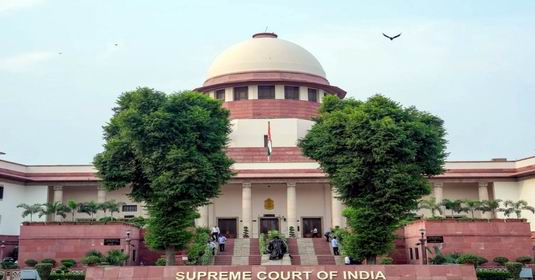
New Delhi. The Supreme Court has made important comments regarding the right to protest and the use of public places. The court said that every citizen and organization of the country has the constitutional right to demonstrate peacefully, but this does not mean that any one group should occupy a designated protest site indefinitely. There should be such a system that farmers, labourers, traders, journalists, lawyers and other organizations can also get space to raise their demands.
A bench headed by Chief Justice Surya Kant made this oral comment during the hearing of petitions related to the protests that took place in Delhi on November 3. The bench also included Justice Joymalya Bagchi and Justice V. Mohana. The court said that there should be a time limit for the use of designated protest sites, so that the rights of others are not affected if one organization remains there for a long time.
Farmers and laborers should also get a chance
During the hearing, the bench raised the question that if one organization remains sitting at a place for a long time, then where will the other groups protest? Referring to farmers, labourers, trade unions and homeless people, the court said that everyone has the right to express their views. An organization cannot assert its monopoly over a public place merely because it had started protesting there earlier.
The bench clarified that the protest site cannot be the permanent property of any one group. The administration should make such a system in which different organizations can be allowed to demonstrate for a stipulated period.
Traders raised the issue of loss
This hearing was also held on the petition of business organizations of Delhi, which demanded a ban on protests in the capital during festivals. Senior advocate Mukul Rohatgi, appearing for the traders, argued that the markets and business have been affected due to the continuous protests. He claimed that traders have suffered losses worth thousands of crores of rupees and around 50 lakh people live in the areas around Delhi alone.
The traders also demanded a ban on demonstrations for two months during festivals. On this, the Supreme Court said that the matter is not only about the profits of the shops, but also about the livelihood of those daily wage laborers and small businessmen, whose income depends on daily work.
The court indicated that it was necessary to strike a balance between the right to peaceful protest and the right to trade and livelihood.
The issue of July's demonstration also came up
In the hearing, Solicitor General Tushar Mehta, appearing for the Central Government, said that in July, the Cockroach Janata Party (CJP) was given permission for a one-day demonstration at Jantar Mantar, but the protesters allegedly remained there for 17 days. He also said that later an attempt was made to march towards Parliament without permission.
In this case, there are several petitions before the court related to the protests against Chief Election Commissioner Gyanesh Kumar in Delhi. In these, issues like police action, alleged illegal detention, internet ban, closure of metro stations and surveillance of protesters have been raised.
Notice to Center on traders' petition
The Supreme Court issued a notice to the Central Government on the petition of Grocery Committee Delhi. The court also asked the trade organizations to make the organizations organizing the protest and the concerned parties parties to the case, so that the dispute can be considered after hearing all the parties.
It is noteworthy that on October 12, Delhi Police had removed Jantar Mantar from the list of scheduled protest sites. Subsequently, Ramlila Maidan, East Delhi's CBD Ground and Burari Ground were identified as alternative protest sites.
These comments of the Supreme Court are oral comments made during the hearing. The court did not call for abolishing the right to protest at this stage, but stressed the need to strike a balance between the use of public places, business and livelihood of the common people.