
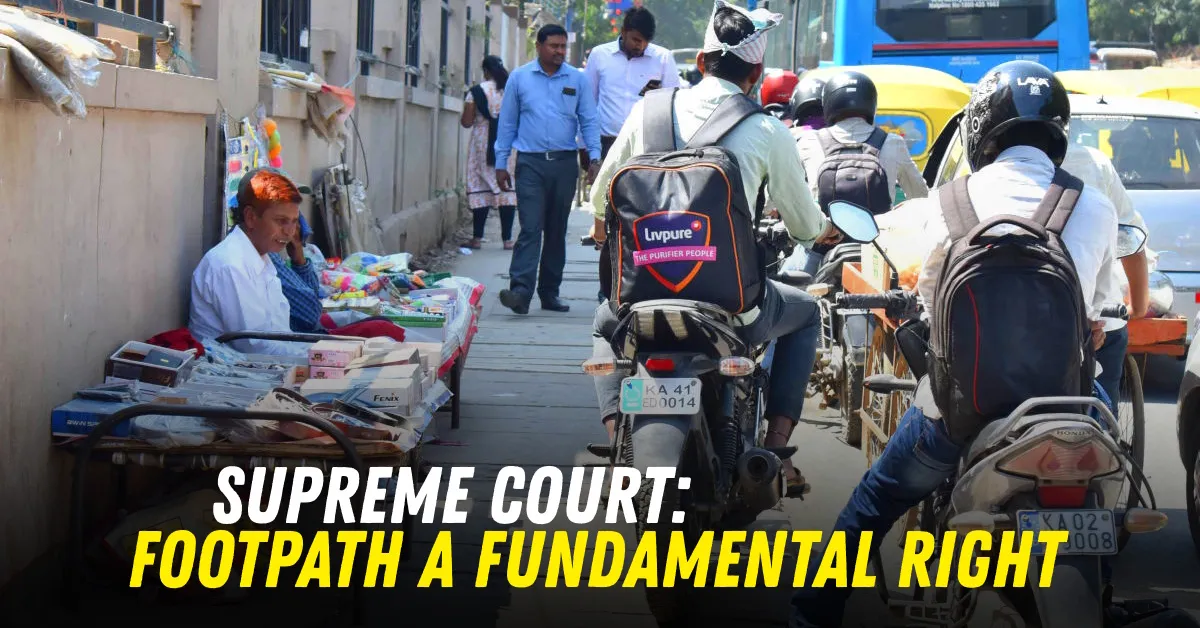

The Supreme Court on June 18, 2026 ruled that the right to walk on a demarcated footpath is a fundamental right under Article 19(1)(d) of the Constitution, which guarantees freedom of movement. The Court went further and stated explicitly that this right takes priority over the movement of motorised vehicles. It also held that the right to walk is inextricably connected to daily life and is therefore integral to the right to life under Article 21 as well.
The case, bearing Writ Petition numbers 4665-4666 of 2025, was decided by a bench that directed urban development authorities, municipal corporations, municipalities, and panchayats to demarcate, construct, maintain, and safeguard footpaths.
The Court held that if a road exists, the duty to provide a proper walkable footpath alongside it automatically follows. There is no discretion for the concerned authority to treat pedestrian infrastructure as optional.
The practical content of the judgment is significant. The Court held that violating a pedestrian’s right to use a properly demarcated footpath entitles the affected citizen to constitutional remedies, meaning they can approach a High Court or the Supreme Court directly, not just file a complaint with a municipal body.
The Court clarified that this constitutional remedy is available independently of any remedies that exist under the Motor Vehicles Act. A pedestrian who is forced onto a road because the footpath is encroached upon or non existent does not have to go through the slower process of motor vehicle law. They can invoke Article 19 or Article 21 directly.
The judgment draws on a line of precedent going back to the 1985 Olga Tellis v. Bombay Municipal Corporation ruling, which first established pedestrian rights under Article 21. The current ruling builds on that foundation and adds the Article 19(1)(d) dimension: freedom of movement now explicitly includes the freedom to walk safely on a footpath, and that freedom is primary when it conflicts with a motorist’s use of the same road space.
To understand why the Court felt the need to issue a formal constitutional ruling on something as basic as a footpath, the numbers on pedestrian safety provide context. Nearly 20 per cent of road accident fatalities in this country involve pedestrians.
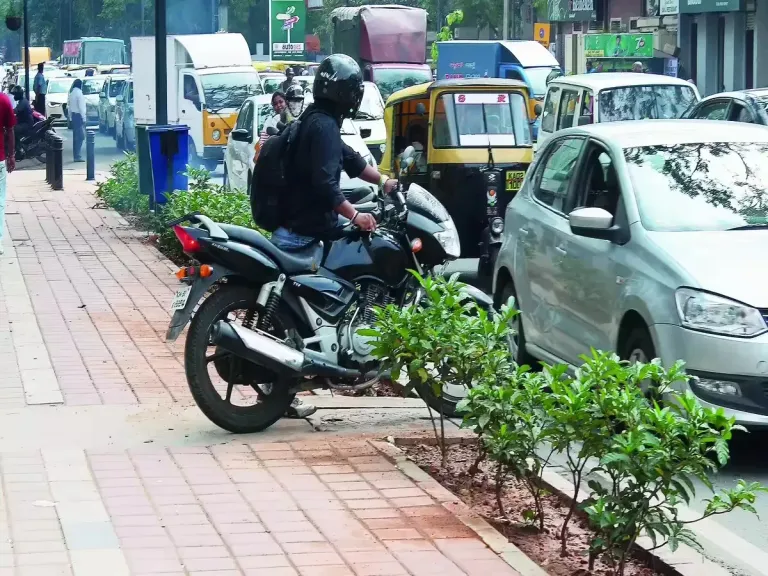
A large proportion of these deaths occur on stretches where there are no footpaths, where footpaths are broken and unusable, or where footpaths have been occupied by parked vehicles, street vendors, or permanent constructions.
A two-wheeler parked on a footpath outside a shop forces the pedestrian onto the road. A car reversing into a footpath space does the same. The Supreme Court’s ruling now classifies that displacement, whether by a vehicle or by any encroachment, as a potential constitutional violation rather than just a traffic nuisance. The person walking has a right that the motorist does not get to override.
The judgment places the compliance burden squarely on civic bodies, not on individual motorists. Municipal corporations and urban development authorities are the duty-bearers. They must demarcate footpaths where none exist, maintain those that are broken, and remove encroachments that make them unusable. The Court also asked the government to frame legislation specifically to protect the right to walk.
Whether any of this translates into actual footpath construction and maintenance depends on how aggressively affected citizens and civil society organisations use the constitutional remedy the Court has now explicitly recognised. The ruling gives them the legal basis.
Comments are closed.