
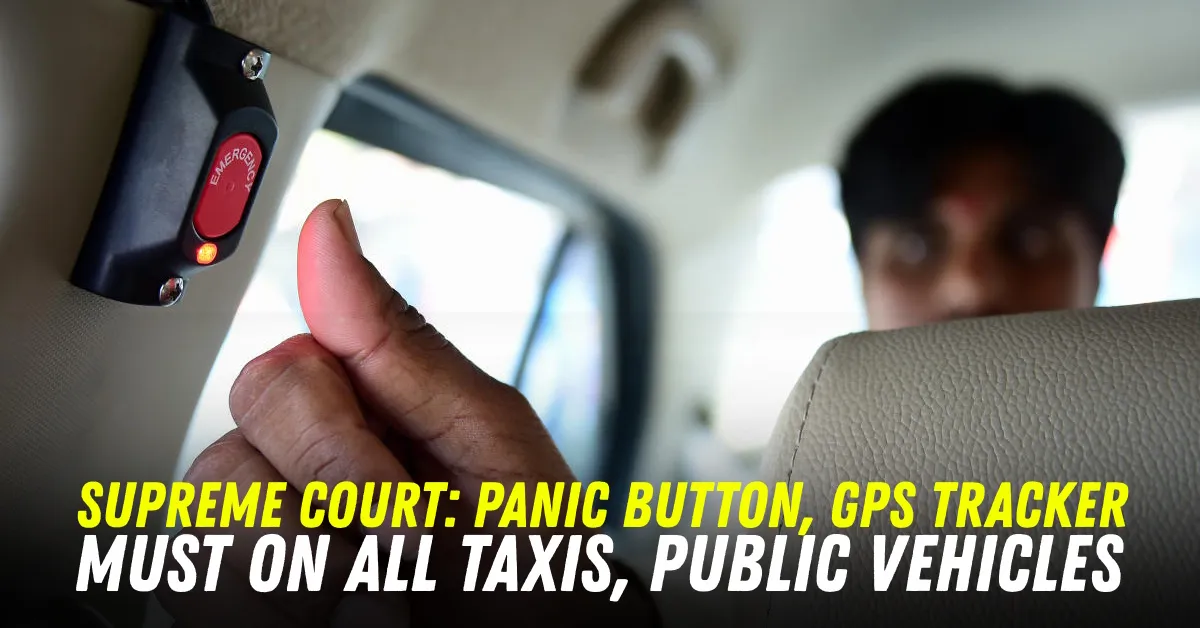

Less than 1% of public transport vehicles in the country currently carry a Vehicle Location Tracking Device. That number, cited by the Supreme Court in a recent hearing, is the backdrop to a sharp order the bench issued on May 14: all states and Union Territories must now strictly enforce Rule 125H of the Central Motor Vehicles Rules 1989, which mandates the installation of location tracking devices and panic buttons in all public service vehicles.
The order came from a bench of Justices JB Pardiwala and KV Viswanathan, in a road safety PIL originally filed by Coimbatore-based orthopaedic surgeon S Rajaseekaran in 2012.
The case has been running for over a decade, with the court periodically issuing directions on road safety compliance. This particular direction is time-bound and verifiable, meaning states cannot simply acknowledge it and move on.
The court made the compliance conditions direct and operational. No public service vehicle will be granted a fitness certificate or a transport permit unless it is fitted with a VLTD and an emergency panic button.

These installations must also be reflected in the Vahan app, the government’s central vehicle database. This last point gives the order a mechanism for enforcement, since fitness certificates and permits are renewed periodically and can be withheld at source.
The court also asked the Central government to explore requiring manufacturers to install VLTDs and panic buttons at the factory stage itself, before sale, and to submit a report after holding consultations with vehicle makers. If that direction is eventually formalised, it would shift the compliance burden upstream, making safety hardware a default feature rather than an aftermarket add-on.
This order is not the first time these requirements have been mandated. Rule 125H has existed for years. The problem has been state-level enforcement, which has been inconsistent at best and absent at worst. The 1% compliance figure speaks for itself.
Taxi aggregators like Ola and Uber already embed GPS tracking within their apps, and their vehicles are partially covered by those systems, but standalone app-independent VLTDs, which can be monitored by transport authorities outside of any platform, remain rare.
The panic button requirement is aimed specifically at passenger safety, with the court calling out women, senior citizens, and children as the groups most at risk in public transport. A properly installed panic button, linked to an emergency response system, gives passengers a direct line to law enforcement from inside the vehicle.
The court also took note of two other persistent problems: the non-existent National Road Safety Board, which it has repeatedly directed to be set up, and the failure of multiple states to report back on speed governor compliance. The absence of lane discipline in the country was separately flagged by the bench as a significant contributor to accident fatalities, with a direction to the Centre to examine it as a policy priority.
Comments are closed.