
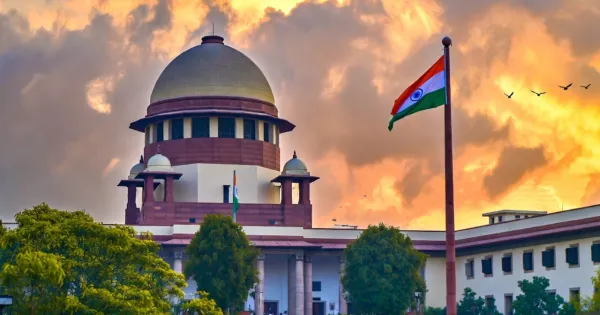
Supreme Court’s tough stance on reservation: ‘If parents are IAS, then why do children need reservation?’

New Delhi: The Supreme Court on Friday gave a new twist to the debate on reservation and asked a direct question that why should the children of families whose parents already have high jobs like IAS and permanent economic security, want reservation? While hearing on reservation and social mobility, the court said in clear words that there is a need to seriously think about the need and justification of quota for the next generations of families who have risen up in the society through education and income and have achieved economic-educational empowerment.
Both parents are IAS, so why reservation?
During the hearing, the court directly commented, “If both the parents are IAS officers, then why is reservation being sought for the child?” This comment applied to children whose families have created better opportunities for education and jobs through reservation or quota systems in the previous generation. The court emphasized that social rise comes only through educational and economic progress, hence once one has reached the top, reservation should be decided in a more sensitive manner.
Creamy layer and continuous reservation – now the question
The Supreme Court bench expressed concern over the continued extension of reservation benefits on the creamy layer of backward classes. The court said that many government orders already have provisions for excluding advanced classes from the benefits of reservation on the basis of income and position, but now such arrangements are being challenged. The court remarked that families whose parents are government officials, in well-paid jobs or have a professional background still demand the benefits of reservation, which needs to be thought through.
Justice Nagarathna’s strict opinion
Justice BV Nagarathna made a strong comment in this matter, saying that if the parents are in good jobs, are earning adequate income and the children are getting quality education, then it does not seem appropriate to implement reservation for them. “The parents of the students are in good jobs, earning good income and the children want reservation again. They should be kept out of reservation,” he said. According to him, the purpose of reservation is to promote social upward mobility of genuinely backward and lower class people, in a balanced and regular manner.
Re-analyzing eligibility for the next generation
The Court also emphasized that once a family through reservation reaches a level of education and employment where it becomes economically and socially stable, it is necessary to re-evaluate the eligibility for the next generations. The judge said, “Some balance has to be struck – socially and educationally backward, sure; but once the parents reach a point where their economic and social condition improves with the benefit of reservation, the need and justification for the quota for their children will have to be reconsidered.” The court also strongly underlined the difference between reservation for EWS (Economically Weaker Section) and socially backward classes, so that the benefits reach only those sections who are actually dependent on them for support.
improvement in reservation
This comment of the Supreme Court is being seen as an indicator for the future planning of the reservation policy. The court made it clear that reservation is a temporary measure, not a permanent privilege, and the repeated demand for “quota two” should be strictly considered when families rise on the basis of social mobility and education-income. Now after this comment, intensive dialogue and legislative re-evaluation is expected in the next few months between both the policy makers and the judiciary on the scope of reservation, creamy layer and eligibility of the next generation.

Comments are closed.