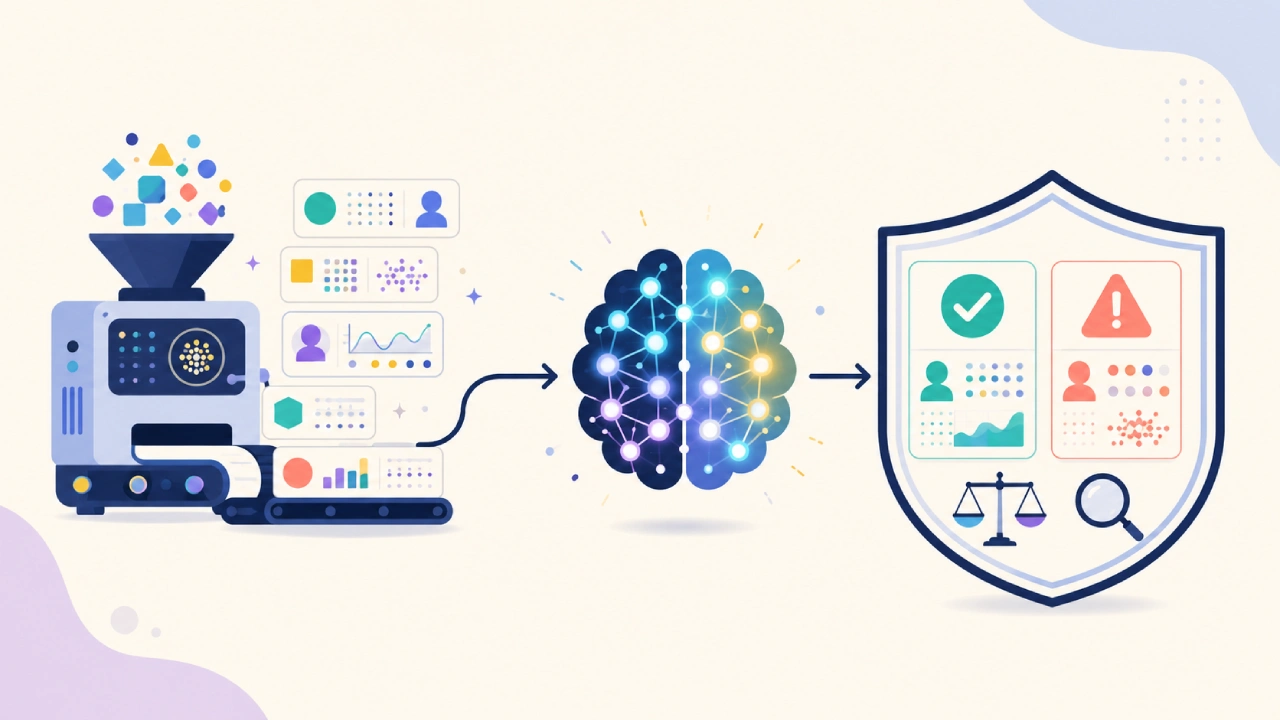
Training a machine learning model requires data that is sufficiently large, diverse, and representative of the environment in which the model will operate. However, obtaining such data is not always straightforward. Real-world datasets may be expensive to collect, difficult to label, restricted by privacy requirements, or simply unavailable in sufficient quantities.
Synthetic data offers an alternative. It consists of artificially generated information designed to reproduce useful characteristics of real-world data without necessarily representing actual individuals or events. Depending on the application, it can include generated text, images, audio, tabular records, sensor readings, or other forms of information.
The approach is gaining attention because it can address several data-access problems at once. However, the United Nations University has warned that synthetic data should not automatically be considered equivalent to real-world data, citing concerns about quality, security, bias propagation, and increasing model error.
Where Synthetic Data Can Help
One of the biggest advantages of synthetic data is its ability to expand datasets when real examples are limited. This can be particularly useful for situations involving rare events. For example, a system designed to identify unusual equipment failures may have access to only a small number of real failure cases. Synthetic examples can be generated to increase the variety of situations available during training. Synthetic data can also help with privacy-sensitive applications.
Organizations may be reluctant or legally unable to share datasets containing personal information. Well-generated synthetic datasets can help develop and test systems while reducing direct dependence on identifiable records. NIST recognizes synthetic data as one possible approach within broader data-sharing and de-identification strategies.
At the same time, it stresses that organizations should assess disclosure and re-identification risks rather than assuming that a transformed dataset is automatically safe. Another benefit is flexibility. Developers can create controlled scenarios that may be difficult to collect naturally.
In computer vision, for instance, synthetic environments can provide examples of particular objects, conditions, or edge cases. In other applications, generated records can help developers test how a system responds to unusual inputs before deployment.
The Bias Problem Behind Artificial Data
The biggest misconception about synthetic data is that artificial data is automatically neutral. Synthetic data is usually generated from patterns learned from existing information. If the original dataset is incomplete, unbalanced, or biased, those characteristics can be reflected in the generated output.
In some circumstances, the generator may even reinforce them. Consider a training dataset in which one demographic group is significantly underrepresented. Generating more examples from that same underlying distribution does not necessarily solve the representation problem. It may simply produce a larger dataset containing the same imbalance. Generated data can also introduce new distortions.
A synthetic-data system may simplify complex relationships, remove unusual cases, or produce statistically plausible examples that do not accurately reflect real-world conditions. NIST notes that bias can arise from non-representative samples and can become embedded in datasets and automated systems.

AI can then increase the speed and scale at which such biases affect people and organizations. This makes validation essential. Synthetic data should be compared with relevant real-world data wherever possible, particularly across important demographic groups, rare cases and critical conditions. Quality should be measured by intended use rather than by how realistic the generated records appear.
Privacy Does Not Mean Risk-Free
Synthetic data can reduce exposure to personal information, but it should not be treated as a universal privacy solution. The privacy strength of a synthetic dataset depends heavily on how it was generated. Some methods may unintentionally preserve patterns that make it easier to infer information about people in the original dataset. NIST notes that not all synthetic-data techniques provide formal privacy guarantees.
Differentially private synthetic data can offer stronger mathematical privacy protection, although achieving useful accuracy can be challenging. This distinction matters because organizations may otherwise assume that replacing real records with generated ones eliminates their privacy responsibilities.
A responsible approach therefore requires privacy testing alongside utility testing. Organizations need to examine whether synthetic records reveal too much about the source data, whether rare individuals or characteristics can be inferred, and whether the dataset remains appropriate for its intended level of sharing.
Building Governance Around Synthetic Data
Governance is what determines whether synthetic data becomes a useful engineering tool or another source of hidden risk.
- The first requirement is documentation. Teams should record where the source data came from, how the synthetic data was generated, which models or techniques were used, and what limitations were identified. This creates a clear chain of accountability when the dataset moves between teams or becomes part of a production system.
- Second, synthetic data needs measurable evaluation. Organizations should test both utility and risk. Utility testing asks whether the generated data preserves the characteristics needed for the model-training task. Risk testing examines privacy exposure, bias, security issues and other potential harms. The process should also include human oversight. Automated quality scores cannot always determine whether a dataset represents the real-world population fairly. Domain experts can identify gaps that statistical similarity measures may overlook.
- Finally, synthetic data should not automatically replace real-world data. In many cases, the strongest approach is a combination of real and synthetic examples, with synthetic data used strategically to fill specific gaps. The United Nations University similarly notes that synthetic data is most often used alongside real-world data rather than as a complete replacement.

Conclusion
Synthetic data can make AI development more flexible by addressing data scarcity, supporting controlled testing, and reducing some of the difficulties associated with sensitive information. But its usefulness depends on the quality of the process behind it. Artificially generated data can reproduce existing inequalities, introduce statistical distortions or create a false sense of privacy and accuracy.
As a result, organizations should judge synthetic data by more than its volume or realism. The better approach is to treat synthetic data as an engineered resource that requires evaluation and governance. Clear documentation, privacy assessment, bias testing, representative validation, and human oversight can help organizations understand where synthetic data adds genuine value. Used carefully, it can strengthen model training; used without sufficient controls, it can simply make flawed assumptions harder to see.