Speaking on Wednesday, Deputy Transport Minister Sanphet Boonyamanee described the project as a crucial step toward closing a “missing link” in Thailand’s national logistics system, in line with infrastructure policies outlined by the government, according to Bangkok Post.
He was referring to the 110-kilometer railway linking Chumphon and Ranong Port, allowing the country’s primary rail network to connect directly to its only deep-sea port, opening a new trade gateway to the Indian Ocean.
The rail link is intended to establish a seamless multimodal transportation network integrating roads, railways, ports, airports, and border crossings.
Although shorter than many of Thailand’s main rail corridors, the railway is expected to serve as a strategic land bridge. Once completed, freight from agricultural and industrial areas in the north, northeast, central, and southern regions will be able to travel directly by rail to Ranong Port, eliminating the need for road transport on the final leg of the journey, according to The Nation.
|
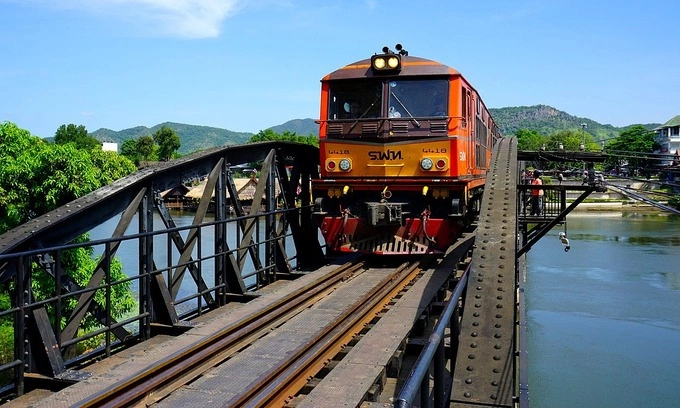
A train crossing River Kwai in western Thailand. Photo by Pixabay/foursummers |
The line will also give Thailand direct rail access to both coasts. While the existing network links to Gulf of Thailand ports, including Laem Chabang, Bangkok, and Map Ta Phut, the new route will provide direct access to the Andaman Sea and the Indian Ocean, expanding access to markets in the Middle East and Africa.
In addition to boosting international trade, officials expect the project to spur economic growth in Chumphon and Ranong by attracting private investment in warehouses, distribution centers, and logistics facilities.
Government agencies are conducting assessments of the project’s economic, environmental, and social impacts. The studies are also examining whether to expand existing facilities at Ranong Port or build a new deep-sea terminal capable of accommodating larger container vessels.
The State Railway of Thailand has completed the project’s detailed engineering design and submitted its Environmental Impact Assessment report for review. Pending environmental approval later this year, bidding for the construction contract is expected to begin in 2027.
The government formally studied the possibility of the project in 2019 but later put it on hold due to concerns of economic viability.