The third-largest Southeast Asian economy this week agreed to give U.S. pork greater access to its market as the two countries announced they had reached an Agreement on Reciprocal Trade.
In response to the trade talks, the Swine Raisers Association of Thailand has proposed buying more U.S. animal feed ingredients as an alternative to opening the Thai market further to pork imports, according to porciNews Asia, a trade publication covering the pork industry.
The association urged Thailand to give priority to agricultural goods it needs to import and avoid purchases that would compete directly with domestic producers. It identified feed corn, soybeans and soybean meal as alternatives to pork.
|
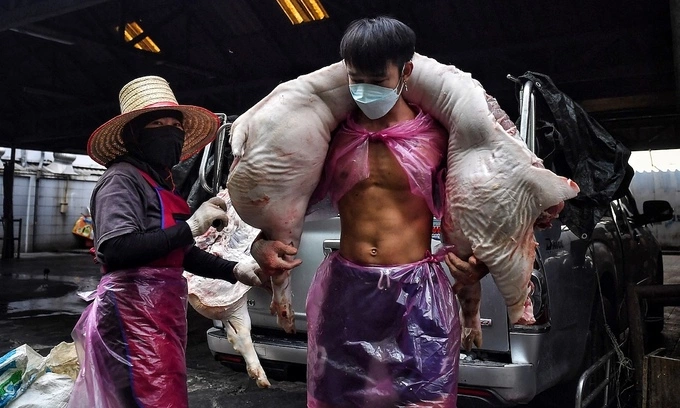
A butcher carries pig carcasses at Bangkok Noi wholesale market in Bangkok on January 14, 2022. Photo by AFP |
Thai farmers grow too little corn to meet domestic demand, the association said. Thailand also relies heavily on imported soybeans and soybean meal to produce livestock feed.
Brazil supplies more than 90% of Thailand’s soybean and soybean meal imports, according to the association. It said Thailand could shift some of those purchases to U.S. suppliers as part of its broader trade commitments.
The pork concession illustrates the trade-offs Thailand made to keep its exports competitive in the U.S., its largest overseas market.
Poonpong Naiyanapakorn, permanent secretary at Thailand’s Ministry of Commerce, said Thailand needed to retain its foothold in the U.S. market, where it competes with other regional exporters, particularly Malaysia, Indonesia and Vietnam.
If the U.S. imposed higher tariffs on Thai goods than on competing products from those countries, Thai exporters would find it harder to compete, with consequences for orders, production, investment and jobs throughout the supply chain, he said, as reported by The Nation Thailand.
Addressing concerns about opening Thailand’s agricultural market, particularly to U.S. pork, and about the use of substances that promote lean muscle growth, Poonpong said the ministry had not negotiated to allow imports that would put public health at risk. He said some details remained confidential under the terms of the negotiations.
“No one went into these talks to open the market to products that would harm Thai people’s health,” Poonpong said.
For U.S. pork producers, the new market would be relatively small. Dan Halstrom, CEO of the U.S. Meat Export Federation, estimates annual sales could reach $10-25 million. That would represent less than 1% of the value of U.S. pork exports last year.
But the impact could be considerably greater in Thailand, where domestic production meets nearly all demand and imports account for only about 1% of consumption. Thai producers fear even small shipments of cheaper U.S. pork could drive prices down further.
“That may not seem like a large amount, but what we are particularly concerned about is the ability to control the volume,” Anan Traidechapong, a pig farmer and adviser to the Swine Raisers Association of Thailand, told Bloomberg.
Thai pig farmers were losing money even before the prospect of new U.S. competition. Their combined losses totaled 36.7 billion baht (US$1.1 billion) from 2023 through 2025, according to the association.
It said losses continued this year as production outpaced consumption. Output is forecast to reach 24.3 million pigs in 2026, up from 20.3 million in 2023, with about 95% of production consumed in Thailand.
Thai pork costs about 35% more than U.S. pork, according to Kasikorn Research Center. The center estimates that increased U.S. competition could cut the value of Thailand’s pork industry by about 112 billion baht and affect roughly 149,000 farmers, more than 97% of whom are smallholders.
After years of losses, the number of Thai pig farmers fell by more than a fifth between 2021 and 2024.
The Thai Chamber of Commerce welcomed progress toward a deal that could give Thai exporters greater access to the U.S. market. Its chairman, Poj Aramwattananont, said businesses and farmers facing increased foreign competition would need government support.
But pig farmers’ immediate concern is that more pork entering the market could prolong a downturn that has already lasted years. “If this goes ahead,” Anan said, “the industry will never recover.”