By: The Obnews Editorial Team
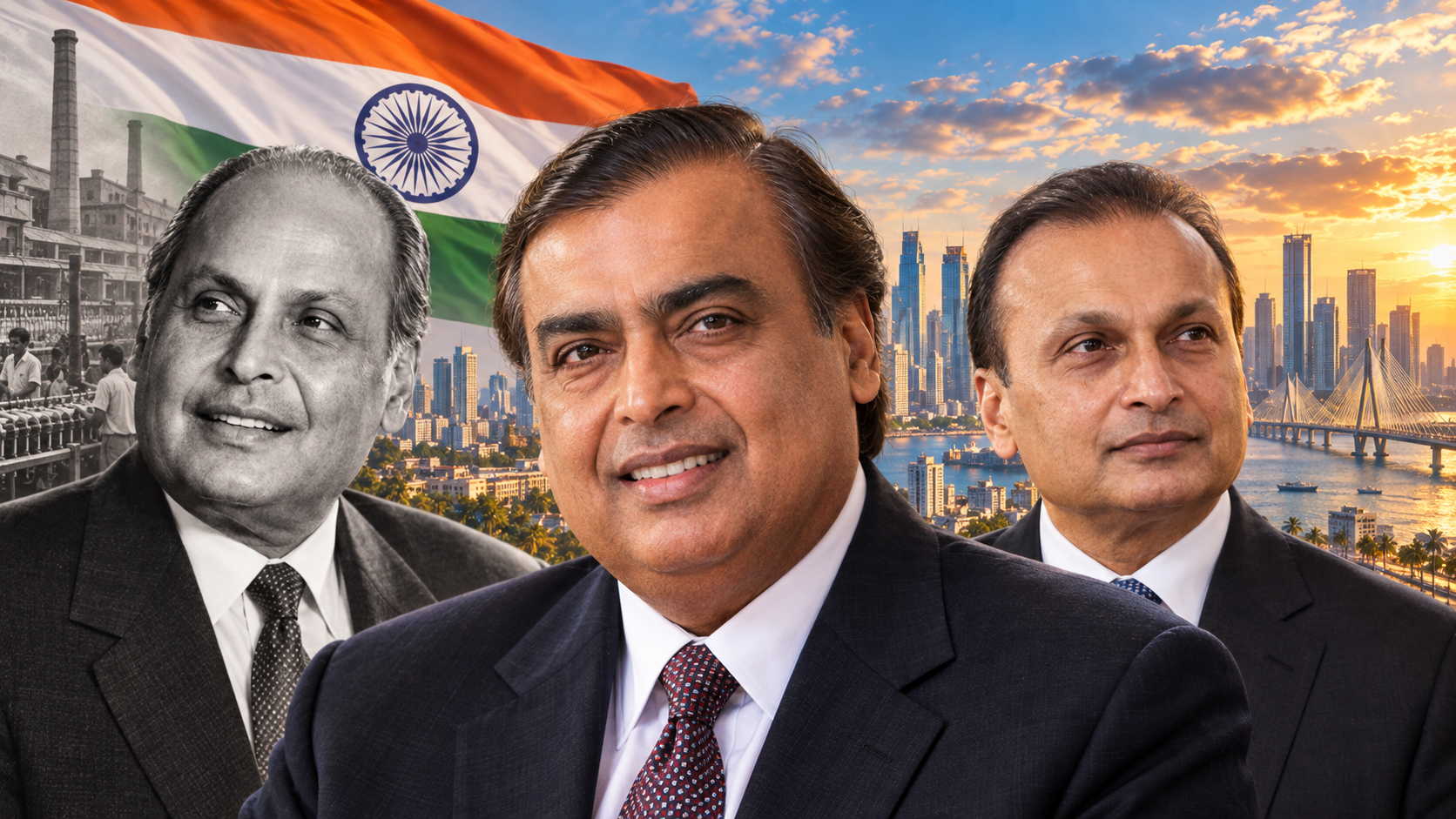
From Dhirubhai Ambani’s beginnings as a trader to Mukesh Ambani’s industrial and digital expansion, the family’s story spans migration, ambition, conflict and the challenge of preparing a third generation to lead.
The Ambani story begins with a journey across the Arabian Sea. A young man from Gujarat went abroad to earn a living, returned to India with limited capital, and built a business that would eventually reach into the daily lives of millions. Dhirubhai Ambani’s rise created the foundation for a family dynasty. His eldest son, Mukesh, would spend his career enlarging that foundation and repeatedly changing what stood upon it. Voice of America’s account of Dhirubhai Ambani’s life.


Across three generations, the family’s history poses an enduring question: how does an enterprise preserve the ambition of its founder when the circumstances that produced him have disappeared? The first generation must find a way in. The second must prove that inheritance can become achievement. The third must establish its authority inside an institution already large enough to shape entire markets.
For Mukesh Ambani, that question has become increasingly immediate. Reliance Industries now spans energy, petrochemicals, retail, digital services and entertainment. Its decisions influence how Indians communicate, shop and consume media, while its industrial operations connect India to international energy markets. Understanding the family requires following the businesses that made its wealth possible. Reliance’s corporate overview.
Dhirajlal Hirachand Ambani, known as Dhirubhai, was born on December 28, 1932, in Chorwad, in present day Gujarat. His father was a schoolteacher. As a young man, he worked in Aden, now part of Yemen, before returning to India and entering trade. These origins placed the future industrialist outside the established circles of inherited corporate power. Dhirubhai Ambani’s biographical record.
By the late 1950s, Dhirubhai was building a trading operation in Mumbai. Spices and yarn were among the commodities associated with its early development. The practical education of trading was valuable: a merchant had to understand prices, credit, supply and the reliability of people. A promising order meant little unless goods could be obtained, delivered and paid for. The future Reliance grew out of that world of transactions and relationships. Reliance’s early business history.

Manufacturing offered a path to greater control. Reliance established a synthetic fabrics mill at Naroda in Gujarat in 1966, and Vimal later became its defining textile brand. The move from trading goods to making them changed the business fundamentally. Factory ownership brought larger financial commitments and operational risks, but it also created the possibility of building a recognisable product and capturing more of the value generated along the way. Reliance’s textile origins.
Another decisive step came in 1977, when Reliance Textile Industries went public. The company records that its initial public offering was subscribed seven times. Dhirubhai cultivated support among ordinary investors, helping to bring a wider public into the ownership of a growing industrial enterprise. Reliance’s relationship with shareholders became an important part of its identity. Reliance’s historical timeline.
This broadened the meaning of the family’s success. Small shareholders could participate in the growth of a company whose founder had himself begun with little. Their capital helped finance expansion, while the company’s performance sustained their confidence. Dhirubhai helped popularise the idea that industrial growth and household wealth could advance together through share ownership. Voice of America’s retrospective.
His rise also attracted criticism over his influence on government policy and treatment of competitors. Voice of America’s retrospective recorded those accusations alongside his achievements, noting that he dismissed such criticism as a consequence of success. The debate over corporate power was already part of the family’s story. Voice of America’s account.
Mukesh Dhirubhai Ambani was born on April 19, 1957, in Aden, to Dhirubhai and Kokilaben Ambani. He grew up in Mumbai alongside his younger brother Anil and sisters Nina and Dipti. The family’s early living arrangements were modest by the standards of the wealth it would later accumulate, and his childhood coincided with his father’s emergence as an entrepreneur. Mukesh Ambani’s biographical record.
That timing matters. Mukesh experienced the family enterprise while it was still being constructed. He could observe the transition from a relatively small business to an increasingly ambitious industrial organisation. EBSCO’s biography describes a childhood in which education was valued and the children were expected to learn ordinary practical skills, including using public transport, as the family became wealthier. EBSCO’s Mukesh Ambani biography.
Mukesh studied chemical engineering at Mumbai’s Institute of Chemical Technology, then pursued an MBA at Stanford University. He left those studies in 1981 to return to the family business. His engineering background became central to the responsibilities he assumed: the development of large industrial facilities demanded an understanding of processes, machinery, construction and the economics of production. McKinsey’s biographical introduction.
Reliance’s polyester and petrochemical expansion gave him a formidable apprenticeship. The Patalganga development in the early 1980s and the commissioning of Hazira in 1991 were important milestones in the company’s increasing industrial integration. These projects helped establish the manufacturing base from which later expansion would proceed. Reliance’s development timeline.
The underlying strategy was to move further into the production chain. A textile company could manufacture polyester; a polyester producer could enter petrochemicals; a petrochemical business could expand into refining and the sourcing of hydrocarbons. Mukesh played a central role in this progression. Each step enlarged Reliance’s capabilities and reduced its dependence on buying essential inputs from others. It also made the company more complex and increased the consequences of its investment decisions. Reliance’s account of Mukesh Ambani’s industrial leadership.
Jamnagar became the most powerful expression of that approach. Mukesh led the development of a vast refining complex in Gujarat, combining processing facilities with petrochemicals, power and transport infrastructure. Over successive phases, the site became an industrial system of exceptional scale. Reliance currently describes its Jamnagar operations as having crude processing capacity of approximately 1.4 million barrels a day. Reliance’s refining and marketing overview.
The significance of such a complex extends beyond its headline capacity. Refineries compete through the crude they can process, the products they can make, their operating reliability and their access to customers. Integrating those functions can create advantages that are difficult to reproduce quickly. Jamnagar helped turn engineering execution into a lasting commercial strength and gave Reliance an international industrial presence. Reliance’s description of the Jamnagar complex.

During these years, Mukesh also established his own family. He married Nita Ambani in 1985. Their children, twins Isha and Akash and younger son Anant, would eventually become central to the next succession. The family’s increasingly public life developed alongside the company’s growing reach. Mukesh Ambani’s family biography.
Dhirubhai died on July 6, 2002, at the age of 69. His death brought an extraordinary entrepreneurial career to an end and placed responsibility for its continuation with the next generation. India later recognised his contribution to trade and industry with a posthumous Padma Vibhushan in 2016. Reliance’s founder biography.
The transition became the family’s most consequential internal crisis. Disagreement between Mukesh and Anil became public in 2004. Kokilaben helped broker a settlement in 2005, followed by the formal division in 2006. Mukesh retained Reliance Industries and its principal industrial businesses, while Anil received businesses in telecommunications, power, financial services and entertainment. Reuters’ account of the family division.
Kokilaben’s intervention deserves a central place in the history. The dispute showed how closely family relationships and corporate authority could become intertwined. Employees, lenders and shareholders needed clarity about who would control which businesses. The settlement established separate paths, and its legacy remains relevant whenever the family discusses how another generation will assume responsibility.
The brothers’ later fortunes diverged. Anil’s businesses encountered serious debt and insolvency problems, including those affecting Reliance Communications. These belong to the history of the separately controlled Anil Ambani group and should be distinguished from Mukesh’s Reliance Industries. The broader lesson is that a famous surname and substantial inherited assets cannot remove the consequences of financing decisions, competition and execution. Reuters’ history of Anil Ambani’s business difficulties.
Mukesh’s next transformation brought Reliance closer to the Indian household. The company entered organised retail in 2006. Its expansion made groceries, clothing and consumer electronics increasingly important to a group long associated with industrial production. Building a consumer business required different capabilities, including understanding shopping habits, managing a wide assortment of goods and serving customers consistently across locations. Reliance’s business overview.
By the quarter ended June 2026, Reliance reported more than 20,000 stores and a registered retail customer base of approximately 396 million. Its formats and platforms stretch from everyday purchases to fashion, beauty and luxury. This reach illustrates how far the group has travelled from its original textile identity. Reliance Retail’s operating overview.
Retail also reveals a recurring Ambani instinct: build the infrastructure that allows a large market to be served repeatedly. Stores need sourcing, warehouses, transport, inventory systems and digital ordering. The customer experiences a purchase; the company must coordinate everything that makes the purchase possible. Reliance’s effort to connect physical stores with digital commerce applies its preference for integration to the consumer economy. Reliance Retail’s business model.
The most dramatic expression of Mukesh’s willingness to enter a new market came with Jio. Its commercial services became available in September 2016, with an introductory offer that gave customers free access to voice and data. The launch centred on a nationwide 4G network, affordable connectivity and a broad suite of digital services. It was a major attempt to accelerate how extensively Indians used the internet. Mukesh Ambani’s Jio launch address.
The economic logic was ambitious. Lower the cost of access, encourage people to use more data, and build a business around the resulting expansion in digital activity. Communications, entertainment and commerce could increasingly share the same connection. The potential benefits for users were substantial, while the commitment required from Reliance was enormous.
In his 2025 interview with McKinsey, Mukesh identified Jio as the largest risk Reliance had taken. He described a willingness to accept disappointing financial returns if the investment still helped digitise India. That is his own account of the decision, but it captures the scale of the wager and his tendency to connect corporate ambition with a wider national purpose. Mukesh Ambani’s McKinsey interview.
The investment subsequently attracted powerful international partners. In April 2020, Facebook announced an investment of ₹43,574 crore for a 9.99 per cent stake in Jio Platforms. The agreement demonstrated how valuable access to India’s expanding digital market had become to global technology companies. Reliance’s Facebook investment announcement.
Jio also helped redefine the kind of company Reliance could become. An industrial group with a large consumer network could connect its manufacturing and financial resources to new services, technologies and partnerships. In analytical terms, Mukesh’s distinctive achievement has been the ability to use an existing business base to finance entry into markets that eventually change the identity of the whole group.
The media expansion carried this logic further. In November 2024, Reliance, Viacom18 and Disney completed the combination of major Indian television and streaming businesses. The transaction valued the joint venture at approximately US$8.5 billion, with Reliance in control and Nita Ambani as chairperson. It brought together significant entertainment brands and sports rights. The joint venture’s completion announcement.
The commercial connection is clear: a network delivers the programme, a media business supplies it, and advertising or subscriptions help pay for it. The same combination also raises questions about competition and the influence of large groups over cultural distribution. The companies’ announcement records that India’s competition authority approved the transaction subject to modifications they had offered. The transaction’s regulatory disclosures.
Financial services added another dimension to the wider Ambani business story. In 2023, Jio Financial Services and BlackRock announced an agreement to form an equally owned asset management venture. The stated aim was to combine BlackRock’s investment expertise with Jio Financial Services’ local knowledge and digital capabilities. The connection with the family’s earlier history is striking: capital markets helped build Reliance, and investment services became a further area of ambition. BlackRock’s partnership announcement.
The resulting scale is substantial. For the financial year ended March 31, 2026, Reliance reported gross revenue of approximately ₹11.76 trillion, equivalent to US$124 billion using the company’s published conversion, and profit after tax of approximately ₹957.5 billion, or US$10.1 billion. Capital expenditure was approximately US$15.2 billion. These are company figures, distinct from estimates of the family’s personal fortune. Reliance’s financial reporting.
The latest quarterly reporting provides another measure of its reach. At June 30, 2026, Jio’s connectivity customer base was approximately 533 million. Such numbers help explain why the group’s strategic decisions command attention: changes in its pricing, investment or products can reach an exceptionally large audience. Reliance’s June 2026 quarterly results.
Nita Ambani has built a substantial institutional role within this history. Reliance Foundation, established in 2010 under her leadership, works across education, health, rural development, disaster response, women’s empowerment, sport and culture. Its activities extend the family’s public presence into areas that affect how its contribution is assessed beyond commercial results. Reliance Foundation’s overview.
Her work encompasses the Sir H N Reliance Foundation Hospital, sporting initiatives associated with Mumbai Indians, and the Nita Mukesh Ambani Cultural Centre. Together, these ventures place care, sport and cultural patronage alongside the industrial and consumer businesses in the Ambani legacy. Her influence has helped broaden the kinds of institutions associated with the family name. Nita Ambani’s foundation profile.
These institutions will have their own tests of longevity. Hospitals must deliver quality care, educational initiatives must develop students, and cultural venues must support meaningful artistic work. Buildings and launches establish visibility. Sustained public value depends on the standards, access and leadership that follow.
The family’s private celebrations have attracted a different kind of attention. Anant Ambani’s July 2024 wedding to Radhika Merchant followed months of events featuring international celebrities and performers. The scale of the festivities made the family’s wealth a global spectacle and prompted debate about inequality. It also demonstrated how widely the Ambani name had become recognised beyond business audiences. Associated Press coverage of the wedding.
The more lasting story now concerns the work assigned to Mukesh and Nita’s children. Isha, Akash and Anant joined the Reliance Industries board in 2023. Their responsibilities increasingly connect them to the group’s main areas of activity. The transition is taking place while Mukesh remains available to guide it, an arrangement that gives this succession a different starting point from the family crisis after Dhirubhai’s death. Reliance’s succession timeline.
Isha Ambani’s principal business responsibility lies in retail and consumer activities. She graduated from Yale University in 2013 and completed an MBA at Stanford in 2018. Reliance credits her with expanding its digital retail presence and developing formats including AJIO and Tira. Her role demands close attention to a market in which customer loyalty, product selection and convenience must be earned continuously. Isha Ambani’s official profile.
Akash Ambani, an economics graduate of Brown University, has chaired Reliance Jio Infocomm since June 2022. His official profile also identifies him as managing director of Jio Platforms. His responsibilities place him at the centre of the group’s technology and communications ambitions, where the next challenge is to turn widespread connectivity into services that customers find valuable enough to keep using. Akash Ambani’s official profile.
Anant Ambani, also a Brown University graduate, is an executive director of Reliance Industries and is associated with its energy transition. His responsibilities connect the company’s established industrial strength with its ambitions in cleaner energy and advanced materials. He is also the founder of Vantara, the wildlife rescue and conservation initiative at Jamnagar, which has become a prominent part of his public identity. Anant Ambani’s official profile.
At Reliance’s June 2026 annual meeting, Mukesh described Isha as leading consumer businesses, Akash as leading technology and Anant as leading energy. He said the transfer of daily management to a new generation was almost complete while he continued to provide active leadership. He also emphasised his intention to maintain a united Reliance. These statements describe the family’s announced direction rather than a completed transfer of all authority. Mukesh Ambani’s 2026 shareholder address.
The distinction between responsibility and ownership is essential. Leading a business division does not automatically mean inheriting it as a separate personal enterprise. The children operate within companies that have boards, professional executives, investors and obligations to shareholders. Their performance will need to be assessed through those institutions, as well as through the family’s expectations.
The next generation will also inherit a demanding benchmark. Dhirubhai established the enterprise. Mukesh repeatedly expanded its possibilities. His children must demonstrate that they can make difficult choices of their own, including decisions to delay, reshape or abandon projects. Access to capital creates opportunities; judgement determines which opportunities deserve it.
Artificial intelligence is one of the largest emerging tests. Reliance and NVIDIA announced a partnership in 2023 to develop AI infrastructure and capabilities for India, including work relevant to Indian languages. The ambition connects computing capacity with the ability to serve a large domestic market. NVIDIA’s partnership announcement.
In June 2026, Mukesh said Reliance Intelligence was building AI infrastructure at Jamnagar, with an initial 120 megawatts targeted for commissioning by the end of the year. That timetable is an announced target. The importance of the investment will ultimately depend on reliable operation, customer demand and the usefulness of the services built on top of it. Reliance’s 2026 shareholder address.
One possible advantage is the combination of connectivity, business customers and industrial resources. Reliance could distribute new services through relationships it already possesses. That is an inference from its business structure, not a guarantee of technological leadership. AI will require continuing investment in talent, computing, software and trust, alongside evidence that customers receive sufficient value to justify the expense.
Clean energy presents another opportunity to apply the family’s industrial experience. Reliance’s programme includes solar manufacturing, batteries, renewable power, green hydrogen and advanced materials. Its Dhirubhai Ambani Green Energy Giga Complex at Jamnagar covers approximately 5,000 acres, and the company has set a goal of reaching net zero carbon status by 2035. These plans place the energy transition within the same geography that helped establish its refining strength. Reliance’s new energy programme.
The symbolism is powerful, but the operating challenge is concrete. Factories must achieve competitive costs, products must find customers, and new capacity must generate acceptable returns. A refinery’s success does not automatically establish leadership in batteries or solar technology. The opportunity lies in applying relevant construction and manufacturing capabilities while learning the economics of different markets.
Capital markets will remain important to the next phase. In August 2026, The Economic Times reported that Jio Platforms had received regulatory clearance to proceed with its proposed public offering, following the filing of draft documents in June. The development links the current generation to a familiar theme in the family’s history: inviting outside investors to participate in a business built at substantial scale. The Economic Times on Jio’s proposed offering.
Outside investment also brings expectations. Investors will judge earnings, cash generation, governance and the returns produced by expansion. The same scale that gives Reliance strategic options makes its choices consequential. Allocating capital between established operations and emerging businesses will remain one of the leadership’s most important responsibilities.
The wider legacy will be judged through equally practical questions. Can consumers obtain useful services at fair prices? Can suppliers build sustainable businesses around the group’s operations? Can employees develop careers in an organisation whose leadership remains strongly associated with one family? Can new industrial investment create durable value while meeting environmental responsibilities? These are the questions that connect a corporate dynasty to the country around it.
For South Asian readers in Canada and elsewhere, the Ambani story also offers a way to think about migration, family ambition and the changing meaning of success. Dhirubhai’s journey began with earning a living abroad. Mukesh’s generation built at industrial scale. The next generation is being asked to manage institutions whose reach extends far beyond the household that controls them.
The family’s central achievement has been its ability to keep enlarging the field of possibility. Its central challenge is to preserve that capacity as leadership passes to people who begin with advantages their grandfather could scarcely have imagined. Mukesh Ambani’s place in the story is already substantial: he carried forward an inherited enterprise and helped transform the markets around it. The next chapter will establish whether his children can give that inheritance a similarly consequential future.