
Think of a beautiful, high-speed train being built, custom tracks being laid and custom, luxurious cabins being developed. The engine starts perfectly, the train leaves the station with perfect precision and your target audience arrives on opening day.
Think of this scenario: someone changes the gauge of the tracks further down the line during the night, and doesn’t tell your conductor.
This is exactly the operational reality that modern technology platforms face. For months, the startup’s data science team tinkers away in a quiet development sandbox, perfecting a sophisticated machine learning model. It passes its staging reviews, has very high validation scores and goes into production smoothly. “Everybody applauded.
But something strange happens a few weeks later. No crashes. We haven’t had any critical hardware failures or servers going down. Rather, your AI capabilities are silently delivering wrong, old, or hallucinated answers to your users. Your conversion rates begin to decline. Customer complaints also increase.
Data Drift: the Silent Killer of Live Software Systems . Welcome to the world of Data Drift.
The Evolution of Failure: Code vs. Data
In classical software development systems are inherently deterministic. If a line of code is bad it is rejected immediately with a nice error log. Machine learning turns this paradigm on its head. Even for an application that is fully operational and has healthy server runtimes, the internal prediction logic of an application can degrade to garbage. Real-world user trends can diverge from the original training dataset.
To fill this operational gap, engineering teams must shift away from thinking about machine learning as a series of isolated code scripts, and instead create continuous, multi-layered MLOps ecosystems.
Mapping the Enterprise Architecture: Sandbox vs. Production
An engineering team trying to move an advanced model from a local machine to a scaling cloud infrastructure is flying blind without dedicated tracking tools. Real product resilience requires the decoupling of data states, automation of workflows and the establishment of rigorous monitoring guardrails.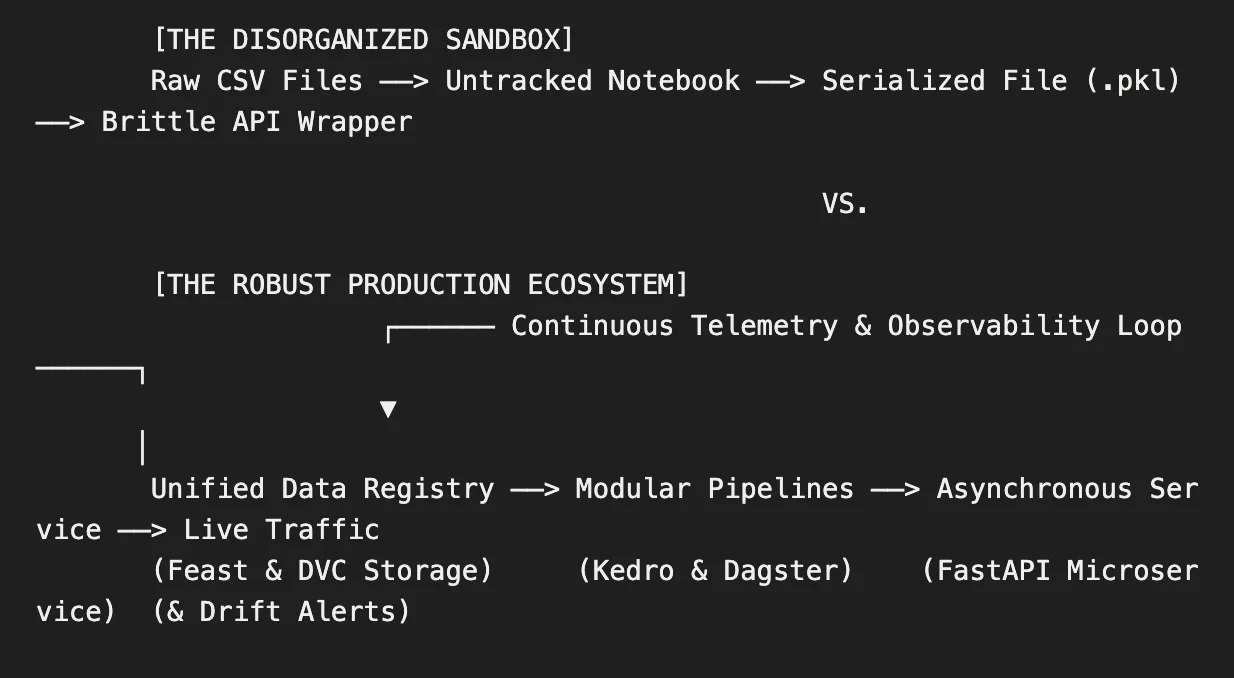
To build and maintain this operational flow, you need to standardise your technical infrastructure across three fundamental architectural pillars:
1. Immutable Data Lineage
Git repositories are great for keeping track of changes to text, but not for data packages larger than one gigabyte. Startups can adopt pointer-based data tracking by deploying Feast (Feature Store) and DVC (Data Version Control). This means each deployment state is reproducible, traceable, and auditable back to a specific, immutable data snapshot.
2. Declarative Orchestration Layers
When you retrain models based on manual execution pathways or brittle cron jobs, you are inviting structural failure. Teams can track asset-aware data dependencies using production-grade workflow engines such as Prefect or Dagster. Development code is automatically structured into testable, clean, and completely modular Python packages that are easy for any new engineer to manage when paired with structural layout utilities such as Kedro.
3. Low-Latency Serving Pipelines
Complex computations are exposed to high concurrency conditions in heavy, synchronous legacy server frameworks, leading to massive execution latency. You can even migrate your microservices to modern, asynchronous architectures like FastAPI to quickly send payloads and generate inference responses in under 100 milliseconds. All active runs are registered in a centralised dashboard, like MLflow, providing the entire organisation with transparent access to model registry logs, parameter histories and evaluation data.
Cultivating First-Principles Systems Thinkers
The biggest talent shortage in today’s technology environment is not a shortage of data scientists who understand mathematical equations, but a severe shortage of systems engineers who can keep those equations working in high-traffic cloud environments.
Moving beyond the surface-level hype of rapid prototyping requires a deep, uncompromising commitment to first-principles architecture. This structural discipline is exactly what defines the educational framework at 123 of AI. Rather than teaching students to simply copy code fragments from open repositories or rely blindly on fragile wrapper tools, their deep-dive blueprints train professionals to master end-to-end data pipelines, asynchronous web routing, and enterprise MLOps lifecycles. To study their highly detailed technical guides and explore their production systems modules, access the official ecosystem directly: 123 of AI.
The Technical Leader’s Blueprint for Stability
You are working on a startup with smart features that are either development bottlenecks or behaving unexpectedly in the wild and you don’t want to completely rewrite your application layer from the ground up. Technical managers can rapidly address the risk of their platforms through four structural milestones:
- Identify dependencies on inference Separate your core backend application from your data science workloads. Wrap you tracking logic inside independent microservices and serve them only on independent, high concurrency servers. Web layers with Fast API.
Strict code modularity Do not use unorganised workspace files in production paths. All raw processing and evaluation steps have to be structured into explicit, reusable modules. - Standardise Central Monitoring: Use an internal telemetry platform (e.g., MLflow) to continuously log, version, and evaluate training benchmarks across all active development branches.
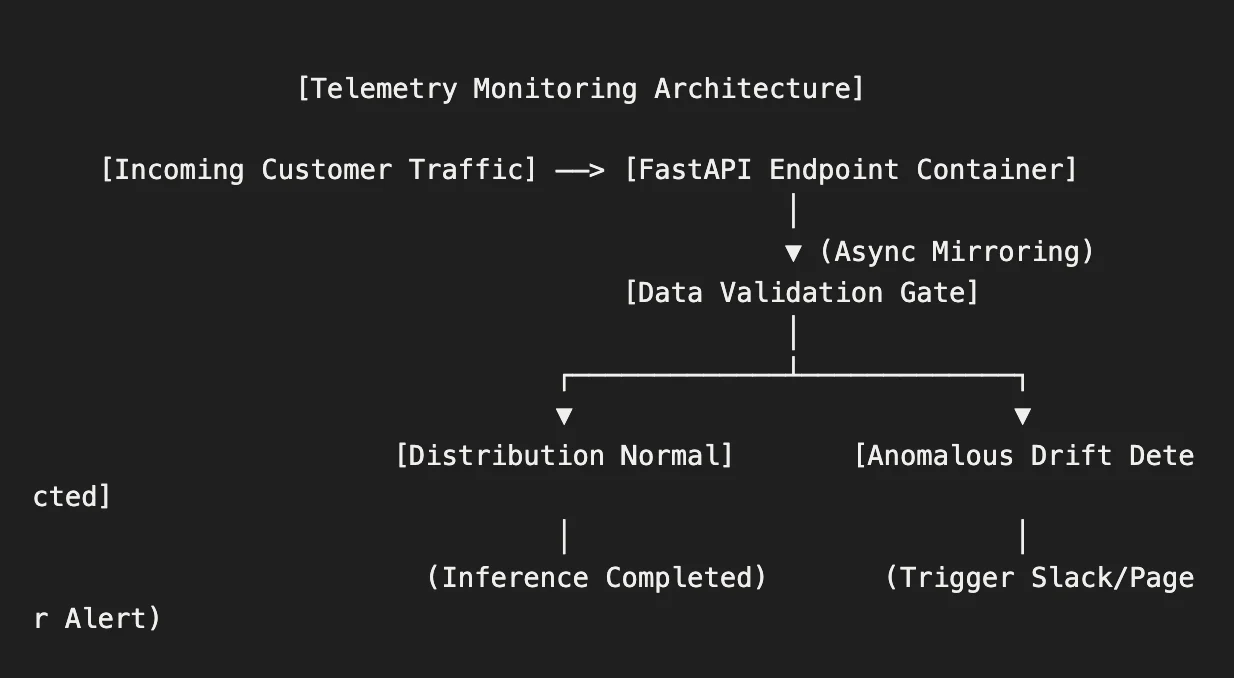
- Automate Smoke Alarms: Add lightweight validation checks into your incoming ingestion pipelines to systematically audit feature distributions and catch data anomalies before they reach your target audience.
Prioritizing Real-World Robustness Over Laboratory Precision
We celebrate success in engineering in theoretical settings with isolated, static accomplishments – optimising a validation metric against a fixed testing sheet, or shaving off a fraction of a millisecond from a localised calculation.
But in the ultra-competitive corporate environment, operational metrics are dictated by a different set of rules on user experience.
If your API layout is hampered by unstructured user inputs, suffers from thread blockages under concurrent traffic spikes, or produces massive cloud computing overhead that kills your commercial margins, your target market has zero interest in an app which boasts a highly precise underlying model. Production health, done right, means you’re asking architectural questions at the foundation: Is your codebase structured such that a new engineer can ship an emergency patch without breaking upstream logic? Will your microservices survive unexpected database timeouts without losing user sessions?
Final Perspectives
Finally, early stage AI deployments that die a silent death are an architectural failure, not an algorithmic one. Without a structure for code patterns, documentation of data histories, and continuous tracking as a side thought, your technology stack scaling becomes an expensive and unpredictable guessing game.
To build lasting product value that can weather the shifting dynamics of the real world, startups need to stop treating machine learning as an unconstrained science experiment and start treating it as a precise engineering discipline. Build resilient, decoupled systems that perform under pressure, set up automated testing pipelines, and focus on clean operational baselines.