
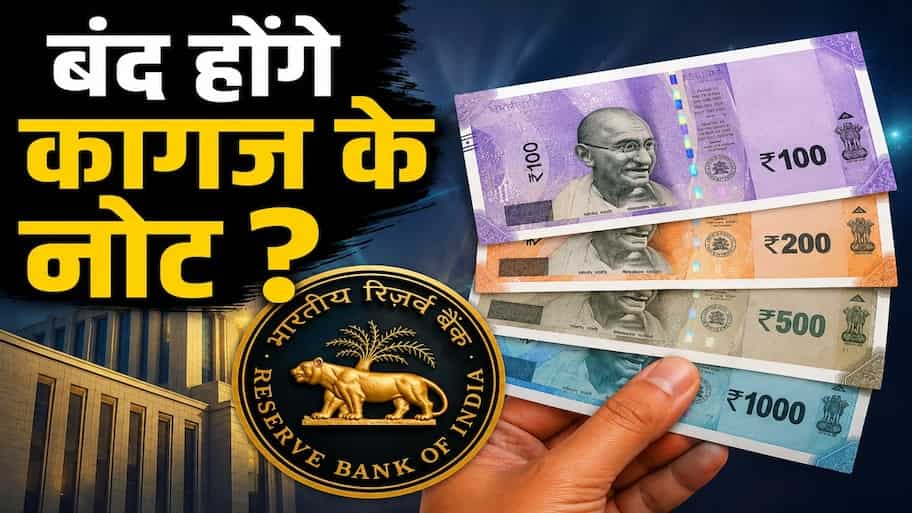
The hassle of getting torn in the pocket and getting wet in water is over: Know when new plastic notes of ₹ 10 and ₹ 20 are going to arrive in your pocket.

During the demonetization of 2016, old paper notes of Rs 500 and Rs 1000 were discontinued and new notes of Rs 500 and Rs 2000 were issued. Now another big historical change is going to happen in the Indian currency market. The Reserve Bank of India (RBI) is soon preparing to launch durable and strong ‘polymer’ i.e. plastic bank notes in place of traditional paper notes. After getting formal approval from the Central Government, the Reserve Bank has prepared a blueprint for printing 200 crore new plastic notes. This simply means that in some time to come, you will start seeing plastic notes in your pockets which become ineffective due to tearing and getting wet.
India will be included in the list of 60 countries of the world, know when the plan was made
With this step, India will now join the ranks of more than 60 countries in the world like Australia, Canada and the United Kingdom (UK), where plastic currency is already in use with success. In the Parliament, Minister of State for Finance Pankaj Choudhary himself gave official information about the Central Government giving the green signal to RBI to print plastic notes. However, this is not the first time there is talk of introducing plastic notes in India. Earlier in the year 2012 also, a proposal was made to launch polymer notes in the market with the aim of increasing the life of the currency.
Initially 200 crore notes of ₹10 and ₹20 will be issued, know the legal rules
The Reserve Bank will first conduct a field trial of this new system. After success in this trial, new notes of Rs 10 and Rs 20 denomination will be printed first. Under the scheme, 100 crore plastic notes of Rs 10 and 100 crore of Rs 20, i.e. a total of 200 crore plastic notes will be printed. Talking about the legal framework, the Central Board of RBI has proposed the design and material of these new polymer notes to the government under ‘Section 25 of the Reserve Bank of India Act, 1934’.
Will remain ineffective against water, dust and dirt: Know 5 big benefits of plastic notes
RBI will print these notes on ‘polymer substrate’ sheets instead of cotton paper. These notes will look and feel much like paper notes, but their strength will be many times higher:
Will not spoil: Plastic notes will not get damaged by water, sweat, dust and dirt and will not tear easily even when pulled by hand.
Lightweight and foldable: Like paper notes, these can also be easily folded and kept in pocket or purse.
Similar Experience: To touch and use, it will feel as comfortable and light as normal paper notes.
Fake notes will be controlled: Advanced security features will be added between the layers of polymer sheets, which will be almost impossible for fraudsters to copy. This will provide relief from the problem of fake currency.
Saving to the exchequer: Due to the quick fading of paper notes, the government has to spend a huge budget on printing every year. In the financial year 2024-25 alone, RBI had spent about ₹6,372 crore on printing of paper notes. The longer life of plastic notes will significantly reduce re-printing and distribution costs.
How is the decision to print notes taken and where are the 4 printing presses of India?
RBI decides the need of cash in the country’s economy, the size, color and security standards of the notes. Under Section 22 of the Reserve Bank of India Act, 1934, RBI has the exclusive right to print notes. Under Section 25, the design, material and color of the note gets approval from the government, while Section 26(2) is used to remove the legal tender status of any old note.
At present a total of 4 printing presses are working for printing notes in India:
Mysore (Karnataka) – RBI subsidiary
Salboni (West Bengal) – RBI subsidiary
Nashik (Maharashtra) – Under the central government
Dewas (Madhya Pradesh) – Under the central government
Will old ₹10 and ₹20 paper notes be discontinued?
After the news of the introduction of plastic notes, many people have a doubt whether the old paper notes will be discontinued. The answer to this is absolutely ‘no’. The Reserve Bank is introducing plastic notes only as a pilot project or trial. Even after the introduction of new plastic notes, the old paper notes will remain completely legal tender like before. Both polymer and paper notes will continue to exist together (co-existence) in the market. Until plastic notes are completely established in the economy, paper notes will continue to circulate.
When will it come in the market and will there be changes in ATM?
RBI has issued tenders for the supply of polymer substrate sheets, the last date of which has been fixed as August 18, 2026. After the completion of the tender process, printing will start and they will be launched in the market in a phased manner. At present, the government or RBI has not decided the date of their official launch.
As far as ATMs and note counting machines are concerned, trials are currently being conducted with small notes of ₹ 10 and ₹ 20, which are generally not kept in ATMs. Therefore, there will be no need for any technical changes in ATM machines immediately. However, if in future this experiment is successful and bigger notes of ₹100, ₹200 or ₹500 are also minted in plastic, then banks will have to recalibrate their ATM machines according to the size and weight of the new notes.
Is it expensive to print plastic notes?
Yes, initially the primary cost of printing plastic notes is slightly higher than traditional paper notes, because the polymer material and printing technology used in it is very advanced. However, due to the longer life of plastic notes compared to paper notes, there will be no need to print and distribute them again and again, which will save thousands of crores of rupees for the Reserve Bank on a long-term basis.

Comments are closed.