
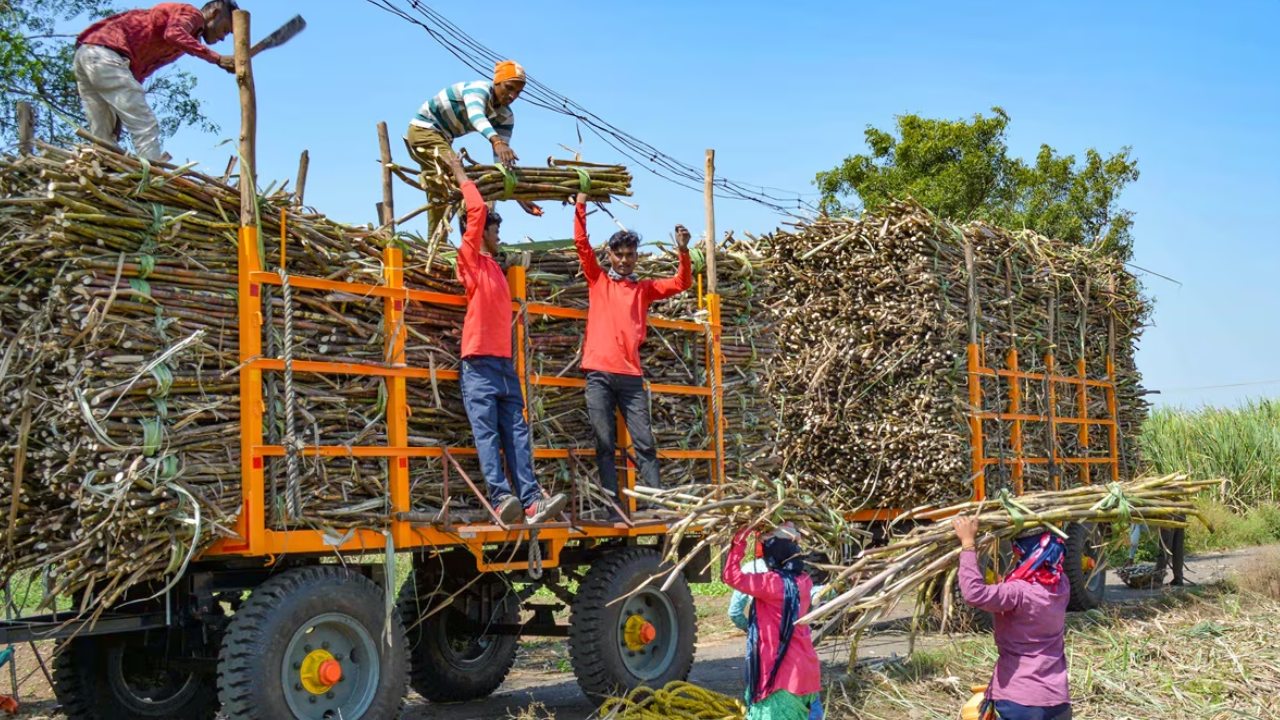
The law related to sugarcane will change after 60 years! Farmers benefit or loss? Big impact on ethanol production too?

- The law related to sugarcane will change after 60 years!
- Farmers benefit or loss?
- Will there be a big impact on ethanol production?
Sugarcane New Rule : A big news for farmers in all the sugarcane producing states including Maharashtra is that the Central Government is in the final stages of amending the ‘Sugarcane Control Order, 1966’. The Act regulates the relationship between sugar mills and farmers, cane prices and the supply chain. After almost 6 decades, these changes are likely to completely change the picture of the sugar industry. This will directly benefit the farmers. According to officials involved in the matter, the central government has proposed to replace the Sugarcane Control Order of 1966 with a comprehensive and new regulatory framework. It is for the first time bringing together a formal system for ethanol production, digital compliance and approval of factories. The government has invited suggestions on this draft till May 20.
New Guidelines: The arbitrariness of the bank will no longer work! Alert will be received before the money is deducted from the account; What is the new regulation of RBI?
Developed a new framework
The Union Food Ministry’s draft Sugarcane (Control) Order 2026 retains the basic structure of the old law. These include fair and economical pricing rules, control of sugarcane movement, 14-day payment term and 15% annual interest on late payment. But a new framework has been developed to suit a completely changed industry. These rules will benefit farmers the most, as they currently owe thousands of crores of rupees to factories.
600 liters of ethanol is one ton of sugar
The most important change in the 1966 Act was the explicit inclusion of ethanol in the sugarcane regulatory framework, and the draft expanded the definition of a sugar factory to include ethanol production from sugarcane juice, syrup, sugar and molasses. A robust conversion formula is presented, according to which 600 liters of ethanol will be treated as equivalent to one ton of sugar for production calculations.
Exemption from bank guarantee for some companies
The draft states that only ethanol-producing units, which do not process sugarcane on their premises, are exempted from the requirement of performance bank guarantee. This is a deliberate policy initiative to increase independent ethanol capacity without relaxing controls on integrated sugar-cum-ethanol plants. Clauses 6A to 6C of the draft include provisions which were not there in the old order. These include a formal IEM-based approval process for new factories, minimum spacing requirements, raising the performance bank guarantee to Rs 2 crore and setting effective measures and timelines for commercial production.
Excitement in sugar mills
Prakash Naiknaware, managing director of the National Federation of Cooperative Sugar Factories Limited, said the 1966 order existed long before the ethanol economy and hence the need for a new law. Meanwhile, President of All India Sugar Trade Association Prafulla Vitthalani said that the draft also provides for stricter monitoring of sugar factories. These provisions are designed for the benefit of sugarcane farmers.

Comments are closed.