
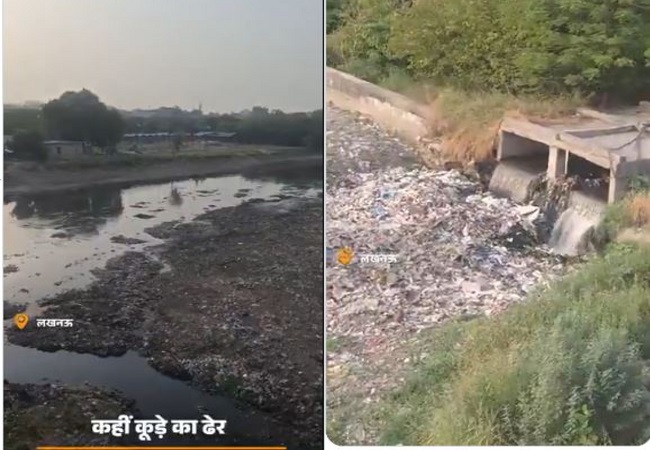
The sad story of ‘Gomati’ going missing due to the corrupt policies of BJP, Akhilesh Yadav exposed the claims of river conservation by sharing the video.

Lucknow. Gomti River, which is called the lifeline of Lucknow in Uttar Pradesh, is today going through the biggest crisis of its existence. Gomti River, once a symbol of clean water, biodiversity and cultural heritage, is now facing the brunt of shrinking stream, pollution and illegal encroachment. According to the report, the water level in the river is decreasing and pollution is increasing rapidly, due to which the water is becoming poisonous.
Read :- Ayodhya busting will turn the ‘centenary celebrations’ of unrighteous people into ‘completion ceremony’: Akhilesh Yadav
Akhilesh Yadav, national president of the state’s main opposition party Samajwadi Party, and environmentalists allege that during the tenure of the BJP government, tall claims were made in the name of river conservation, but the situation on the ground kept worsening. Sewage falling into the river, illegal mining, encroachment on the banks and negligence in conservation of water sources have weakened the flow of Gomti.
While sharing a video of a news portal on X Post, Akhilesh Yadav wrote that the sad story of ‘Gomati’ is going missing due to the corrupt policies of BJP. It is being said in the same video that there is a big threat to the existence of the creatures living in the river along with about 20 lakh people of the capital.
The sad story of ‘Gomti going missing’ due to the corrupt policies of BJP. pic.twitter.com/S0GJ3NClZ0
— Akhilesh Yadav (@yadavakhilesh) June 20, 2026
Read :- Due to the efforts of SP MP Rajiv Rai, ‘Mau-Anand Vihar train’ ran in public interest, but the atmosphere was deliberately created tense at the time of inauguration: Akhilesh Yadav
Experts say that not enough attention was paid to the conservation of natural water sources and tributaries of the Gomti River. The river water level has declined alarmingly at many places, adversely affecting aquatic life and the local ecology.
The opposition alleges that the funds allocated for river revitalization and cleaning do not show the expected results. He says that corruption, lack of transparency in the implementation of schemes and lack of seriousness towards environmental issues have put Gomti in trouble.
However, the government says that several projects are being conducted for the conservation and pollution control of Gomti and efforts are underway to revive the river. The question of Gomti is not just about a river, but about the environment, water security and the future of the coming generations. There is a need to save it through scientific and transparent efforts rising above political allegations and counter-accusations.
Gomti River is in serious ecological crisis despite spending thousands of crores of rupees on cleaning and revitalization projects. Pollution levels remain a concern, aquatic biodiversity is declining, and rapid urbanization is putting new pressure on the river that is the city’s primary source of raw water.
Read: Rajbhar himself is surrounded by claims of disunity in Akhilesh’s party, on the contrary, the journalist raised the question how many of your MLAs are roaming around with SP flags?
The Gomti River, flowing through the heart of the city of Lucknow, provides drinking water to millions of people, replenishes underground water reserves and supports an ecosystem that extends far beyond its banks. A healthy river is helpful in rejuvenating watersheds, regulating local temperature and providing habitat for fish, birds, reptiles and micro-organisms, which collectively maintain ecological balance. As climate change intensifies and urban centers grapple with rising temperatures and water scarcity, the role of rivers like the Gomti becomes even more important.
Professor Venkatesh Dutta, Department of Earth and Environmental Sciences, BBAU, said the first step towards saving the Gomti River is to ensure 100 per cent treatment of municipal sewage. He said that almost half of Lucknow’s sewage enters the river without treatment. Merely building new sewage plants without proper maintenance of existing sewage plants will not suffice.
He said embankments, roads and bridges built on both sides of the river have left little room for the river to breathe. Embankments made of cement impede groundwater recharge, while the thick layer of silt on the river bed prevents natural recharge. He further said that the ongoing repair work of Gomti Barrage provides an opportunity to remove the accumulated sludge, but no such efforts are being made at present.
After spending thousands of crores of rupees, has the river returned to its old condition?
Over the past two decades, governments have invested heavily in various river-related projects, estimated at over Rs 2,500 crore. Its objective was to stop untreated sewage from entering the river, improve water quality and restore the ecological health of the Gomti River, but the river could not achieve the expected revival.
While officials point to improvements in infrastructure and sewage treatment capacity, environmental experts argue that ecological indicators tell a more complex story. Recent media reports state that the water quality of the river deteriorates rapidly while passing through Lucknow. This decline is mainly linked to sewage discharge, reduced ecological flows and increasing urban pressure.
Read :- Akhilesh’s counter attack on OP Rajbhar, said – ‘Rumorous’ minister is not getting even a single seat.
Despite the expansion of treatment facilities, a significant amount of waste water generated by the city continues to enter the river system directly or indirectly. A senior environmental planner said the challenge is that city growth has often outstripped the expansion of environmental infrastructure.
Inherent crisis: For a river to remain healthy, it must contain aquatic life.
The effects of pollution are perhaps most clearly visible in the changing ecology of the river. For a river to remain healthy, it is necessary to have aquatic life in it. Fish, plankton, aquatic plants and microorganisms form an interconnected ecosystem that enables the river to naturally clean itself and maintain biodiversity. Experts say that pressure on the ecosystem is increasing. Populations of native fish have declined, and over the years they have become almost extinct in urban areas of the river. Fish extinction is not just a biodiversity issue. Declining fish populations often indicate deeper environmental problems such as low dissolved oxygen levels, pollution, and habitat degradation.
Saving Gomti and its tributaries
Lucknow is also focusing on Kukrail river, one of the major tributaries of Gomti, to reduce pollution entering the main river. Over the past few years, several projects have been undertaken, including blocking drains carrying sewage, diverting waste water to treatment plants, restoration of ponds and wetlands, and plans to restore ecological flows in the river.
Despite these initiatives, environmentalists say the improvements visible on the ground remain limited. Large stretches of the Kukrail River remain under pressure from pollution and encroachment, raising concerns that unless tributaries are effectively rehabilitated, efforts to revitalize the Gomti River may fail to achieve their intended impact. Environmental experts have warned that the consequences of an unhealthy Gomti river will not be limited to the river itself, but will be much wider than that.
Comments are closed.