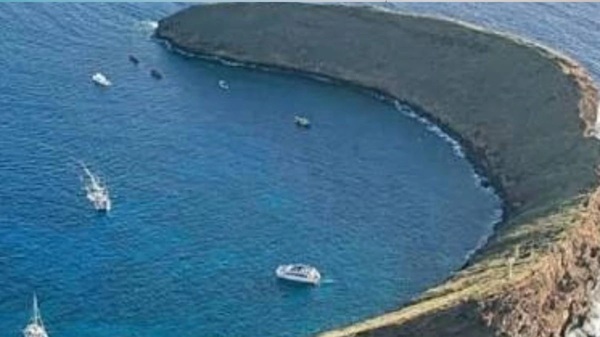
New York. As soon as we hear the name America, images of the tall buildings of New York, the business world of Wall Street and the power centers of Washington, DC come to our mind. The common belief is that America has modern roads, fast transportation, and technology-enabled facilities everywhere. But there is another world connected to the geographical boundaries of the country, where the pace of life is completely different from that of big cities. These are America's remote islands, where the ocean, weather and limited resources affect everyday life.
According to data from the US Geological Survey (USGS), there are a total of 18,617 islands in the US. The geographical conditions of these islands spread from the Pacific Ocean to the Arctic region are different. While goods and services may be readily available in large mainland cities, on many remote islands the supply of essential goods depends on weather and sea transport.
Life dependent on ships and small planes
Getting goods to Alaska's Aleutian Islands and many small islands in the Pacific Ocean is not easy. There is not a wide network of wide highways and road transport available here like the mainland. Essential commodities like fresh vegetables, milk, medicines and fuel are transported by ships or small planes.
If transportation is affected due to bad weather at sea, strong winds or dense fog, the delivery of goods may be delayed. In such a situation, there is a danger of shortage of essential commodities in the local markets. Long distances and high costs of transportation also impact prices. On some remote islands, bread, milk and other daily necessities can be much more expensive than on the mainland.
Availability of electricity and drinking water is also a big challenge in these areas. Where the central electricity grid is not accessible, alternatives such as diesel generators, solar energy and wind energy are used. There is also a reliance on technology for collecting rain water and purifying sea water for drinking water.
American citizens, but not everywhere the right to vote in presidential elections
The political situation of some island regions of America is also different from that of the mainland states. Citizens' rights and political representation in territories such as Puerto Rico, Guam, the U.S. Virgin Islands, and the Northern Mariana Islands are not the same.
Most people born in Guam, the U.S. Virgin Islands, and the Northern Mariana Islands are U.S. citizens. People born in Puerto Rico are also usually U.S. citizens. However, American citizens living in these areas do not have equal rights to vote in the general election of the US President.
Voting as a resident of a state in a U.S. presidential election usually requires residency in that state. People living in Puerto Rico, Guam, the U.S. Virgin Islands, and the Northern Mariana Islands cannot vote in the presidential general election from there. But if they go to any American state or District of Columbia and get eligibility according to the voting rules there, then they can vote.
Even in the US Congress, the representation of these regions is different from that of the states. Their representatives participate in the House as representatives or delegates, but they do not have the same power in the final voting of the House as members of the states with full voting rights. There has been debate for a long time about the political status and representation of these areas.
Islands play a big role in America's maritime power
Despite the challenges of transportation and infrastructure on remote islands, their strategic importance is immense. America's islands and other maritime zones play an important role in its security, military presence, and access to marine resources.
The US Exclusive Economic Zone (EEZ) defines the broad scope of its rights in the sea. Under international maritime law, the US gets exclusive rights to explore, exploit and manage natural resources in this area. This includes fishery resources, seabed minerals and energy resources. However, EEZ does not mean complete sovereignty or monopoly over all resources of the ocean.
Places such as Guam and Hawaii in the Pacific Ocean are important for US military and naval activities. Their geographical location helps America to maintain its military presence in the vast area of the ocean. Thus, while New York and Washington represent the country's economic and political power, remote islands are an important part of its maritime strategy and global influence.
Sweden, Norway and Finland ahead in number of islands
The figure of more than 18 thousand islands of America is definitely big, but there are many countries in the world where the number of islands is much more than this. Nordic countries like Sweden, Norway and Finland count not thousands, but millions of islands.
In the available geographical data, Sweden has about 2.67 lakh islands, Norway has about 2.39 lakh islands and Finland has about 1.79 lakh islands. Canada also has more than 52 thousand islands. However, the methods used to calculate islands and the criteria for considering a landmass as an island may differ from country to country, so direct comparison of these figures should be made with caution.
The Ice Age also contributes to the large number of islands in these countries. The sliding and melting of glaciers caused erosion in the rocky areas and many small and big islands were formed on the banks of seas and lakes. Traces of this geological process are still visible today, especially in the coastal areas of Sweden, Norway and Finland.
India also has 1,382 islands
India also holds an important place in this global picture of islands. According to available data, India has a total of 1,382 islands. These include 572 islands of the Andaman-Nicobar archipelago located in the Bay of Bengal and 36 islands of Lakshadweep located in the Arabian Sea. Apart from this, there are many islands in the coastal states and rivers of India. Majuli of Assam is a prime example of this.
Many of these islands are uninhabited or sparsely populated. Some areas are sensitive in terms of environmental protection and protection of tribal communities. In such areas, it is necessary to conduct development activities keeping in mind the local ecology and rights of communities.
India's approximately 7,517 km long coastline and its islands are also important from the point of view of national security. Because of these, India gets a vast exclusive economic zone in the sea, where the country has exclusive rights to use and manage natural resources.
In this way, be it the thousands of islands of America or the marine and river islands of India, their importance is not limited to geography alone. These areas are deeply linked to local lifestyle, environment, trade, natural resources and national security. The world of these islands, located away from the glitter of big cities, also shows that the real picture of a country is formed not only by its metropolis, but also by the lives and challenges of the people living in remote areas.