
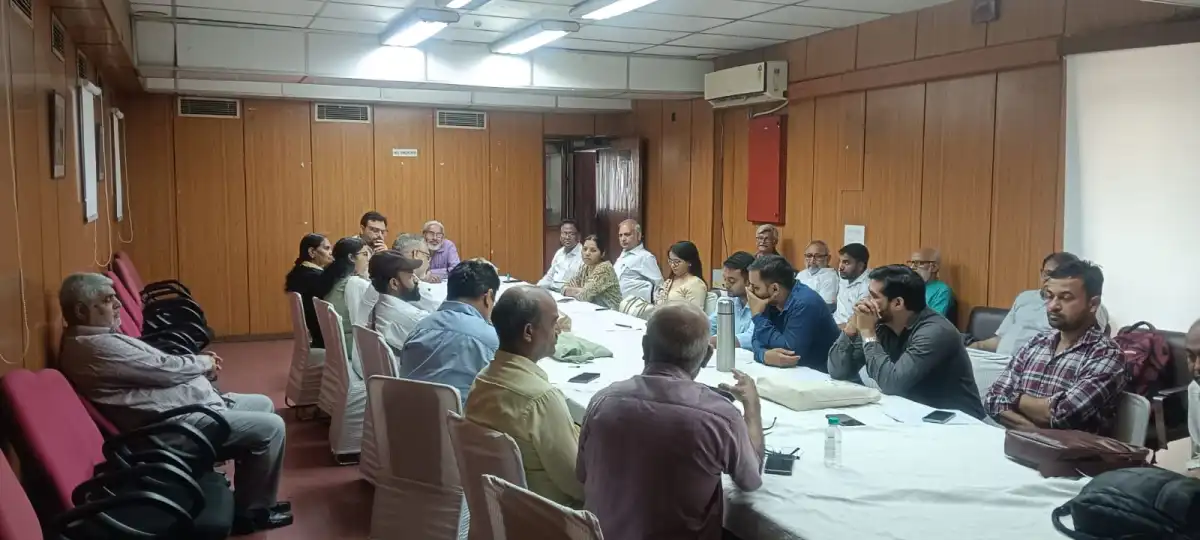

New Delhi. On the occasion of World Labor Day and Madhu Limaye Jayanti, Young Socialist Initiative organized a discussion on the challenges facing the labor movement in the era of corporate capitalism on 1 May 2026 in the seminar room of Rajendra Bhawan, Delhi.
The discussion was started by Ritu Kaushik, Secretary of All India Women’s Cultural Organization. He said that the rulers in India have cut the base line of labor rights by rejecting the minimum wage fixed for 8 hours of work. In such a situation, it becomes meaningless to talk about necessary provisions like proper facilities, safety and guarantee of human dignity at the workplace. Political parties run on funding from corporate houses. Therefore, they follow the policy of ‘maximum exploitation of workers and maximum profit of corporate houses’.
The nexus of political power and corporate capital has led to the blatant plundering of workers’ labor and national resources. It is the responsibility of the labor movement to break this nexus. Ritu Kaushik also stressed that the problems of women laborers are not isolated. Women’s problems have to be seen in totality. On this occasion, he recalled the continuous struggle of socialist leader Madhu Limaye against capitalist and communal forces.
Taking the discussion forward, senior labor leader Comrade Narendra linked the current condition of the workers with the new economic policies implemented in 1991. He said that India’s labor organizations and labor leaders did not acquire knowledge of this new phase of capitalist exploitation. Neither could they themselves understand the new map of means of production and production relations, nor could they explain it to the workers. Therefore, they have proved incapable of coping with the corporate-political nexus of the digital age. Today’s labor movement will have to adopt new knowledge and strategies in new circumstances.
Advocate Arun Maji, President, People’s Union for Civil Liberties, Delhi, quoting the Dunkel Draft issued in 1991, which was linked to the Uruguay Round of the General Agreement on Tariffs and Trade (GATT), and which was signed by the Government of India in April 1994, said that thereafter the pattern and relations of production in the world changed. Big corporations became owners of the world’s labor and resources.
The workers in the organized sector working in public sector enterprises and limited factories kept on decreasing. Privatization led to large-scale dispersion of the labor force. Organizing this scattered labor force is the biggest challenge facing the labor movement.
He told that Madhu Limaye was not only a strong MP but also a struggling labor leader. Indian politics has become empty of such leaders. Merely remembering his thoughts and struggle is not enough. There is a need to take inspiration from them to understand the challenges facing the labor movement.
Famous farmer leader Dr. Sunilam expressed strong objection to the arrests of workers and their supporters following the recent labor protests in Noida and Manesar. He said that if the big trade unions and opposition political parties had immediately come out in support and defense of the workers, then the indiscriminate FIRs lodged by the police could have been canceled and the arrests of the workers could have been stopped. He said that we have failed the workers.
Remembering Madhu Limaye, he underlined her important role in the socialist movement and the labor movement. Citing his last book ‘Communist-Socialist Interaction’, he said that the onslaught of corporate capitalism can be countered only by building unity between communists and socialists in India.
Senior Gandhian thinker Ramesh Sharma advised using the products of cottage industries to counter high technology and its markets. Labor leader Ashok Tak and senior socialist leader Purushottam, while describing the plight of sewer workers, stressed the need for immediate solution to their problems.
YS Gill, a serious scholar of workers’ problems, described the current era of capitalism as digital imperialism and stressed the need to invent new ways to combat it. Bhaskar said that the changed character of capital has also changed our sense of value to a great extent.
Young journalist Rajesh Kumar said that the entire media of the country is more or less part of the corporate network. Social media also cannot be considered outside the corporate network. In such a situation, only citizens with independent constitutional thinking about the alternatives of liberalization-privatization-globalization can solve the crisis.
The program was presided over by Dr. Prem Singh. In his presidential address, he said that economists should tell that what is the share of cheap labor of workers and looting of the country’s resources and treasury in the accumulation of private capital that has taken place in corporate India and is being praised? It should also be pointed out who has allowed the loot of cheap labour, resources and treasury?
Progressive economists also review the anti-worker conditions created due to corporate capitalism, but do not explain the mathematics of how corporate capitalism itself has come into existence and is running unabated. Because this fascination that ‘capitalism is a revolutionary stage in the development of human civilization’ has not yet been eradicated!
He said that there is a need for the emergence of a new labor consciousness for an effective and permanent solution to the increasing exploitation and oppression of workers along with the erosion of labor rights in the era of corporate capitalism. An important opportunity had come during the Corona period for the emergence of a new labor consciousness. But no initiative was taken in that direction.
Actually, this work cannot be done by the political parties of the present era and their leadership. Even civil society activists who run NGOs with domestic and foreign funds cannot do this work. Individual activists who accept huge foreign awards in return for their public interest speeches or writings also cannot play a meaningful role in this.
Only the established transformative big and small trade unions in the country can create a new labor consciousness through workers’ education. For this, labor unions will have to organize afresh and move forward with ideological clarity. Even if they have to sever their ties with political parties. By standing firmly on the national and international heritage of labor struggle, they can become the source of awakening of new labor consciousness in the new circumstances.
This is the work of labor organizations to achieve far-reaching goals. But at the same time they will have to speed up the work to achieve the immediate goals. This includes ensuring guarantees of wages, facilities, security, dignity and a decent living for all types of workers, including their families.
Needless to say, social education will also take place parallel to labor education. This process can generate political education that can become a strong foundation for alternative politics.
On this occasion, ‘Labour-Education’ note written by Dr. Ram Manohar Lohia in 1936 was distributed. The program was conducted by Dr. Hiranya Himkar. Dr. Akashdeep gave vote of thanks at the end of the discussion.
(Report by Rajesh Kumar)

Comments are closed.