
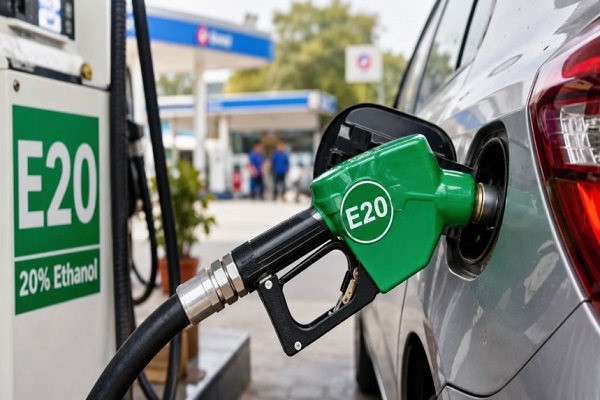
There is no evidence of E20 petrol causing damage to vehicle engines, the government told Parliament.

The central government informed Parliament on Monday that E20 petrol provides vehicles with better acceleration, smoother ride quality, and approximately 30% lower carbon emissions than E10 petrol. The government also clarified that extensive scientific studies and real-life data have found no evidence of engine corrosion, abnormal wear, or reduced vehicle life due to ethanol-blended fuel, even among the millions of older vehicles that were not originally certified for E20.
Minister of State for Petroleum Suresh Gopi said in the Rajya Sabha – E20 fuel improves the ride quality of the vehicle.
In a written reply to a question in the Rajya Sabha, Minister of State for Petroleum and Natural Gas Suresh Gopi said that E20 fuel improves the ride quality of the vehicle and emits about 30% less carbon than E10.
According to the Petroleum Ministry, fuel with higher ethanol blending ensures cleaner and more complete combustion, reducing particulate matter (PM) emissions to almost zero and improving air quality in urban areas.
E20 found safe in tests
The government stated that the Automotive Research Association of India (ARAI), the Society of Indian Automobile Manufacturers (SIAM), the Indian Oil Corporation (IOC), the Indian Institute of Petroleum (IIP), and various vehicle manufacturers conducted laboratory and field trials prior to the introduction of E20 fuel. These tests evaluated various aspects, including engine strength, vehicle performance, startability, corrosion resistance, material compatibility, emissions, and fuel efficiency. According to the government, all studies found E20 fuel to be safe within the prescribed standards.
No adverse effect was found on old vehicles also
The government said tests also showed that E20 fuel had no significant adverse effect on the performance of older vehicles, and there were no signs of abnormal wear on the engine or other components.
Data of crores of vehicles was cited
The government cited extensive data to support its claim. According to it, a major automobile company serviced 28.4 million vehicles during the 2025-26 fiscal year, of which approximately 15 million were not originally certified as E20-compliant. Despite this, there were no complaints of engine corrosion, abnormal wear, or reduced component life due to E20.
Similarly, a major two-wheeler manufacturer found similar results. Another major automobile manufacturer (OEM) monitored 14 million E20-fueled vehicles over a long period of time, but found no evidence of engine corrosion or technical problems due to ethanol.
Testing is done as per international standards
The ministry said ARAI has also reiterated that before any vehicle is delivered to customers, it has to undergo stringent tests and validation processes as per international standards to ensure its safety and performance.

Comments are closed.