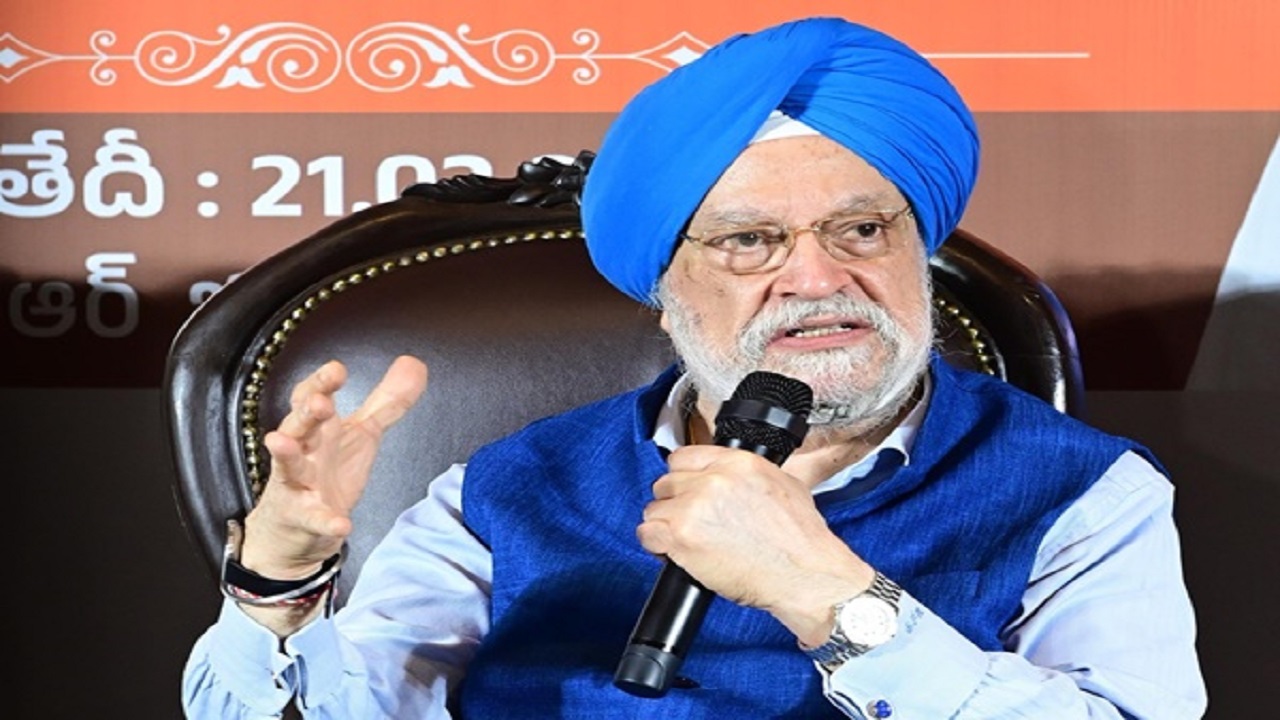
New Delhi: Union Petroleum Minister Hardeep Singh Puri has claimed that even after the war situation in West Asia adversely affected the transportation of petroleum products in the Strait of Hormuz , India has not let consumers feel any shortage through diversified sources, increased refining capacity and domestic production.
Addressing an event organised by industry body CII, Puri said India has adopted a comprehensive approach to energy security, which is not limited to the availability of hydrocarbons alone, but also includes diversification of imports, strategic partnerships, expansion of infrastructure and adoption of alternative fuels. Despite the disruption in shipping through the Strait of Hormuz, the country’s fuel supply remained completely uninterrupted.
“Before the Iran war, India imported nearly half of its crude oil from countries along this route, while 90 percent of its LPG and 60 percent of its gas imports were also through this route,” Puri said.
Ethanol policy is very appropriate.
The central government is promoting compressed biogas and ethanol blending programmes. Hardeep Singh Puri dismissed questions about the quality of ethanol-blended petrol and said that out of 107,000 petrol pumps, only four pumps were found to be defective, which does not indicate any widespread problem. With the government’s excise duty cut, the impact on consumers of fluctuations in global crude oil prices is negligible. The increase in petrol and diesel prices in the last few years has been limited and has been offset by tax cuts.
This solution was taken.
– Despite the disruption in supply, India diversified its sources to ensure that the country does not face any shortage.
– The city gas distribution network has also expanded from 55 sections to 309 sections.
– Domestic LPG production was increased to compensate for the decline in imports from the Gulf countries.
– Today, the US has become India’s largest supplier of LPG, accounting for approximately 67 percent of total imports.
– The government has approved the Rs 84,000 crore ‘Samudra Manthan’ programme, which aims to promote deep sea oil and gas exploration.
– The scheme will involve private sector participation and the government will contribute 50 per cent of the drilling cost, i.e. up to Rs 650 crore per well.
– The government has opened up offshore areas for oil and gas exploration and more licensing opportunities will be made available in the future.
“I can confidently say that not a single petrol pump has gone empty as India has increased its crude oil import sources from 27 countries to 41 countries, while the number of petrol pumps has increased from approximately 52,000 in 2014 to 107,000 now.”
– Hardeep Singh Puri, Petroleum Minister